
Search engine marketing delivers what most channels promise but rarely achieve: reaching buyers at the exact moment they search for what you sell. When someone types “CRM software Singapore” or “office cleaning service Orchard” into Google, they are not browsing — they are buying. SEM puts your business in front of those high-intent searches immediately.
But SEM is not as simple as setting a budget and letting Google optimise. Without proper campaign structure, bidding strategy, and ongoing management, you will burn through budget on irrelevant clicks and lose ground to competitors who manage their campaigns with precision.
This guide covers everything Singapore businesses need to run effective search engine marketing campaigns in 2026.
What Is Search Engine Marketing?
Search engine marketing is the practice of using paid advertisements on search engine results pages to drive targeted traffic. In Singapore, SEM is predominantly synonymous with Google Ads, which commands over 95% of search market share.
When you run an SEM campaign, you bid on keywords relevant to your business. Google runs a real-time auction considering your bid, ad quality, and expected impact of extensions to determine your Ad Rank.
SEM offers distinct advantages for Singapore businesses:
- Immediate visibility — appear on page one within hours of launching
- Precise targeting — reach users by search intent, location, device, and audience
- Measurable ROI — track every click, conversion, and dollar spent
- Scalable spend — start with SGD 500/month and scale to SGD 50,000+ as you prove profitability
For a comprehensive search engine marketing service, the combination of strategic planning and hands-on management separates profitable campaigns from money pits.
SEM vs SEO — Understanding the Difference
| Dimension | SEM (Paid Search) | SEO (Organic Search) |
|---|---|---|
| Speed to results | Immediate — ads live within hours | Slow — 3–12 months for rankings |
| Cost model | Pay per click (CPC) | Investment in content and optimisation |
| Sustainability | Traffic stops when budget stops | Traffic compounds over time |
| Click-through rates | 2–5% for most industries | 20–35% for position 1 |
| Trust perception | Perceived as advertising | Perceived as earned authority |
The most effective approach for most Singapore businesses is blended: SEM for immediate results and testing, SEO for long-term compounding traffic. Our comparison of SEO vs SEM for Singapore explores this balance in depth.

Campaign Structure and Account Architecture
Google Ads follows a three-level hierarchy: campaigns (budget, targeting, bid strategy), ad groups (themed keyword sets with corresponding ads), and individual ads and keywords.
A typical Singapore B2B account structure:
- Campaign 1: Brand terms — defensive bidding on your brand name
- Campaign 2: Core services — high-intent keywords for primary offerings
- Campaign 3: Industry verticals — service keywords with industry modifiers
- Campaign 4: Competitor terms — competitor brand names to capture switchers
- Campaign 5: Remarketing — ads targeting previous website visitors
This structure enables budget allocation by intent level, different bid strategies per campaign type, and meaningful performance measurement.
SKAGs vs Themed Ad Groups
The debate between single keyword ad groups (SKAGs) and themed ad groups has shifted in recent years. With Google’s increased use of close variants and broad match, SKAGs provide diminishing returns for the management overhead they create. In 2026, most experienced SEM managers recommend themed ad groups with three to ten closely related keywords, supplemented by responsive search ads that adapt to individual queries.
Keyword Strategy for SEM
Match Types
| Match Type | Syntax | Best For |
|---|---|---|
| Broad match | keyword | Discovery, paired with smart bidding |
| Phrase match | “keyword” | Balanced approach, maintaining intent |
| Exact match | [keyword] | High-value terms, tight budget control |
For Singapore campaigns under SGD 5,000/month, start with exact and phrase match, then expand to broad match once you have enough conversion data.
Negative Keywords
Negative keywords are arguably more important than target keywords. Essential categories for Singapore businesses:
- Job-related — “jobs,” “career,” “salary,” “hiring,” “intern”
- Educational — “course,” “tutorial,” “free”
- Geographic — other countries if you only serve Singapore
Review search term reports weekly. A well-maintained negative list reduces wasted spend by 20–40%.
Keyword Research for SEM
SEM keyword research differs from SEO keyword research in one critical way: you are optimising for conversion probability, not just search volume. A keyword with 50 monthly searches and a 15% conversion rate is more valuable than one with 5,000 searches and a 0.5% conversion rate.
Use these sources to build your SEM keyword list:
- Google Keyword Planner — volume estimates and competition levels
- Search term reports — actual queries that triggered your ads (the best source of keyword ideas)
- Competitor analysis tools — SEMrush or SpyFu to see competitors’ paid keywords
- Customer language — the words your customers use in sales calls, support tickets, and reviews
Bidding Strategies and Budget Allocation
| Strategy | Type | Best For | Minimum Data |
|---|---|---|---|
| Manual CPC | Manual | New accounts, low volume | None |
| Maximise Conversions | Automated | Maximum leads within budget | 30+ conversions/month |
| Target CPA | Automated | Controlling cost per acquisition | 30+ conversions/month |
| Target ROAS | Automated | Maximising e-commerce revenue | 50+ conversions/month |
For Singapore SMEs, begin with manual CPC to build conversion data. Transition to automated bidding once you have 30+ conversions per month.

Allocate budget by intent: brand campaigns 10–15%, high-intent services 50–60%, discovery campaigns 20–30%, remarketing 10–15%. Understanding Google Ads costs in Singapore helps set realistic expectations — CPCs range from SGD 1–3 for B2C to SGD 5–25 for competitive B2B keywords.
Ad Copy and Landing Page Optimisation
Responsive Search Ads
RSAs are now the default format. Provide up to fifteen headlines and four descriptions; Google tests combinations. Best practices: include keywords in at least three headlines, highlight differentiators (“15 Years in Singapore,” “500+ Local Clients”), include clear calls to action, use numbers and specifics, and pin critical headlines to position one.
Landing Pages
High-converting pages share these characteristics:
- Message match — headline mirrors the ad copy and search query
- Single objective — one clear CTA, not five competing options
- Trust signals — client logos, testimonials, certifications
- Fast loading — under three seconds on mobile
- Mobile optimised — over 70% of Singapore searches happen on mobile
- Minimal form fields — every additional field reduces conversions by 5–10%
Quality Score and Ad Rank
Quality Score is Google’s rating (1–10) of the overall quality of your ads, keywords, and landing pages. It directly impacts your ad position and cost per click — a higher score means you pay less and appear higher.
Quality Score Components
- Expected click-through rate — Google’s prediction of how likely users are to click your ad
- Ad relevance — how closely your ad copy matches the search query and user intent
- Landing page experience — load speed, content relevance, mobile usability, and navigation ease
Improving Quality Score
- Tighten ad group themes — ensure every keyword in an ad group is closely related so ads can be highly specific
- Write specific ad copy — include the target keyword naturally in headlines and descriptions
- Optimise landing pages — match content to search intent, improve load speed, enhance mobile experience
- Use negative keywords — prevent irrelevant impressions that drag down CTR
A one-point improvement can reduce CPC by 10–15%. Moving from Quality Score 5 to 8 across your account could mean paying SGD 3 per click instead of SGD 5 — a 40% reduction compounding across thousands of clicks.
Advanced SEM Tactics for 2026
- Audience layering — adjust bids for high-value segments (remarketing lists, Customer Match) on top of keyword targeting
- Performance Max — Google’s AI-driven campaigns across Search, Display, YouTube, Gmail, and Maps. Effective but requires 50+ conversions/month and careful monitoring.
- First-party data — with third-party cookies increasingly blocked, upload customer lists for targeting and implement enhanced conversions. Ensure PDPA compliance.
- Offline conversion tracking — import closed-deal data back into Google Ads to optimise for revenue, not just form submissions. Improves lead quality by 20–40%.
For PPC campaign management, these tactics differentiate acceptable ROAS from exceptional. Consider a specialised SEM agency in Singapore if your team lacks experience here.
The Singapore SEM Landscape
| Industry | Top-of-page CPC, Oct 2026 (SGD) | Conversion Rate | Cost per Lead (SGD) |
|---|---|---|---|
| Legal services | S$3.07–S$13.50 | 3–5% | $200–800 |
| Financial services | S$3.93–S$27.11 | 2–4% | $150–600 |
| SaaS / Technology | S$5.99–S$51.23 | 3–6% | $80–400 |
| Education (tuition) | S$5.90–S$56.92 | 4–7% | $40–200 |
| E-commerce | Not tracked | 2–4% | $15–100 |
CPC ranges are volume-weighted top-of-page bids (low to high end) from Marketing Agency Singapore’s October 2026 CPC data; financial services spans financial advisers to loans, and the tuition figure is pulled up by “math tuition singapore” (median tuition keyword S$11.13). Conversion rates and cost per lead are indicative. See our Google Ads CPC by industry index for monthly updates.
Updated November 2026 Singapore Google Ads CPC Index: November 2026 data
Average top-of-page bids range from S$1.98 (F&B & Catering) to S$56.92 (Tuition & Enrichment) across 22 industries. Most expensive:
- Tuition & Enrichment: S$5.90–S$56.92
- B2B Software: S$5.99–S$51.22
- Accounting & Corporate Secretarial: S$5.70–S$31.14
- Loans & Moneylending: S$7.00–S$27.11
- Pest Control: S$6.33–S$20.19
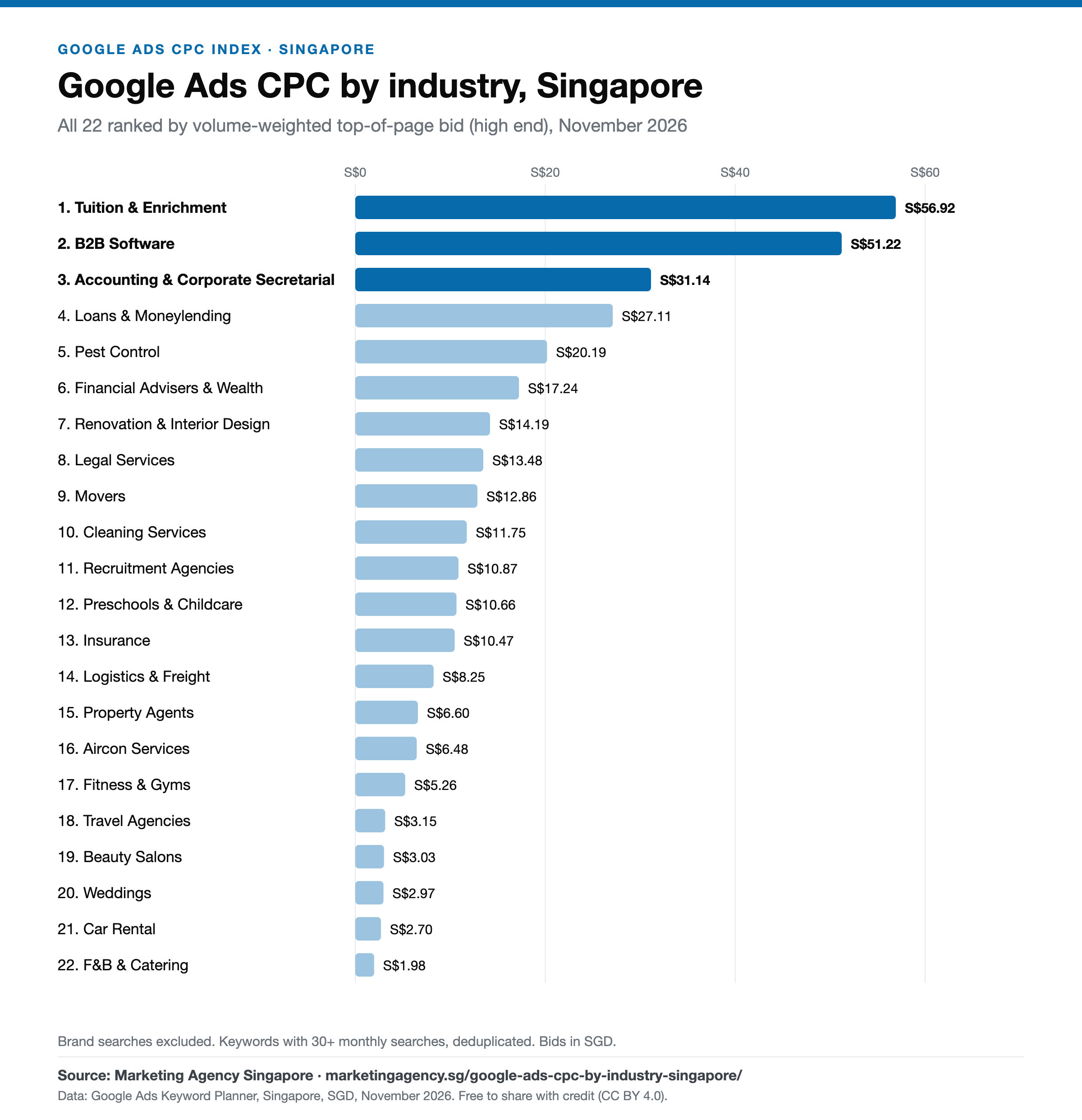
Source: Marketing Agency Singapore’s Singapore Google Ads CPC Index, built from Google Ads API data and updated monthly. Full breakdown, history and forecast →
Geographic Targeting
Singapore’s compact geography means location targeting is less granular than in larger countries. Use radius targeting for retail and F&B (e.g., 5 km around your outlet), country-level targeting for national services, and exclude neighbouring countries (Malaysia, Indonesia) to prevent wasted spend from cross-border searches.

Mobile-First Considerations
Over 70% of Google searches in Singapore happen on mobile devices. Ensure your ads and landing pages are mobile-optimised, use call extensions for businesses that take phone enquiries, and consider mobile bid adjustments based on your conversion data by device. For B2C campaigns, consider adding Mandarin-language campaigns to uncover lower-competition keywords with strong commercial intent.
Frequently Asked Questions
How much should I spend on SEM in Singapore?
Start with SGD 2,000–3,000 per month in ad spend plus SGD 1,000–3,000 for management. Scale based on ROAS. Most Singapore SMEs spend SGD 3,000–15,000 monthly on Google Ads, while larger companies allocate SGD 20,000–100,000+.
How quickly will I see results from SEM?
Impressions and clicks appear within hours. Meaningful optimisation takes two to four weeks. Expect optimal CPA and ROAS to stabilise within eight to twelve weeks of active management.
Can I run SEM campaigns myself?
You can run basic campaigns, but experienced managers typically achieve 30–50% lower CPA through better keyword selection, negative management, and bid optimisation. If your monthly spend exceeds SGD 5,000, professional management usually pays for itself.
What is a good conversion rate for Google Ads in Singapore?
The average is 3–5% for search campaigns. Top-performing accounts achieve 8–12% through precise targeting and strong landing pages. Below 2%, focus on landing page optimisation and keyword relevance before increasing budget.
Should I bid on my own brand name?
Yes, in most cases. Brand campaigns protect search real estate from competitors, capture high-intent traffic at SGD 0.20–0.50 per click, and provide messaging control organic listings cannot match.
How do you choose an SEM agency in Singapore and what does it charge?
Choose an SEM agency that is a Google Partner, explains its account structure and bidding, and reports on cost per lead or sale rather than clicks. Ask who manages the account and how often search terms are reviewed. SEM agency fees in Singapore are commonly about 20% of ad spend or a fixed fee from around S$600 a month, falling to roughly 10% for large MNC budgets.
Is SEO part of search engine marketing?
In current usage, search engine marketing usually means paid search ads such as Google Ads, while SEO covers unpaid organic rankings. Some older definitions treat SEM as an umbrella for both. In Singapore, SEM services almost always refer to paid campaigns on Google, which delivers visibility within hours, whereas SEO typically takes three to twelve months but keeps generating traffic after spending stops.
Is Microsoft Bing Ads worth using for SEM in Singapore?
Microsoft Advertising (Bing Ads) is usually a secondary SEM channel in Singapore, because Google handles the vast majority of searches. It can still be worthwhile for B2B and older desktop audiences, often at lower cost per click with less competition. Most advertisers launch on Google Ads first, then import proven campaigns into Microsoft Advertising and keep them if cost per lead matches or beats Google.
What is the difference between SEM and PPC?
SEM refers to paid advertising on search engines, while PPC is the pay-per-click pricing model used by search and many other ad platforms. All Google search ads are both SEM and PPC, but PPC also covers Meta, LinkedIn, TikTok and display ads charged per click. An SEM agency focuses on Google and Bing search, whereas a PPC agency typically manages paid campaigns across several platforms.