Part of our Advertising in Singapore guide →
Table of Contents
How much does MRT advertising cost in Singapore?
Rates are quoted per four-week cycle. Platform screen door panels run from about S$400–S$1,200 at Tier 2 and 3 stations and S$800–S$3,000 at Tier 1 stations. Digital screens cost S$1,500–S$5,000 per screen, escalator panel sets S$3,000–S$8,000, station wall murals S$8,000–S$25,000 and full station domination S$30,000–S$100,000. Full train wraps cost S$50,000–S$120,000 per train including production. See the full MRT advertising rates or ask us for a station-by-station quote.
Why MRT Advertising Delivers Results
MRT advertising Singapore reaches over three million commuters daily across six train lines and more than 140 stations. Few other advertising channels offer this combination of massive reach, high frequency and captive audience attention in a single market like Singapore.
Commuters spend an average of 30 to 45 minutes per MRT journey, and most make two trips per day. This creates repeated exposure to advertising messages in an environment where there are limited distractions. Unlike social media feeds or web pages where users scroll past ads in milliseconds, MRT passengers actively look around platforms, corridors and train interiors during their commute.
The MRT network covers virtually every part of Singapore, from Jurong East to Changi, Woodlands to HarbourFront. This geographic spread means you can reach audiences across the entire island or concentrate on specific corridors and neighbourhoods. Combined with other OOH advertising formats, MRT ads form the backbone of many successful outdoor campaigns in Singapore.
Brand recall studies consistently show that MRT advertising generates strong unaided recall. Commuters who see the same ad twice daily for four weeks develop deep familiarity with the brand, making MRT particularly effective for launches, rebranding exercises and sustained awareness campaigns.
MRT Advertising Formats
The MRT network offers a diverse range of advertising formats, each suited to different objectives and budgets. Here are the main options available to advertisers.
Platform Screen Door Panels
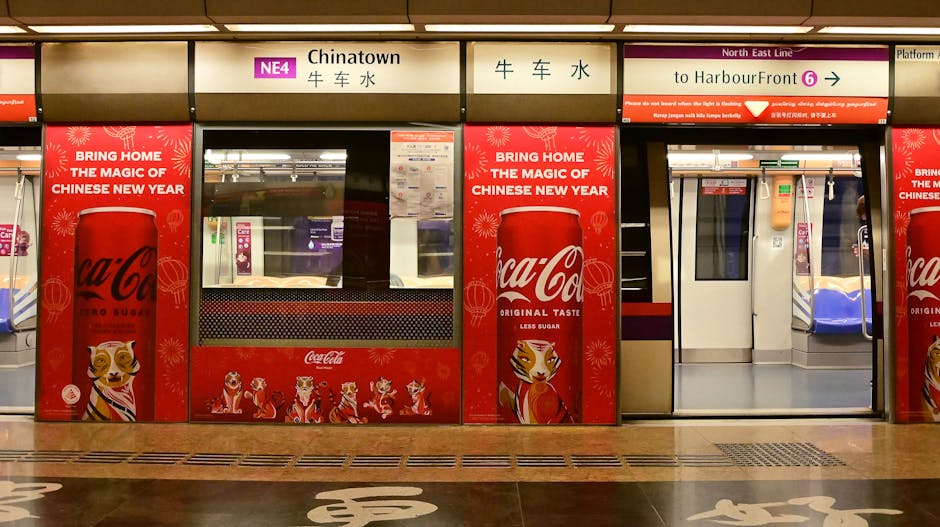
These large-format panels sit at eye level on the platform screen doors, directly in commuters’ line of sight as they wait for trains. They offer excellent visibility and dwell time, typically 2 to 5 minutes during peak hours. Available in most newer stations across the Downtown Line, Circle Line and Thomson-East Coast Line.
Station Wall Murals and Mega Panels
Large wall spaces in station corridors and concourses can be converted into high-impact murals. These domination formats are ideal for brand launches and major campaigns. Stations like Orchard, City Hall, Raffles Place and Dhoby Ghaut offer premium wall inventory that reaches the highest foot traffic.
Escalator Panels
Sequential panels along escalator walls create a storytelling opportunity as commuters ride up or down. The captive nature of escalator travel means viewers see multiple panels in sequence, allowing brands to build a narrative or highlight multiple product features.
In-Train Advertising
Options inside train carriages include overhead header panels, side cove panels, door-side stickers and digital screens on newer trains. In-train ads benefit from extended exposure during the journey itself, when commuters have limited alternatives for visual attention.
Full Train Wraps
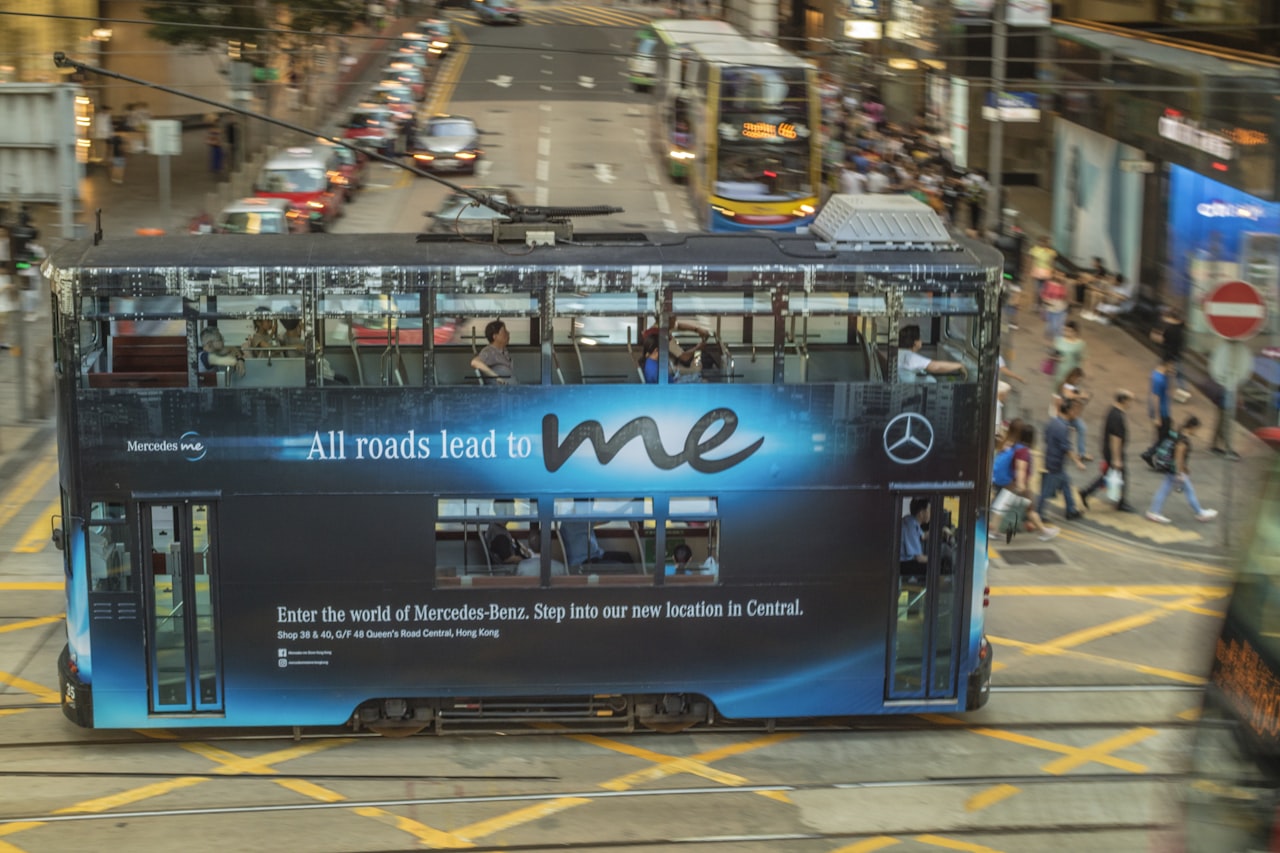
The most impactful MRT format, a full train wrap transforms an entire train into a branded experience. Both the exterior and interior are covered with the campaign creative. This format generates significant PR value and social media buzz in addition to commuter impressions. It is also the most expensive format.
Digital Screens
Digital screens in stations and on newer train lines allow for video content, animated creative and real-time messaging. These screens are increasingly being offered through programmatic buying platforms, connecting MRT advertising with the broader digital out-of-home ecosystem.
Station Domination
For maximum impact, brands can book every available advertising space within a single station. This includes walls, floors, pillars, screen doors, escalators and digital screens. Station dominations create an immersive brand environment that is impossible to ignore.
Station Tiers and Audience Profiles
Not all MRT stations are equal. Media owners typically categorise stations into tiers based on daily ridership and audience demographics.
Tier 1 stations include the busiest interchanges and CBD stations such as Raffles Place, City Hall, Orchard, Dhoby Ghaut, Jurong East, Bishan and Ang Mo Kio. These stations see daily ridership of 50,000 to over 150,000 passengers and command premium pricing.
Tier 2 stations cover busy residential and commercial hubs like Tampines, Woodlands, Toa Payoh, Clementi and Bugis. These stations still offer strong reach with daily ridership of 20,000 to 50,000 and are priced moderately.
Tier 3 stations are smaller residential stations with lower ridership. While individually they offer fewer impressions, they can be booked in bulk for cost-effective coverage of specific neighbourhoods. This approach works well when combined with bus advertising in the same areas.
Audience profiles vary significantly by station and time. CBD stations over-index for professionals, PMEBs (professionals, managers, executives and businesspeople) and high-income earners during weekday peak hours. Heartland stations skew toward families, students and retirees. Entertainment district stations like Clarke Quay and Bayfront attract younger demographics, especially on weekends.
MRT Advertising Costs
MRT advertising costs depend on the format, station tier, campaign duration and number of placements. Here is a general pricing guide based on current market rates.
- Platform screen door panels: S$800 to S$3,000 per panel per four-week cycle at Tier 1 stations; S$400 to S$1,200 at Tier 2 and 3 stations
- Station wall murals: S$8,000 to S$25,000 per four-week cycle depending on wall size and station
- Escalator panels (set of 10 to 20 panels): S$3,000 to S$8,000 per four-week cycle
- In-train header panels: S$300 to S$600 per train per four-week cycle
- Full train wraps: S$50,000 to S$120,000 per train per four-week cycle including production
- Station domination: S$30,000 to S$100,000 per station per four-week cycle
- Digital screens: S$1,500 to S$5,000 per screen per four-week cycle
Production costs vary. Printing and installing static panels typically costs S$200 to S$500 per panel. Train wraps require specialised materials and installation, which account for roughly S$10,000 to S$20,000 of that all-in cost. Most media owners offer package deals that bundle multiple formats or stations at discounted rates.
Creative Best Practices for MRT Ads
MRT advertising creative must work within the constraints of the transit environment. Follow these guidelines to maximise impact.
For platform and corridor placements, keep text to seven words or fewer. Commuters are moving and may only glance at your ad for one to three seconds. Use bold colours, high contrast and a single dominant visual element. Your brand logo should be prominent and your call to action simple.
For in-train placements, you can afford more text since commuters are seated or standing with more time to read. However, keep the message focused. A header panel might include a short headline, a brief body copy line and a URL or QR code. Avoid dense paragraphs that commuters will not read.
QR codes are increasingly effective in MRT environments. Commuters have their phones in hand and connectivity is available throughout the network. Link QR codes to mobile-optimised landing pages with clear next steps. Your website design must support fast-loading mobile pages to convert this traffic.
For escalator panel sequences, tell a story that builds from panel to panel. Start with a question or problem, build through the middle panels and resolve with your brand solution at the end. Ensure each panel also works independently since some commuters will only see a portion of the sequence.
Campaign Planning and Booking
Planning an MRT advertising campaign requires coordination with media owners, creative agencies and sometimes multiple approvals. Here is a typical timeline.
- Brief development: two to four weeks before campaign. Define objectives, target audience, budget and preferred formats and stations.
- Media proposal: one to two weeks after brief. Media owners will provide availability, pricing and audience data for recommended placements.
- Booking confirmation: four to six weeks before campaign start. Premium placements and peak periods like Chinese New Year, National Day and Christmas require earlier booking.
- Creative development: three to four weeks before campaign. Design and produce artwork to media owner specifications.
- Production and installation: one to two weeks before campaign. Printing, delivery and installation by the media owner’s team.
- Campaign live: monitor and document placements. Conduct site visits to verify installation quality.
For detailed guidance on location selection and budget allocation across OOH formats, refer to our OOH media planning guide.
Integrating MRT Ads With Digital Channels
MRT advertising achieves its strongest results when integrated with digital marketing channels. The combination of offline reach and online conversion creates a powerful full-funnel approach.
Use MRT advertising to drive branded search. When commuters see your brand on the platform every day, many will search for it on Google. Ensure your SEO strategy captures these branded searches with optimised landing pages, and run Google Ads on your brand terms to dominate the search results page.
Geofencing technology allows you to retarget mobile devices that have been detected near your MRT placements. Serve follow-up display ads, social media ads or video ads to commuters who were exposed to your outdoor creative. This bridges the gap between offline exposure and online engagement.
Social media amplification extends the value of MRT campaigns. Full train wraps and station dominations are inherently shareable. Create a campaign hashtag and encourage commuters to share photos. Your social media marketing team should monitor for organic mentions and engage with them to boost reach further.
Coordinate MRT campaign timing with content marketing pushes. Publish blog posts, videos and social content that expand on the message introduced in your OOH placements. This layered approach builds deeper engagement than any single channel could achieve alone.
Frequently Asked Questions
How many people see MRT ads daily?
The MRT network carries over three million passenger trips daily. Individual station ridership ranges from under 5,000 to over 150,000 depending on the station. A campaign across 20 Tier 1 and 2 stations can generate over one million daily impressions.
What is the minimum booking period for MRT advertising?
Most MRT advertising formats require a minimum four-week booking. Some digital screens offer shorter minimum periods of one to two weeks. Full train wraps are typically booked for four to twelve weeks.
Can I choose which specific MRT stations to advertise in?
Yes. Media owners offer both network packages covering multiple lines and stations, and cherry-picked individual station bookings. Individual station selection gives you more control but may cost more per station than package deals.
How do I track the results of MRT advertising?
Track branded search volume before, during and after the campaign. Use unique QR codes and URLs to measure direct response. Commission brand lift studies through research agencies. Mobile location data can also estimate exposure and subsequent behaviours. See our OOH measurement guide for more methods.
Is MRT advertising effective for small businesses?
Yes, but format selection matters. Small businesses with limited budgets should focus on a few stations near their business location using cost-effective formats like platform panels or in-train cards. This hyperlocal approach delivers relevant reach without requiring a network-wide buy.
What content restrictions apply to MRT advertising?
All MRT advertising must comply with ASAS guidelines and LTA regulations. Content that is political, religious, offensive or promotes restricted products like tobacco and gambling is not permitted. Media owners review all creative before production and installation.
When is the best time to run an MRT campaign?
MRT ridership is consistent year-round, making any period suitable. However, certain periods like back-to-school (January), Chinese New Year, Great Singapore Sale and the year-end festive season see increased activity and competition for premium placements. Book early during these periods.
Can MRT ads include video or animation?
Only on digital screen formats. Static panels, wall murals and train wraps are printed media and cannot display motion. Digital screens in selected stations support video content of 10 to 30 seconds in a loop shared with other advertisers.