Part of our Marketing by Industry & Audience guide →
Singapore’s dental industry is fiercely competitive. With thousands of registered dentists and hundreds of clinics clustered across the island—from Orchard Road’s premium dental suites to heartland HDB dental practices—standing out requires far more than a clean waiting room and a prime unit. In 2026, prospective patients turn to Google before they turn to their neighbours, making digital marketing an essential investment for dental clinics of every size.
The challenge for dental practices in Singapore is twofold. First, the Singapore Dental Council (SDC) imposes strict advertising guidelines that limit the claims clinics can make, the imagery they can use and the way fees are communicated. Second, dental services are inherently local—patients overwhelmingly choose clinics within convenient reach of their home or workplace, which means your marketing must dominate specific geographic areas rather than the entire island.
This guide walks through the most effective digital marketing strategies for dental clinics operating in Singapore’s regulated environment. From Google Ads and local SEO to patient review management and referral programmes, every tactic below is designed to attract new patients whilst keeping your clinic fully compliant with SDC regulations.
Understanding SDC Advertising Guidelines
Before launching any marketing campaign, every dental clinic in Singapore must understand two sets of rules: the Healthcare Services (Advertisement) Regulations 2021 under the Healthcare Services Act (HCSA), which apply to dental clinics as licensees, and the SDC Ethical Code and Ethical Guidelines. The SDC regulates how dental professionals may advertise their services, and breaching these guidelines can result in disciplinary proceedings, fines or even suspension of practising certificates. Ignorance is not an acceptable defence.
Key restrictions include prohibitions on making unsubstantiated claims about treatment outcomes, publishing patient testimonials that could be perceived as endorsements of clinical competence, and advertising specific fee comparisons with competitors. Clinics may list their range of services, the qualifications of their dentists, operating hours and location details. Fee information may be shared but must not be presented in a manner that could be misleading or that implies superiority over other practitioners.
Before-and-after (or “after”-only) photographs are prohibited in a licensee’s advertising under the HCS (Advertisement) Regulations, even with a disclaimer. They can only be shown to a patient during a consultation at your clinic. The same Regulations ban laudatory terms such as “best” and promotional wording such as “discount”, “free” or “complimentary”. Every piece of marketing content your clinic produces should be reviewed against both the Regulations and the current SDC guidelines (see our guide to healthcare advertising rules in Singapore), and when in doubt, seek clarification before publishing. Working with a digital marketing agency experienced in healthcare advertising can help you navigate these requirements confidently.
Google Ads for Dental Keywords in Singapore
Google Ads remains the single most effective channel for capturing high-intent dental patients in Singapore. When someone searches “dentist near Tampines” or “emergency dental clinic open Sunday Singapore,” they are actively seeking a provider and are ready to book. Appearing at the top of these search results delivers immediate, measurable returns.

Dental keywords are cheaper per click in Singapore than most people expect. In Marketing Agency Singapore’s October 2026 CPC data, dental keywords averaged S$1.82–S$6.52 per click at the top of Google, ranking 16th of 20 medical verticals. Invisalign and clear aligner terms sit higher at around S$10.96, while “dental implants singapore” is S$2.40–S$9.98 (see our dental Google Ads CPC data). High-value treatments still deserve their own campaigns because they represent significant patient lifetime value. A well-structured Google Ads campaign should segment campaigns by treatment type, with separate ad groups for general dentistry, cosmetic procedures, orthodontics and emergency services.
Updated November 2026 Dental CPC in Singapore: November 2026 data
Dental keywords average S$1.78–S$6.36 per click at the top of Google (#17 of 20 medical verticals). If you bid to win every auction, Google forecasts S$15.45 average CPC for December 2026, above the typical range because it assumes you outbid competitors for the top spot.
Priciest services: Invisalign & clear aligners S$10.21, Braces & orthodontics S$9.06, Children's dentistry S$8.16.
- “teeth whitening singapore”: S$1.76–S$9.27 (2,900 searches/mo)
- “dentist singapore”: S$2.60–S$9.51 (2,400 searches/mo)
- “dental clinic singapore”: S$2.05–S$7.72 (2,400 searches/mo)
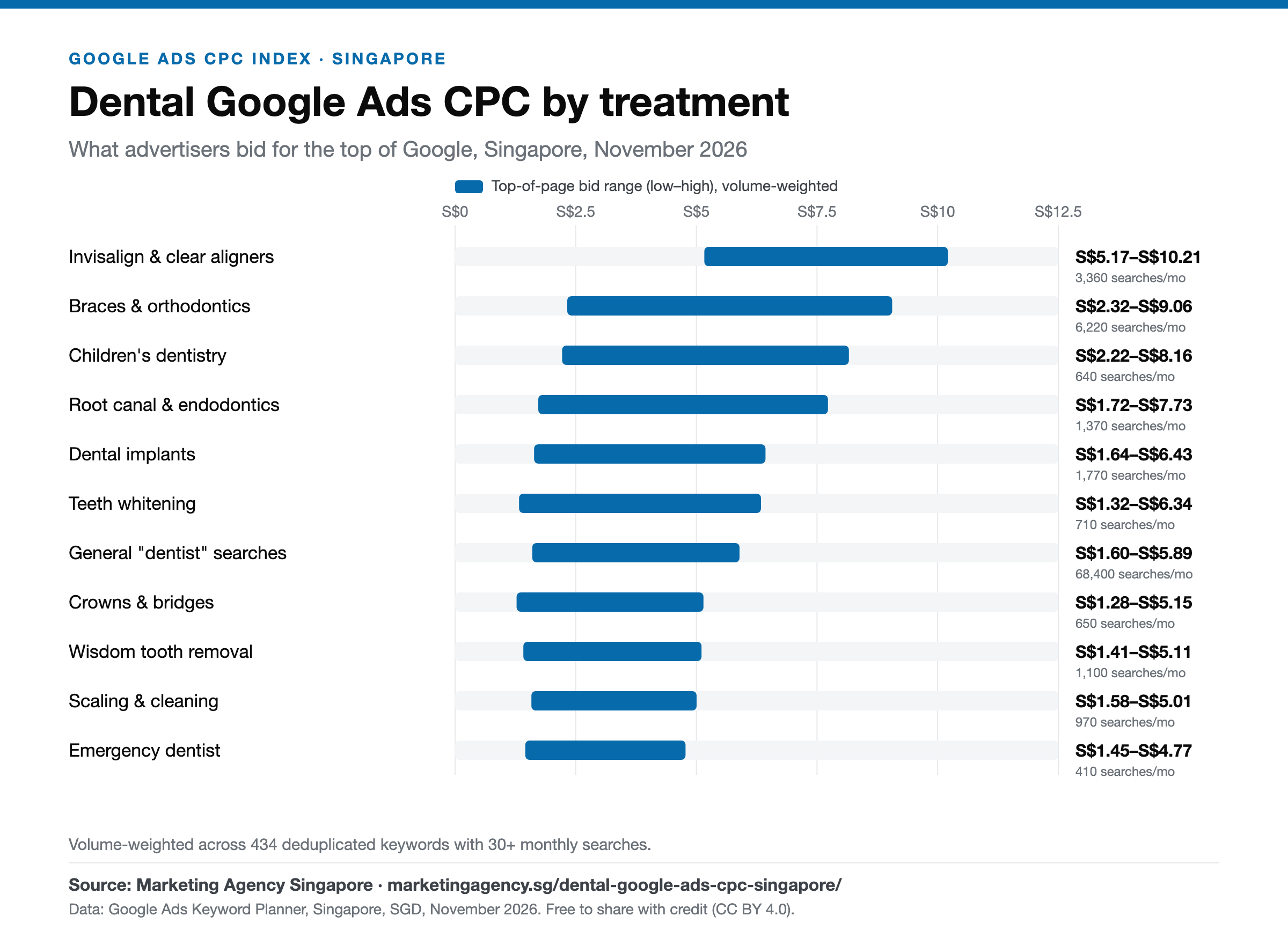
Source: Marketing Agency Singapore’s Singapore Medical CPC Index, built from Google Ads API data and updated monthly. Full breakdown, history and forecast →
Location targeting is critical. Set your campaigns to target specific postal codes or radius distances from your clinic rather than the entire Singapore market. A dental practice in Jurong East gains little from clicks originating in Pasir Ris. Use location extensions to display your clinic address, call extensions to enable one-tap phone calls, and sitelink extensions to direct patients to specific service pages such as teeth whitening, scaling and polishing, or dental implant consultations.
Ad copy must comply with SDC guidelines—avoid superlatives like “best dentist” or unverifiable claims. Instead, focus on convenience factors (location, opening hours, same-day appointments), accepted insurance panels (such as CHAS, Medisave and corporate dental plans) and the qualifications of your dental team. These elements differentiate your clinic without breaching ethical advertising rules.
Local SEO for Dental Clinics
Local SEO is arguably more important for dental clinics than any other healthcare sector. The vast majority of patients search for dental services with location modifiers—”dentist Bukit Timah,” “dental clinic near Clementi MRT,” “Saturday dentist Toa Payoh.” Ranking prominently in Google’s local pack (the map results) and organic listings for these queries drives a consistent pipeline of new patient enquiries.
Your Google Business Profile is the foundation of local dental SEO. Ensure your profile is fully completed with accurate clinic name, address, phone number and operating hours. Select the correct primary category (“Dentist”) and add relevant secondary categories such as “Cosmetic Dentist,” “Orthodontist” or “Emergency Dental Service.” Upload high-quality photographs of your clinic interior, treatment rooms, reception area and team members. Clinics with 20 or more photos on their Google Business Profile receive significantly more direction requests and website clicks than those with fewer images.
On-page SEO for your clinic website should target location-specific keywords naturally. Create individual service pages for each treatment you offer—scaling and polishing, root canal treatment, dental crowns, braces, Invisalign, dental implants—and include references to your clinic’s location within the content. A page titled “Dental Implants in Novena, Singapore” that provides genuinely useful information about the procedure, recovery timeline and Medisave claimable amounts will rank well for patients searching in that area.
Build local citations by listing your clinic on Singapore-specific directories including Healthhub.sg and dental-specific platforms. Consistency in your clinic name, address and phone number (NAP) across all directories reinforces your local search authority and helps Google confidently display your practice in map results.
Patient Review Management
Online reviews are the digital equivalent of word-of-mouth referrals, and for dental clinics, they carry enormous weight. Prospective patients are entrusting their oral health—and often a significant financial commitment—to a practitioner they may never have met. Google reviews, in particular, serve as a trust bridge that reduces anxiety and accelerates booking decisions.
Developing a systematic review generation process is essential. Train your front desk team to mention Google reviews to patients after positive appointments—not in a pushy manner, but as a natural part of the checkout conversation. A simple “We’d really appreciate it if you could share your experience on Google” accompanied by a QR code or short link makes the process effortless. Follow up with a polite SMS or email within 24 hours of the appointment, including a direct link to your Google review page.
Respond to every review—positive and negative. Thank satisfied patients warmly, but avoid using their names or confirming details of their visit, to protect patient confidentiality. For negative reviews, respond professionally, acknowledge the patient’s concern and offer to resolve the issue offline. Never disclose clinical details or argue publicly. Your responses are read by prospective patients as much as the reviews themselves, and a measured, empathetic tone builds confidence in your practice.
Be mindful of SDC guidelines when encouraging reviews. You must not incentivise reviews with discounts or gifts, and you should not coach patients on what to write. Authentic, unprompted reviews carry the most weight with both Google’s algorithm and prospective patients.
Showing Results Without Before-and-After Photos
In many markets, before-and-after imagery is the default way to market cosmetic and orthodontic dentistry. In Singapore it is off the table: the HCS (Advertisement) Regulations prohibit before-and-after and “after”-only photos in a dental clinic’s advertising, including its website and social media, even with patient consent and a disclaimer. The good news is that patients can still understand what a treatment involves without them.

Explain the treatment journey instead of showing patient outcomes. Create articles or videos that walk through what patients can expect at each stage of Invisalign treatment, for example, using illustrations, 3D models, aligner trays and diagrams rather than photographs of patients’ results. Keep before-and-after case photos for the consultation room, where your dentist can show them to the patient in person with proper clinical context, which the Regulations allow.
Dentist-led explainer videos perform well on platforms like Instagram and YouTube. A series explaining how orthodontic treatment works, with commentary on the clinical rationale at each step and no patient result shots, provides genuine value to prospective patients whilst showcasing your clinic’s expertise. Such content also supports your content marketing strategy by generating organic traffic from patients researching specific procedures.
Content Marketing for Dental Practices
Content marketing positions your dental clinic as a trusted authority in oral health—a reputation that pays dividends in patient acquisition and retention. In 2026, patients research extensively before booking dental appointments, and clinics that provide helpful, accurate information during this research phase gain a significant competitive advantage.
Develop a blog covering common dental concerns relevant to Singaporeans. Topics such as “Is Medisave claimable for wisdom tooth surgery?”, “How much do dental implants cost in Singapore in 2026?” and “What to expect during your first visit to a new dentist” address questions that thousands of Singaporeans type into Google every month. Each article should naturally incorporate relevant keywords whilst providing genuinely useful answers.
Educational content about preventive dental care—proper brushing techniques, the importance of regular scaling, dietary habits that affect oral health—positions your clinic as one that prioritises patient wellbeing over revenue. This builds trust and loyalty, reducing patient churn and increasing lifetime value. Share this content across your social media channels and email newsletters to maximise its reach and reinforce your clinic’s expertise.
Encouraging Referrals Within the Rules
Referral programmes remain one of the most cost-effective patient acquisition channels for dental clinics. A referred patient arrives with built-in trust, is more likely to accept treatment recommendations and typically has a higher lifetime value than a patient acquired through paid advertising.
Be careful with incentives. MOH’s guidance on the HCS (Advertisement) Regulations allows clinics to run referral incentives and promotional packages as a practice, but they cannot be advertised: patients may only be told about them at the point of payment, at the counter or on the payment page. Words such as “complimentary”, “free” or “discount” in any advertising count as soliciting. Any incentive must also comply with SDC guidelines and must not amount to fee-splitting.
That rules out printed referral cards, promotional emails, website banners and SMS or WhatsApp reminders about a referral scheme, and MOH has said even patients’ screenshots of a referral programme shared on social media should be removed. Word of mouth itself is not regulated, so focus on making referrals easy: an excellent patient experience, a simple shareable online booking link and clear dentist profiles that a patient can forward to a friend. Track referral sources meticulously in your practice management system to measure the programme’s return on investment and identify your most prolific referrers—these patients are your clinic’s most valuable advocates.
Social Media Marketing for Dentists
A well-executed social media marketing strategy helps dental clinics build brand awareness, engage with their community and attract new patients. Instagram and Facebook are the most relevant platforms for dental practices in Singapore, with TikTok growing rapidly among younger demographics.

Content that performs well for dental clinics on social media includes clinic tour videos, team introductions, oral health tips, behind-the-scenes glimpses of sterilisation processes (which reassure patients about hygiene standards), and celebration posts marking clinic milestones or team achievements. Avoid overly clinical imagery that may alienate casual scrollers—keep content approachable and relatable.
Paid social media advertising can effectively target specific demographics within your clinic’s catchment area. Facebook and Instagram’s location targeting allows you to reach residents within a defined radius, whilst demographic filters help you focus on age groups most relevant to specific treatments—parents for paediatric dentistry, adults aged 25–45 for orthodontics, or those aged 45 and above for implant and prosthodontic services. Ensure your clinic website provides a seamless experience for social media traffic, with clear calls to action and easy online booking.
Frequently Asked Questions
How much should a dental clinic in Singapore spend on digital marketing?
Most dental clinics in Singapore allocate between S$2,000 and S$8,000 per month on digital marketing, depending on location competition and growth targets. Clinics in high-competition areas like Orchard Road or the CBD may need to invest more to achieve visibility. A reasonable starting budget is S$3,000 per month split between Google Ads (60%), SEO (25%) and social media (15%), with adjustments based on performance data after the first three months.
Can dental clinics in Singapore advertise prices online?
Dental clinics may share fee information on their websites and marketing materials, but must ensure pricing is presented in a manner that is not misleading. You should not make fee comparisons with other clinics or present prices in a way that implies superior value. Transparent pricing for common procedures like scaling, polishing and consultations can actually build trust, provided the information is accurate and accompanied by appropriate disclaimers about variations based on individual clinical needs.
What are the best Google Ads keywords for dental clinics in Singapore?
High-performing dental keywords include location-modified terms such as “dentist [neighbourhood name],” treatment-specific phrases like “dental implants Singapore” and “Invisalign cost Singapore,” and urgency-driven queries like “emergency dentist open now Singapore.” Long-tail keywords with lower competition but strong intent—such as “Medisave dental implant claim Singapore”—often deliver the best return on ad spend.
How can I get more Google reviews for my dental clinic?
Implement a systematic review request process. Ask satisfied patients in person after their appointment, then follow up with an SMS or email containing a direct link to your Google review page within 24 hours. Make the process as frictionless as possible—a QR code at the reception desk works well. Do not offer incentives for reviews, as this violates both Google’s policies and SDC guidelines. Consistently responding to existing reviews also encourages others to share their experiences.
Is it worth investing in SEO for a dental clinic?
Absolutely. Local SEO delivers some of the highest long-term returns for dental clinics because it captures patients at the moment of intent. While SEO results take three to six months to materialise, once your clinic ranks well for key local terms, you benefit from a consistent stream of organic patient enquiries without ongoing per-click costs. Combined with a strong Google Business Profile, SEO creates a sustainable competitive advantage that is difficult for competitors to replicate quickly.
Should dental clinics use TikTok for marketing?
TikTok can be effective for dental clinics targeting younger demographics, particularly for treatments like Invisalign, teeth whitening and cosmetic veneers. Educational content that demystifies dental procedures—such as “what actually happens during a root canal”—tends to perform well. However, all content must comply with SDC advertising guidelines. Clinics with limited marketing resources should prioritise Google Ads and SEO before investing in TikTok, as these channels typically deliver more direct patient bookings.
What is the Singapore Dental Council (SDC) and why does it matter for dental marketing?
The Singapore Dental Council (SDC) is the statutory body that registers dentists in Singapore under the Dental Registration Act and sets the SDC Ethical Code and Ethical Guidelines, including rules on how dentists may publicise their services. Dental clinic marketing must satisfy both the SDC guidelines and the Healthcare Services (Advertisement) Regulations 2021. Breaches can lead to disciplinary proceedings, fines or suspension of a dentist’s practising certificate.
What should a dental clinic website in Singapore include?
A dental clinic website in Singapore should include individual pages for each treatment, dentist profiles with qualifications, clinic locations with nearby MRT stations, opening hours including weekend or Sunday availability, and accepted schemes such as CHAS, Medisave and corporate dental plans. Fast mobile loading, one-tap calling, WhatsApp and online booking drive conversions. Content must avoid before-and-after photos, testimonials and words such as best, free or discount.
How should a Singapore dental clinic choose a dental marketing agency?
A dental clinic should choose a marketing agency with proven healthcare experience in Singapore and a working knowledge of the HCS (Advertisement) Regulations and SDC guidelines. Ask how ad copy and content are checked for compliance, request dental or medical case studies, and confirm the clinic will own its Google Ads, Google Business Profile and website accounts. Clear reporting on enquiries and bookings, not just clicks, is essential.
Can dental clinics in Singapore work with influencers for marketing?
Influencer marketing is risky for Singapore dental clinics. Paid posts in which an influencer praises a clinic or shows their treatment results are likely to be treated as testimonials, laudatory claims or before-and-after imagery, all of which are restricted in clinic advertising. Safer options are dentist-led educational content on the clinic’s own channels that explains procedures without patient results, superlatives or promotional wording such as free or discount.