Part of our Marketing by Industry & Audience guide →
Traditional Chinese medicine has been a part of Singapore’s healthcare landscape for generations. From acupuncture and herbal prescriptions to tuina massage and cupping therapy, TCM clinics serve a loyal and growing patient base. Yet many TCM practitioners still rely almost entirely on word-of-mouth referrals and walk-in traffic to sustain their practice.
That approach worked when competition was limited. It does not work as well in 2026, with hundreds of clinics competing for the same patient pool. Younger Singaporeans are increasingly open to TCM — but they search for practitioners online, read Google reviews before booking, and expect a modern digital experience even from traditional practices.
This guide covers the strategies that work for TCM clinic marketing — from local SEO and Google Ads to WeChat marketing and bilingual content — without the fluff.
The TCM Marketing Landscape in Singapore
TCM occupies a distinctive position in Singapore’s healthcare market. It sits between mainstream Western medicine and alternative wellness — trusted by a core demographic of older Chinese Singaporeans, increasingly explored by younger adults seeking holistic health solutions, and growing in popularity among non-Chinese residents curious about acupuncture and herbal remedies.
Several factors shape the marketing environment for TCM clinics in 2026:
- Rising mainstream acceptance: Government moves to integrate evidence-based TCM into mainstream healthcare have boosted credibility. More Singaporeans now view TCM as a complement to Western medicine rather than an alternative to it.
- Younger patient demographics: Millennials and Gen Z Singaporeans searching for treatments like acupuncture for stress, fertility support, and sports injury recovery are entering the market — and they start with Google.
- Cluster competition: TCM clinics tend to concentrate in certain areas — Chinatown, Geylang, Toa Payoh, and suburban heartland malls. Standing out within a cluster requires deliberate marketing.
- Bilingual audience needs: Your patient base likely includes Mandarin-dominant older patients and English-dominant younger ones. Your marketing must serve both.
- Regulatory constraints: The TCM Practitioners Board and Health Sciences Authority impose restrictions on what claims you can make in advertising. This rules out many tactics common in other industries.
Understanding these dynamics is the first step. The clinics that grow in 2026 are those that combine strong clinical skills with a deliberate, compliant healthcare marketing strategy.
Local SEO for TCM Clinics
For most TCM clinics, local SEO is the single most valuable marketing channel. When a potential patient searches “TCM clinic near me,” “acupuncture Tampines,” or “Chinese physician for back pain,” you need to appear in the Google Map Pack and organic results. If you do not, that patient goes to a competitor.

Here is how to build a strong local SEO presence for your TCM practice:
Google Business Profile Optimisation
Your Google Business Profile is the foundation. Most TCM clinics have one, but few optimise it properly. Start with these essentials:
- Accurate categories: Use “Traditional Chinese Medicine Clinic” as your primary category. Add secondary categories like “Acupuncturist” or “Herbalist” if applicable.
- Complete service listings: Add every service you offer — acupuncture, herbal medicine, tuina, cupping, moxibustion, fertility support, pain management. Each service listing is an opportunity to match a patient search.
- Bilingual descriptions: Write your business description in both English and Chinese to capture searches in both languages.
- Operating hours and appointment links: Keep hours accurate. Add a direct booking link if you use an appointment system.
- Regular posts: Publish weekly posts — health tips, seasonal wellness advice, clinic updates.
Our Google Business Profile guide covers the full optimisation process in detail.
Location-Specific Content
Create dedicated pages on your website for each treatment and each location you serve. A page targeting “acupuncture in Bedok” will rank for location-specific searches that a generic “our services” page will not. Include relevant details — nearby MRT stations, parking information, and neighbourhood-specific health concerns your clinic addresses.
Investing in local SEO services specifically designed for healthcare practices can accelerate your rankings significantly compared to generic SEO approaches.
Technical SEO Basics
Your website must load quickly on mobile devices — most patients will find you on their phones. Ensure your site uses HTTPS, has clean URL structures, and includes structured data markup for local businesses and medical practices. Schema markup helps Google understand your services, location, and opening hours, which improves your visibility in search results.
Google Ads for TCM Clinics
Google Ads delivers immediate visibility for high-intent searches. While SEO builds over months, a well-structured Google Ads campaign can drive patient enquiries from day one. TCM clinics benefit from Google Ads because the search intent behind queries like “TCM clinic near me” or “acupuncture for migraine Singapore” is overwhelmingly transactional — these searchers want to book an appointment.
Key considerations for TCM clinic Google Ads campaigns:
- Keyword structure: Build separate ad groups for each treatment type — acupuncture, herbal medicine, tuina, cupping. Each treatment has different search volumes, competition levels, and patient intent.
- Location targeting: Set your campaigns to target a realistic radius around your clinic. Most TCM patients will not travel across Singapore for routine treatments. A 5–10 km radius is typically appropriate, though you may expand this for specialist services.
- Ad copy compliance: Avoid making unsubstantiated medical claims in your ads. Focus on the experience — “Experienced TCM Physician,” “Convenient Heartland Location,” “Book Online Today” — rather than promising specific health outcomes.
- Call extensions and call tracking: Many TCM patients, particularly older ones, prefer to phone rather than fill in forms. Enable call extensions and track which campaigns generate phone enquiries.
- Bilingual campaigns: Run separate campaigns in English and Chinese. The keyword landscape differs significantly between languages, and ad copy must be native-quality in both.
In Marketing Agency Singapore’s October 2026 CPC data, TCM keywords averaged S$1.29–S$4.04 per click at the top of Google, the lowest of the 20 medical verticals we track; “tcm singapore” was S$1.52–S$4.70 and TCM fertility terms sat higher at around S$8.80 (see our TCM Google Ads CPC data). This makes Google Ads a cost-effective channel for TCM clinics with relatively modest budgets.
Updated November 2026 TCM CPC in Singapore: November 2026 data
TCM keywords average S$1.28–S$4.03 per click at the top of Google (#20 of 20 medical verticals). If you bid to win every auction, Google forecasts S$6.40 average CPC for December 2026, above the typical range because it assumes you outbid competitors for the top spot.
Priciest services: TCM fertility S$8.80, TCM slimming & weight loss S$7.42, Acupuncture S$4.67.
- “tcm singapore”: S$1.52–S$4.70 (3,600 searches/mo)
- “acupuncture singapore”: S$1.69–S$5.23 (1,000 searches/mo)
- “cupping singapore”: S$1.08–S$3.17 (480 searches/mo)
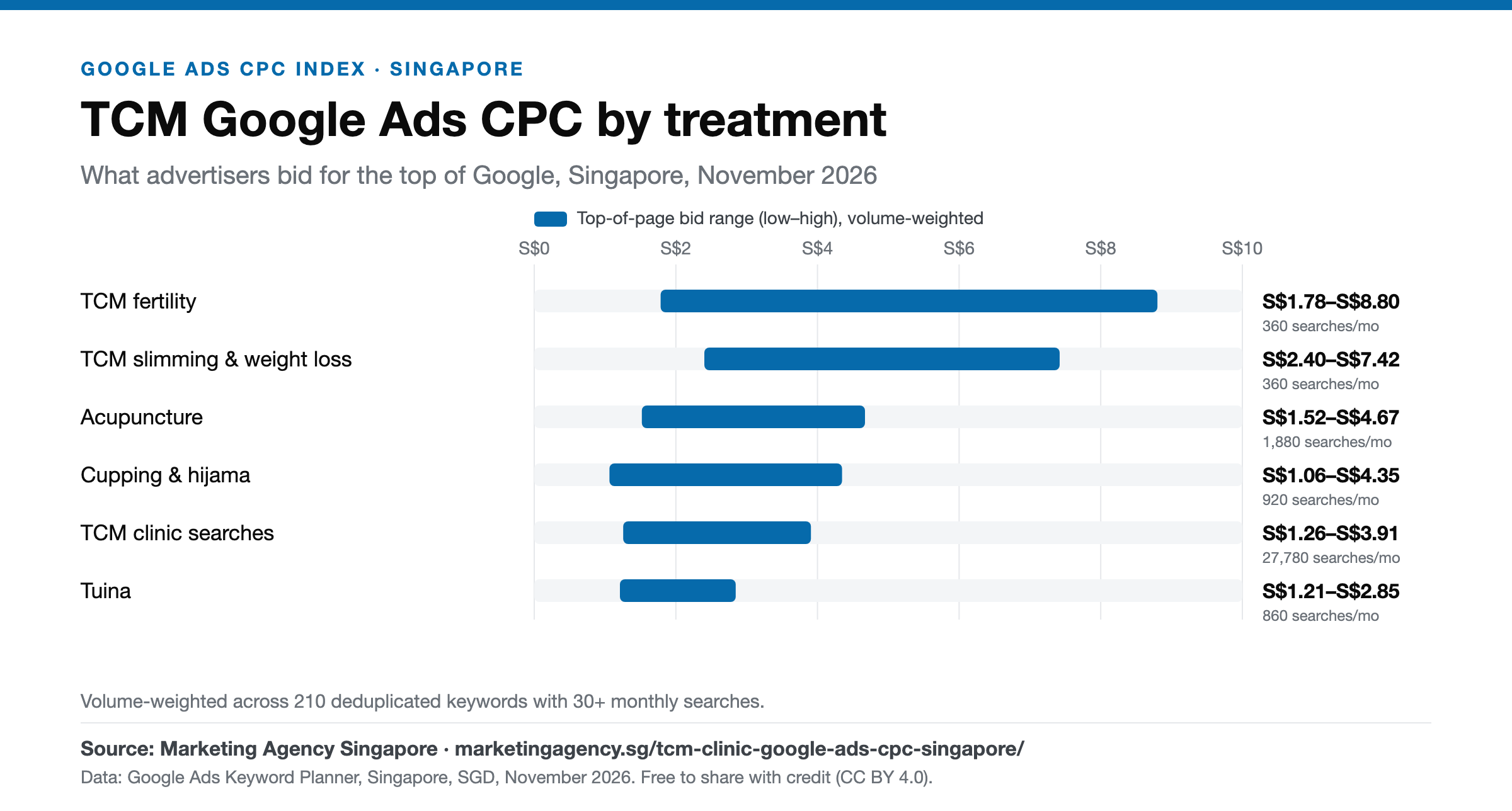
Source: Marketing Agency Singapore’s Singapore Medical CPC Index, built from Google Ads API data and updated monthly. Full breakdown, history and forecast →
Bilingual Content Marketing
Content marketing for TCM clinics educates potential patients and builds topical authority that improves search rankings. The bilingual dimension is what makes TCM content strategy unique in Singapore.
Effective content topics for TCM clinics include:
- Treatment explainers: “What to Expect During Your First Acupuncture Session” or “How TCM Herbal Medicine Works” — these pages capture informational searches from curious potential patients.
- Condition-specific content: Articles addressing common complaints — chronic back pain, insomnia, menstrual irregularities, digestive issues — and explaining how TCM approaches them.
- Seasonal wellness guides: TCM has deep traditions around seasonal health. Content about staying well during Singapore’s haze season or managing dampness during the monsoon resonates with both traditional and modern audiences.
- Myth-busting content: Address common misconceptions about TCM. “Is Acupuncture Painful?” or “Does Herbal Medicine Interact with Western Medication?” — these build trust and capture search traffic.
Managing Two Languages
Do not simply translate your English content into Chinese or vice versa. The two audiences often have different concerns, different levels of TCM knowledge, and different search behaviours. A Mandarin-speaking patient searching for “中医调理” (TCM body constitution adjustment) has different expectations from an English-speaking patient searching for “acupuncture benefits.”
The most effective approach is to create content natively in each language, informed by keyword research in both English and Chinese. This requires either bilingual in-house expertise or a content marketing partner with Chinese-language capabilities. Read more about building an effective healthcare marketing strategy in Singapore that accounts for multilingual audiences.
WeChat and Chinese Social Media
For TCM clinics targeting Chinese-speaking audiences — including Mandarin-speaking Singaporeans, PRC nationals living in Singapore, and medical tourists — WeChat marketing is a channel worth serious consideration.

WeChat’s ecosystem offers several advantages for TCM clinics:
- Official accounts: A WeChat Official Account lets you publish long-form health content, share clinic updates, and build a subscriber base among Chinese-speaking patients.
- Mini programmes: WeChat Mini Programs can serve as lightweight appointment booking systems, making it easy for patients to schedule consultations without leaving the app.
- Moments advertising: WeChat Moments ads allow precise targeting by location, demographics, and interests — useful for reaching Chinese nationals in specific Singapore neighbourhoods.
- Patient community building: WeChat groups can serve as patient communities where you share health tips, answer questions, and maintain ongoing engagement between visits.
Beyond WeChat, consider Xiaohongshu (Little Red Book) for reaching younger Chinese-speaking audiences. Health and wellness content performs well on the platform, and TCM clinics with visually appealing spaces and photogenic treatments like cupping or gua sha can generate organic interest.
The key is consistency. Publishing one WeChat article per week and two to three Xiaohongshu posts builds a presence over time. Sporadic posting yields little return.
Reputation Management and Patient Reviews
Reviews are disproportionately important for TCM clinics. Many potential patients are trying TCM for the first time and feel uncertain about what to expect. Positive reviews from real patients reduce that anxiety and drive bookings.
Here is how to build and manage your review profile:
- Ask systematically: Train your reception staff to ask satisfied patients for Google reviews. The best time to ask is immediately after a positive treatment outcome. Provide a simple QR code or short link that goes directly to your Google review page.
- Respond to every review: Thank positive reviewers specifically. For negative reviews, respond professionally, acknowledge the concern, and offer to resolve the issue offline. How you handle criticism tells potential patients as much as the criticism itself.
- Monitor multiple platforms: Beyond Google, check Facebook and Chinese-language review sites. Patients in different demographics leave reviews on different platforms.
- Showcase testimonials on your website: Feature patient testimonials (with consent) prominently on your service pages.
Online reputation is a measurable competitive advantage — a clinic with 50 genuine Google reviews averaging 4.7 stars will consistently outperform a clinic with five reviews.
Navigating Regulatory Compliance in Marketing
TCM clinic marketing in Singapore operates within a specific regulatory framework. The Traditional Chinese Medicine Practitioners Act, Health Products Act, and various guidelines from the Ministry of Health and Health Sciences Authority all impose restrictions on what you can claim in your marketing materials.
Key compliance principles to follow:
- Avoid unsubstantiated medical claims: Do not claim that TCM can cure specific diseases or conditions unless the claim is supported by recognised evidence. Phrases like “may help with” or “traditionally used for” are generally safer than definitive cure claims.
- No misleading testimonials: Patient testimonials must be genuine and should not imply guaranteed outcomes. Avoid before-and-after comparisons that suggest specific medical results.
- Proper practitioner credentials: Only registered TCM practitioners should be named in marketing materials. Display registration numbers where required.
- Product advertising restrictions: If you sell herbal products, ensure they comply with HSA regulations. Not all traditional remedies can be marketed freely in Singapore.
- Google Ads healthcare policies: Google has its own healthcare advertising policies that apply on top of local regulations. Certain treatment types may face ad restrictions or require verification.
Build your marketing on genuine clinical expertise and patient outcomes, and compliance becomes straightforward.
Registered TCM practitioners must also follow the TCM Practitioners Board’s Ethical Code and Ethical Guidelines, issued under the Traditional Chinese Medicine Practitioners Act. In practice, that rules out claims to cure specific diseases, testimonials that imply guaranteed outcomes and titles that overstate a practitioner’s qualifications, on your website, social media and Google Ads alike. “Cure your back pain with acupuncture” or “guaranteed weight loss through TCM” would cross the line. Describe the services you offer, the conditions you commonly see, your practitioners’ qualifications and the general principles of TCM wellness instead.
Wellness Content, Social Media and Community Engagement
TCM’s focus on prevention, seasonal wellness, dietary therapy and mind-body balance gives clinics an almost endless supply of useful content. Build a calendar around Singapore’s climate and cultural year, with topics such as staying well during the haze season, TCM dietary therapy for hot weather, supporting immunity with Chinese herbs and preparing for Chinese New Year. Myth-busting articles (“Is acupuncture painful?”, “Does TCM conflict with Western medicine?”) remove the doubts that stop first-time patients from booking.
Short videos explaining how acupuncture works, what cupping involves or how herbs are prescribed demystify TCM for younger, English-speaking audiences. Add English and Chinese subtitles. Facebook and Instagram remain the core platforms, with TikTok growing fast for educational health content among 18–35-year-olds. A regular live Q&A with a practitioner, weekly or fortnightly, builds trust and doubles as reusable video. Festivals such as Chinese New Year, Qing Ming and the Mid-Autumn Festival give natural seasonal hooks. Show treatment footage only with the patient’s consent, and keep every post within the advertising rules above.
Offline, partner with community centres and residents’ committees for free wellness talks and workshops on stress, dietary therapy or body constitution, which introduce your practitioners to people in your catchment in a low-pressure setting. Cross-promote with yoga studios, gyms and health food stores, for example through pulse diagnosis sessions or herbal tea tastings. Singapore’s ageing population is a significant opportunity too: senior activity centres and eldercare organisations are natural partners for group wellness sessions with patients who have high lifetime value.
Measuring Results and Tracking Patient Acquisition
Many TCM clinics invest in marketing without tracking which channels actually deliver patients. This leads to wasted spend and missed opportunities. Even with a modest budget, you should track the basics:

- Call tracking: Use different phone numbers or call tracking software for different marketing channels. Know whether a patient came from Google Ads, organic search, or a WeChat post.
- Online booking attribution: If you use an online booking system, track which website pages or campaigns drive the most appointments.
- Google Analytics: Monitor which pages on your website attract the most traffic, which keywords bring visitors, and what percentage of visitors take action (call, book, or enquire).
- Patient intake surveys: Sometimes the simplest method works best. Ask new patients how they heard about your clinic during registration. Track the responses monthly.
- Lifetime value tracking: TCM patients often return regularly. A patient acquired through Google Ads for $30 who visits monthly for a year is worth far more than the initial acquisition cost. Factor this into your budget decisions.
The clinics that grow consistently are those that know their numbers. Working with a healthcare marketing agency that understands both the clinical and commercial sides of TCM practice ensures your marketing investment is measured, optimised, and compliant.
Frequently Asked Questions
How much should a TCM clinic spend on digital marketing?
Most TCM clinics in Singapore should budget between $1,500 and $5,000 per month. A single-location clinic can start with $1,500 covering Google Ads and basic SEO. Multi-location practices may need $4,000 to $5,000 to compete effectively.
Should TCM clinics market in English, Chinese, or both?
Both. Your patient base almost certainly includes English-dominant and Mandarin-dominant speakers. Running marketing in only one language means you are invisible to half your potential audience. At minimum, your website should have bilingual content for key service pages. Google Ads and social media campaigns should be run separately in each language with native-quality copy.
Can TCM clinics advertise on Google without violating healthcare regulations?
Yes, but you must be careful with ad copy and landing page claims. Avoid claiming to cure specific diseases. Focus on your credentials, experience, patient satisfaction, and the types of conditions you treat. Google also has its own healthcare advertising policies that may require account verification. A marketing partner experienced in Google Ads for healthcare can help you navigate these restrictions.
How long does it take for SEO to work for a TCM clinic?
Local SEO for TCM clinics typically shows initial results within three to four months, with meaningful patient acquisition improvements at six to nine months. Google Business Profile optimisation tends to deliver quicker wins than organic website rankings.
Is WeChat marketing worth it for TCM clinics in Singapore?
It depends on your patient demographic. If a significant portion of your patients are Mandarin-speaking — either older Singaporean Chinese or PRC nationals — WeChat is highly effective. The platform allows you to build a subscriber base, share health content, and even facilitate appointment bookings. For clinics whose patient base is primarily English-speaking, WeChat may not justify the investment.
Is TikTok effective for marketing a TCM clinic?
It can be, especially for reaching 18–35-year-olds interested in holistic wellness. Educational videos on body constitution types, seasonal diet tips or what to expect at an acupuncture session tend to perform well. Keep every video within the TCM Practitioners Board’s advertising guidelines and avoid health claims that could mislead.
How can a TCM clinic stand out in a competitive market?
Through practitioner expertise, patient experience and content authority. Highlight qualifications, specialisations and experience, invest in a clean, modern clinic that appeals to younger patients, and publish regular educational content. Clinics that pair traditional expertise with a contemporary patient experience and a strong digital presence consistently outperform those that rely on walk-ins.
How should a new TCM clinic in Singapore market its opening?
A new TCM clinic in Singapore should set up and fully optimise its Google Business Profile before opening, using the Traditional Chinese Medicine Clinic category and listing every service. Bilingual service pages and a small, tightly targeted Google Ads campaign generate first bookings while SEO builds. Free wellness talks at nearby community centres and a systematic review request process help the clinic gain local trust quickly.
What should a TCM clinic website include to get more bookings?
A TCM clinic website should load quickly on mobile and include a dedicated page for each treatment, such as acupuncture, tuina and cupping, in both English and Chinese. Each page should show practitioner names and qualifications, nearby MRT stations, opening hours and an online booking link or click-to-call button. Local business schema and genuine patient reviews strengthen trust without breaking advertising rules.
Should a TCM clinic handle marketing in-house or hire an agency?
A TCM clinic can handle basics in-house, such as Google Business Profile posts, review requests and simple social media updates. Google Ads, bilingual SEO and compliance-sensitive copy usually benefit from a healthcare marketing agency, because TCM Practitioners Board rules and Google’s healthcare policies are easy to breach. Many clinics combine in-house content from practitioners with an agency for paid search and SEO.
Are there government grants for TCM clinic marketing in Singapore?
Singapore SMEs, including TCM clinics, may be able to offset some marketing-related costs through the EDGE Grant. PSG, EDG and MRA are now part of the EDGE Grant, which covers activities such as digital solutions and branding or marketing strategy projects, with support of up to 50% for SMEs. Eligibility and approved vendors should be confirmed before any work is committed.