Overview
dinogame.gg is a browser-games destination — the Chrome Dino game plus a growing library of browser-game guides and round-ups. It competes in one of the most crowded content niches on the web, where the prize is scale: ranking for high-volume gaming queries and being surfaced by both Google and the AI answer engines. We ran a content-led SEO engagement built to win organic search and AI citations at the same time.
Project Snapshot
- Sector: Gaming — browser games / content publishing
- Engagement: Content-led SEO + AI-search (AEO/GEO)
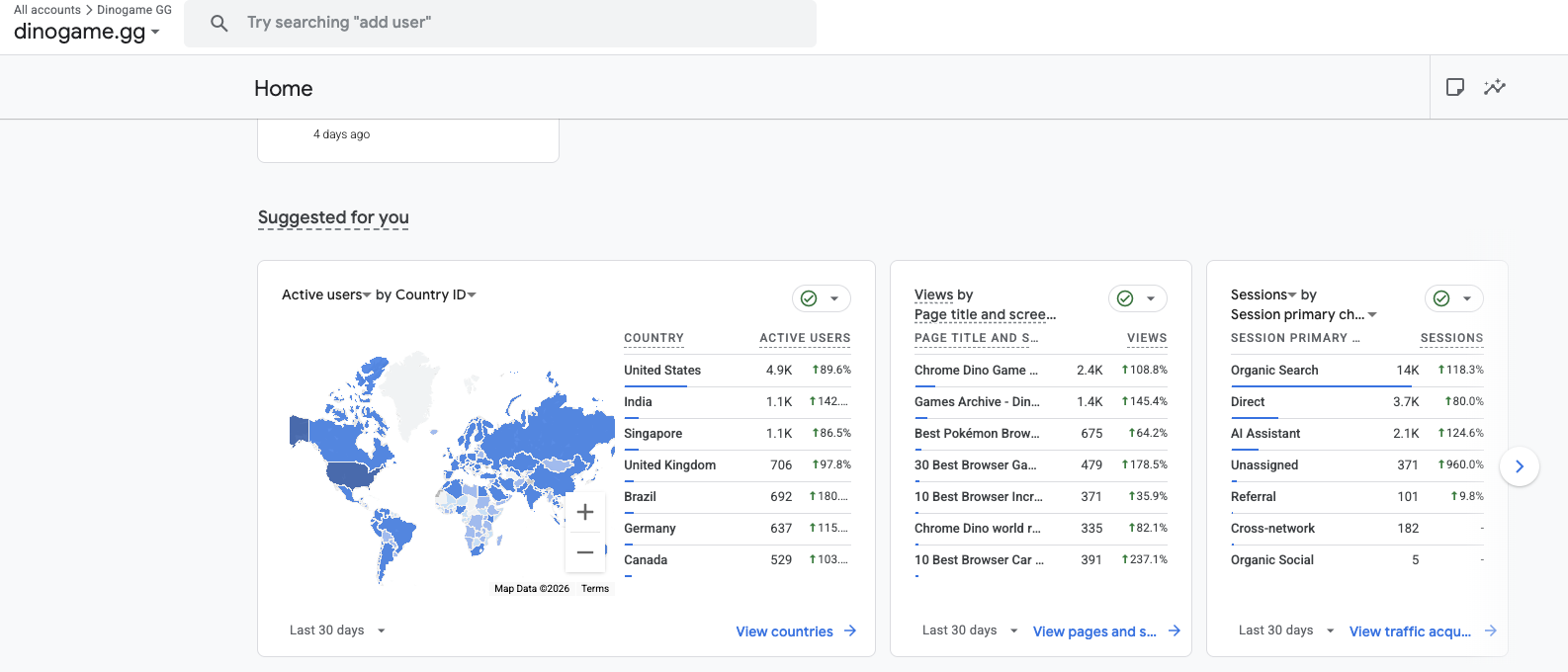
- 18,000 active users (+105%) and 134,000 events (+115%) in the last 30 days
- 14,000 organic search sessions (+118%) and 2,100 sessions from AI assistants (+125%)
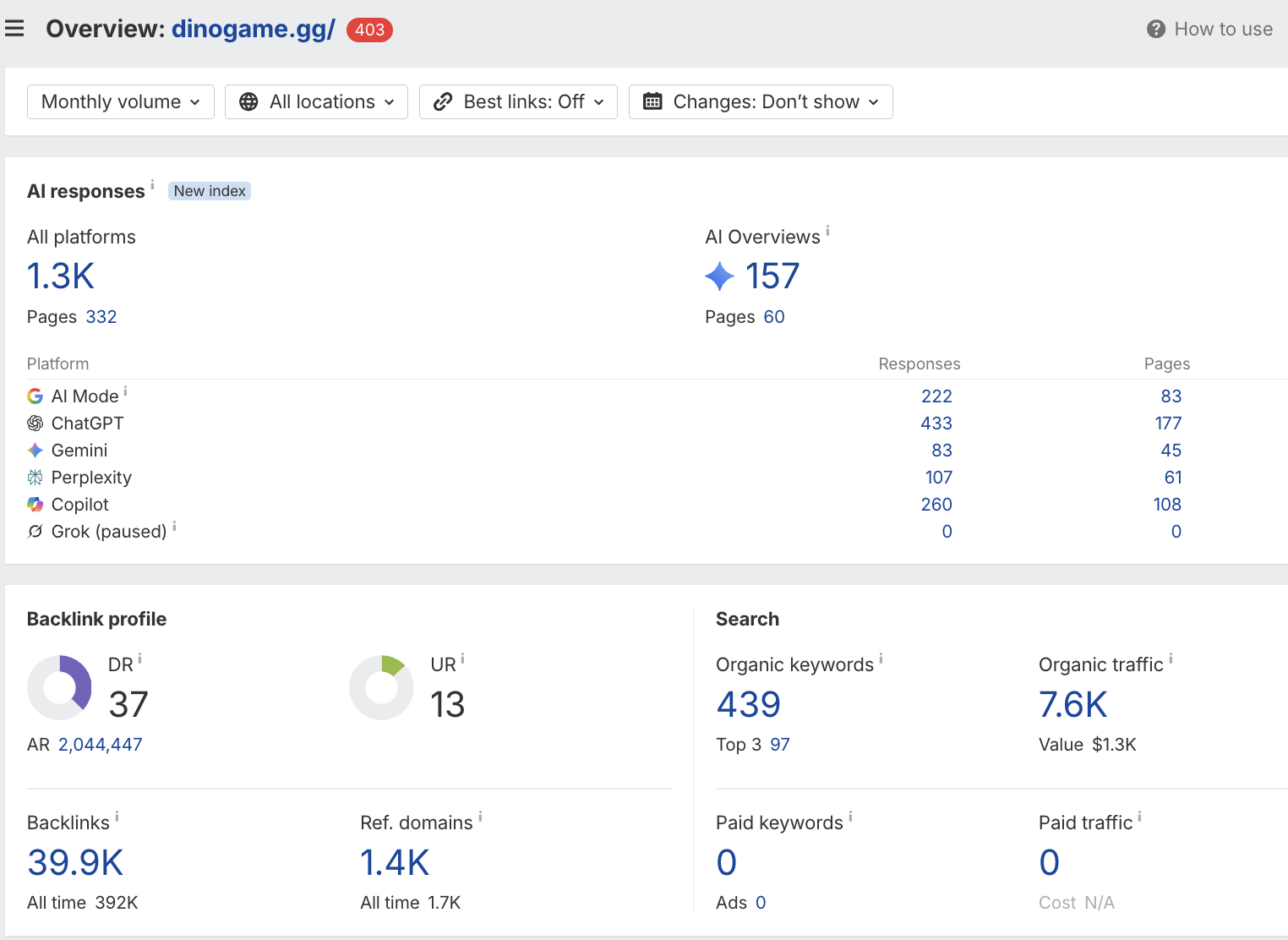
- 7,600 organic visits/mo across 439 keywords (97 ranking top‑3), Domain Rating 37 on 1,400 referring domains
- 1,300+ AI citations across ChatGPT, Copilot, Google AI Mode, Perplexity and Gemini, plus 157 Google AI Overviews
The Challenge
Browser-gaming content is fiercely competitive and largely undifferentiated — thousands of near-identical “best browser games” lists chasing the same head terms. Winning meant two things at once: earning genuine organic rankings for high-volume game queries, and becoming a source the AI answer engines actually cite when users ask “what are the best browser games” or “how do I play the Chrome Dino game”. A pile of thin listicles would have achieved neither.
Our Approach
- Scalable, genuinely useful content — game pages and guides built to actually answer the query, structured so both Google and LLMs can parse and trust them.
- AEO/GEO from the start — clean schema, answer-shaped formatting and factual, citable content, which is why the site earns 1,300+ AI citations rather than pure organic traffic alone.
- Authority building — a referring-domain profile (1,400 domains, DR 37) strong enough to compete for the head terms, not just the long tail.
The Results
In the most recent 30-day window, alongside a compounding organic and AI-citation footprint:
- 18,000 active users (+105%) and 134,000 events (+115%)
- 14,000 organic search sessions (+118%) from a global audience (US, India, Singapore, UK, Brazil)
- 2,100 sessions from AI assistants (+125%) — the AEO/GEO channel
- 439 keywords ranking, 97 in the top 3; 7,600 organic visits/mo
- 1,300+ citations across the AI answer engines (ChatGPT 433, Copilot 260, AI Mode 222, Perplexity 107, Gemini 83)
Why This Worked
Most gaming-content sites optimise for a single Google ranking and stop there. dinogame.gg’s growth came from treating organic search and AI answer engines as one combined objective: content that is genuinely useful and structurally citable ranks in Google and gets quoted by ChatGPT, Copilot and Google’s AI Overviews. That is why a 439-keyword footprint sits alongside 1,300+ AI citations — the same content earning visibility on both surfaces, reinforced by a referring-domain profile strong enough to hold the competitive head terms.
Key Takeaways
- In saturated content niches, being citable by AI engines is a second front that most competitors ignore — and it compounds with organic.
- Scale only works when each page genuinely answers the query; thin listicles win neither rankings nor citations.
- Referring-domain authority is what lets a content site graduate from the long tail to the head terms.
Frequently Asked Questions
Is gaming content too competitive for SEO to work?
It is competitive, but that is exactly why a combined organic + AI-search strategy wins: most competitors publish thin listicles and optimise for Google alone. Genuinely useful, citable content earns rankings and AI citations at once, as the 439 keywords and 1,300+ AI citations here show.
What does “being cited by AI” actually mean for a games site?
When someone asks ChatGPT, Copilot or Google’s AI Overview for the best browser games or how to play the Chrome Dino game, the engine names and links dinogame.gg as a source. That is 1,300+ citations of earned visibility that sits above the classic ten blue links.
Does this approach transfer to other content publishers?
Directly. Any high-volume content vertical — gaming, recipes, tools, how-to — faces the same choice between thin scale and citable depth. The engagement model (useful content, clean schema, AEO/GEO, authority building) is category-agnostic.