Part of our SEO Guides guide →
Rankings up, impressions up, clicks barely moving. If your Search Console looks like that in 2026, your SEO is not broken. Google now answers many searches itself with AI Overviews, so a page-one ranking earns far fewer clicks than it did two years ago.
Last updated: 12 November 2026, checked against Google’s latest Search updates, including the November 2026 core update.
This guide uses real Search Console data from two sites we own, plus the main industry studies, to show what click-through rate (CTR) looks like now. It then covers what that means for how you measure SEO and where to put your effort.
What Our Own Search Console Data Shows
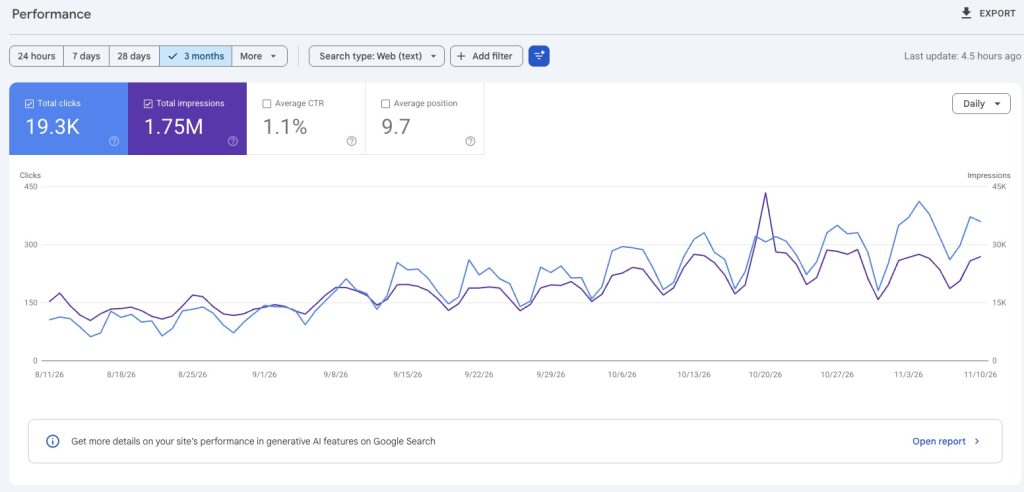
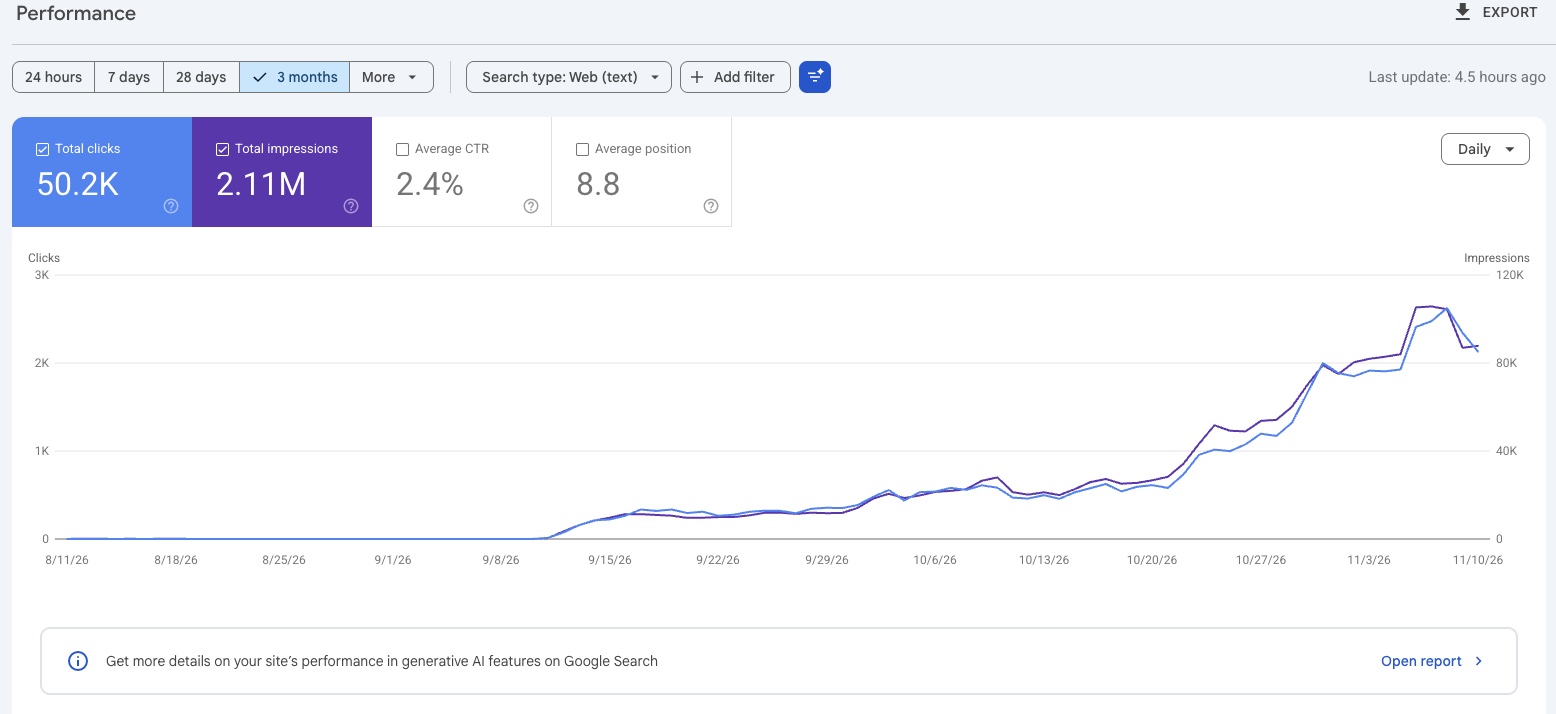
Here are three months of Google Search Console data (web search, 11 August to 10 November 2026) from two sites we own and run: a .com site and a newer .sg site. Both rank on page one on average. Neither gets anywhere near the click-through rates that old SEO benchmarks promise.
| Metric (3 months) | .com site | .sg site |
|---|---|---|
| Total clicks | 19,300 | 50,200 |
| Total impressions | 1.75 million | 2.11 million |
| Average CTR | 1.1% | 2.4% |
| Average position | 9.7 | 8.8 |
Both sites grew strongly. On the .com site, daily clicks rose from roughly 100 to 350–400 and daily impressions from about 15,000 to 27,000. The .sg site went from launch in mid-September to around 2,000–2,600 clicks a day by November. Yet with an average position inside the top 10, CTR sits at just 1.1% and 2.4%.
Across the sites we manage, the pattern holds at the very top too: a number-one ranking now typically earns a 3–7% CTR, not the 25–30% that pre-AI benchmark studies used to quote. Clicks still grow when rankings grow. Each ranking is just worth fewer of them.
Why CTR Falls Even When Rankings Rise
Several changes to Google’s results page stack up against the click:
- AI Overviews answer the question on the page. For informational searches, Google’s AI summary often gives people what they need, so they never scroll to the blue links. Many searches now end without a click to any site.
- Impressions count even when nobody scrolls. Search Console records an impression whenever your result appears on the page the user loads, including links shown inside AI Overviews. More visibility in AI features means more impressions, which pulls average CTR down even as clicks rise.
- More results features compete for attention. Ads, People Also Ask boxes, videos, map packs and shopping units push organic results further down, especially on mobile.
- Average position hides the spread. A 9.7 average blends a handful of top-three rankings with thousands of page-two appearances that get impressions but almost no clicks.
What the Industry Research Says
Our numbers are in line with the large independent studies:
- Pew Research Center (2025): in a study of real browsing by 900 US adults, users clicked a traditional search result in 8% of visits when an AI summary appeared, compared with 15% when it did not. Clicks on the links inside the summary itself happened in only about 1% of visits. (Pew Research Center)
- Ahrefs: across 300,000 keywords, the top-ranking page’s CTR was 34.5% lower when an AI Overview appeared. A later update using December 2025 data put the drop at 58%. (Ahrefs)
- Seer Interactive: organic CTR on informational queries with AI Overviews fell 61% between mid-2024 and September 2025, and paid CTR on the same queries fell 68%. CTR also dropped on queries without AI Overviews. (Seer Interactive)
The studies differ on the exact size of the drop, but they all point the same way: AI Overviews take a large share of the clicks that a top ranking used to deliver.
Latest Google Updates (November 2026)
We check this guide against Google’s official announcements each month. The changes that matter for CTR right now:
- November 2026 core update (started 10 November 2026): Google’s third core update of the year, after March and May. Rankings and traffic can swing while it rolls out, so wait until it completes, then give it at least another week before comparing your Search Console data with a pre-update period. (Google Search Status Dashboard)
- September 2026 spam update (24 September to about 8 October): completed. If your traffic dropped in that window, check it was not spam-related before blaming AI Overviews.
- Generative AI performance reports in Search Console: launched on 3 June 2026 and rolled out to all websites from 31 August 2026. They show how often your pages appear in AI Overviews, AI Mode and Discover’s AI features, but they report impressions only, not clicks. Those appearances are also counted in your main Performance report, which is one reason average CTR keeps falling. (Google Search Central)
Let the Data Speak, Not Google’s Claims
Google’s public line is reassuring. In August 2025, Google’s head of Search wrote that total organic click volume from Search had been “relatively stable” year on year, and that Google was sending “slightly more quality clicks” to websites. (Google) No supporting data was published, and Search Console’s AI reports still show no click figures.
Our advice: set those statements aside and judge by your own numbers. A statement about all of Google Search tells you nothing about your business. Your Search Console does. Ours shows page-one sites earning 1.1–2.4% CTR, and every major independent study shows the clicks per ranking falling. If your numbers say the same, plan around the numbers.
That is how we work. Marketing Agency Singapore is led by SEO specialists, not generalists. Our founder, Eugene Leow, has more than 10 years of hands-on SEO experience, has spoken at the Ahrefs Singapore SEO Summit, and has worked on SEO for brands including Skyscanner. We run and test our own sites, so the benchmarks in this guide come from our own Search Console data, not from vendor claims or recycled statistics.
What a Good CTR Looks Like in 2026
Old CTR curves are no longer a fair yardstick. Use these working ranges instead:
- Position 1: about 3–7% for most non-branded searches, lower for pure “what is” questions that AI Overviews answer fully.
- Site-wide average on page one: 1–3%, as our two sites show at average positions of 8.8 and 9.7.
- Branded searches: still much higher, because people searching your name want your site.
If you are planning traffic from rankings, our keyword CTR and traffic estimator helps you sanity-check forecasts, and our guide to click-through rate covers the basics of how CTR is calculated.
How to Measure SEO When Clicks Are Scarce
When fewer searches produce a click, judging SEO on clicks alone undervalues it. Track these instead:
- Impressions and average position: these show whether Google is putting you in front of more searchers for the terms that matter.
- AI visibility: whether AI Overviews, ChatGPT, Gemini and Perplexity mention or cite your brand. Search Console now links to a report on your site’s performance in generative AI features, and our free AI Visibility Checker shows where your brand appears in AI answers.
- Branded search growth: people who see you in an AI answer often search your name later, so a rise in branded impressions is a sign that visibility is working.
- Leads and revenue per click: the clicks that remain tend to come from people further along, so track enquiries, WhatsApp chats, calls and sales from organic search, not just sessions.
Our Google Search Console tutorial shows how to filter these reports by page, query and country.
What to Do About It
You cannot switch AI Overviews off, but you can make sure your brand is part of the answer and that the clicks you still win convert:
- Write to be cited: answer the question directly in the first lines of each section, use clear headings, and add FAQ sections that match how people phrase questions. Our generative engine optimisation guide covers this in detail.
- Prioritise commercial and local searches: queries like “agency near me”, “price” and “best X in Singapore” trigger fewer full answers and send more buying-ready clicks than broad “what is” questions.
- Build your entity: consistent business details, author profiles, reviews and mentions on trusted sites make it more likely AI systems trust and name your brand.
- Make titles earn the click: with fewer chances to win the click, titles and descriptions should promise something the AI summary does not give, such as prices, tools, templates or local detail.
- Convert every visit: fast pages, clear calls to action and WhatsApp or form options matter more when each click is scarcer.
If you want help getting your brand cited in AI answers as well as ranked, our AI SEO agency and answer engine optimisation teams work on both, and our SEO agency page explains how we measure results.
Frequently Asked Questions
Why are my Google clicks low when my rankings are good?
Mainly because AI Overviews and other results features answer many searches on the results page, so fewer people click any website. Search Console also counts impressions whenever your result appears on the page, including inside AI features, which lowers average CTR even while clicks grow.
What is a good organic CTR in 2026?
For most non-branded searches, a number-one ranking now earns about 3–7% CTR, and a site-wide average of 1–3% is normal for a site ranking on page one. Branded searches still earn much higher CTRs.
Do AI Overviews reduce website traffic?
They reduce clicks per ranking. Ahrefs found the top result’s CTR was 34.5% lower when an AI Overview appeared, later updated to 58%, and Pew found users clicked a result in 8% of visits with an AI summary versus 15% without. Total traffic can still grow if your visibility grows faster, as our own sites show.
Does Search Console count AI Overview appearances?
Yes. Appearances and clicks from Google’s AI features are included in Search Console’s web search performance data, and Search Console now links to a separate report on your site’s performance in generative AI features.
Did the November 2026 core update cause my CTR drop?
Possibly in part, but not alone. The November 2026 core update started on 10 November 2026 and can move rankings while it rolls out. A steady CTR decline that began before then, while impressions grew, is the AI Overviews pattern. Compare data from at least a week after the rollout completes.
Is SEO still worth it if CTR keeps falling?
Yes, but measure it differently. Rankings now drive brand visibility in AI answers as well as clicks, and the clicks that remain tend to convert better. Judge SEO on impressions, AI visibility, branded search and leads, not clicks alone.