Part of our APAC Platforms & Market Entry guide →
Table of Contents
- Why Export Marketing Is Non-Negotiable for Singapore Manufacturers
- Prioritising ASEAN and Global Export Markets
- Building the Export Value Proposition
- Digital Channels for Export Lead Generation
- Trade Missions and In-Market Presence
- Grants and Enterprise Singapore Support
- Measurement Across Multiple Markets
- Frequently Asked Questions
Why Export Marketing Is Non-Negotiable for Singapore Manufacturers
A serious manufacturing export marketing ASEAN strategy is not optional for Singapore producers — it is the commercial logic of the country itself. Singapore’s domestic market is 5.9 million people; the ASEAN market is 680 million and growing 4-5% annually. Any Singapore manufacturer serving only the local market is working with 0.9% of their reachable demand while carrying Singapore’s cost base. Export marketing is how you solve that asymmetry.
The EDB, Enterprise Singapore and the Singapore Manufacturing Federation (SMF) have structured the entire national manufacturing support architecture around exports. Under Manufacturing 2030, the 50% value-add expansion target is explicitly anchored on regional and global demand, not domestic consumption. Free trade agreements — the ASEAN FTA, RCEP, CPTPP, the EU-Singapore FTA, the UK-Singapore Digital Economy Agreement — give Singapore manufacturers preferential access that, properly marketed, is a commercial weapon.
Export marketing sits at the centre of your broader digital marketing for manufacturing programme. It draws from the same content library and channel architecture, but the audience, creative and measurement are reshaped for cross-border buying committees who rarely set foot in Singapore but whose decisions shape 60-90% of your revenue.
Prioritising ASEAN and Global Export Markets
Trying to market across every ASEAN and global corridor simultaneously is how manufacturing marketing budgets are wasted. Prioritise ruthlessly using a three-factor framework: demand density, competitive accessibility and fit with your specific capability mix.
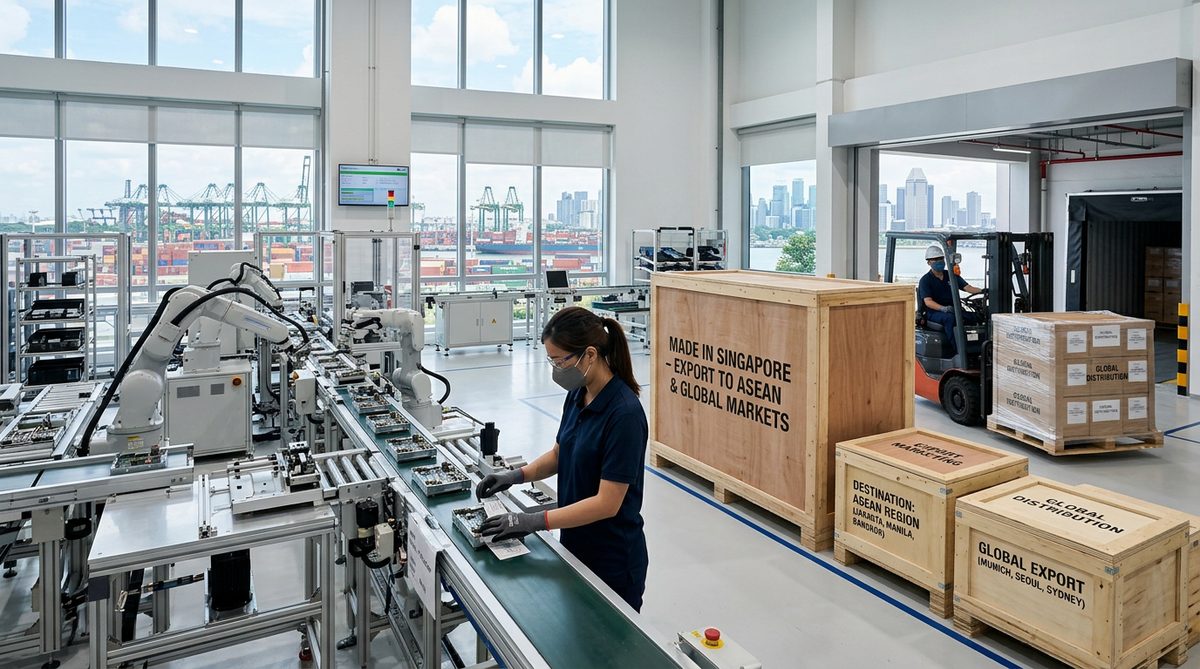
Tier-1 ASEAN markets for most Singapore manufacturers are Malaysia, Indonesia, Thailand and Vietnam. Malaysia’s proximity and industrial base make it a natural extension — Johor’s Iskandar corridor, Penang’s E&E cluster and the Klang Valley automotive belt collectively buy heavily from Singapore contract manufacturers. Vietnam’s electronics and furniture exports into the US and EU have created a procurement middle class that buys premium Singapore-sourced precision components. Thailand’s automotive and medical device clusters similarly absorb high-specification Singapore output.
Tier-2 regional priorities typically include the Philippines (BPO-adjacent electronics), Cambodia and Myanmar for lower-value assembly, and Brunei for energy-sector procurement. Tier-3 global corridors — Japan, South Korea, Taiwan, Greater China, US, Germany — require far higher marketing investment per deal but carry higher average contract values. Singapore manufacturers in semiconductors, aerospace and medtech often skip Tier-2 and go directly Tier-1 ASEAN plus Tier-3 global.
Build a prioritisation matrix scoring each market on demand size, average deal value, logistics cost, regulatory complexity, FTA coverage, language and cultural fit, and installed base of existing customers. Fund only the top three to five markets properly. Underfunding eight markets produces nothing; fully funding four produces pipeline.
Building the Export Value Proposition
A Singapore export value proposition has to answer a question that every overseas buyer asks silently: “Why pay Singapore prices instead of sourcing locally?” The answer is never price. It is risk, quality, IP protection, regulatory compliance and continuity of supply.
Lead with the geopolitical and regulatory story. Singapore’s AAA sovereign rating, strong IP regime, political neutrality between US-China tensions, and membership in RCEP, CPTPP and 27 FTAs make it the single safest contract manufacturing base in Asia for Western and Japanese OEMs pursuing China+1 and friendshoring strategies. This is not abstract positioning — it is a direct response to board-level de-risking mandates at every Tier-1 OEM.
Layer on quality and certification. AS9100D for aerospace, ISO 13485 for medical device, IATF 16949 for automotive, ISO 14001 for environmental, RBA for electronics, ISO 27001 for cyber. Add Industry 4.0 credentials including SIRI band assessment, and sustainability data (Scope 1-2-3 emissions, water recycling, energy per unit produced). Buyers under CSRD, SEC climate rules and their own ESG mandates filter suppliers on these numbers.
Close with capability and case studies. Named customers where NDAs allow, anonymised outcomes where they do not (“a Fortune 500 European medtech OEM reduced supplier lead time from 14 to 6 weeks”). Your brand strategy should weave all three layers into a coherent export narrative, not a list of disconnected claims.
Digital Channels for Export Lead Generation
Digital channels carry export marketing between trade missions and physical visits. Four channels consistently generate pipeline for Singapore manufacturing exporters.
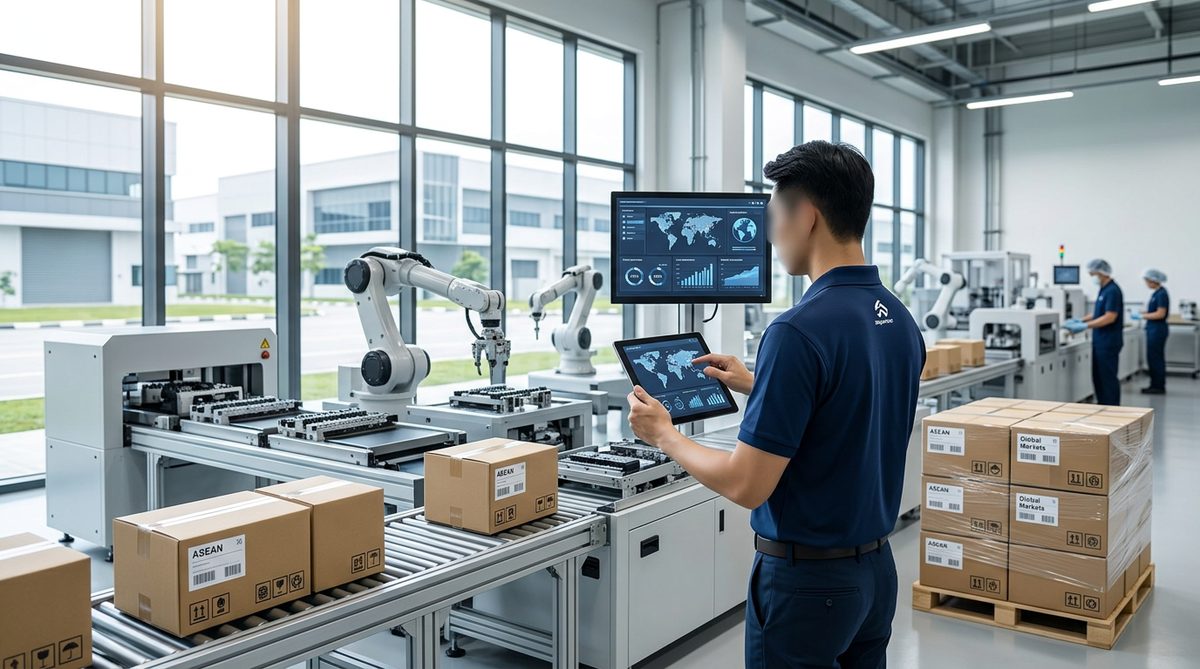
LinkedIn is the dominant B2B export channel across ASEAN and globally, with exceptions for Greater China (WeChat, Baidu, LinkedIn China behaviour) and Japan (where LinkedIn penetration is lower and trade association and email channels matter more). Run always-on ABM campaigns into named target accounts per priority market with localised creative. Malaysian and Indonesian campaigns perform better in English; Thai and Vietnamese campaigns benefit from localised headline variants even when the landing page remains English.
Google Search captures bottom-of-funnel export intent. Terms like “Singapore precision machining supplier”, “ISO 13485 contract manufacturer Asia”, and capability plus country combinations (“PCB assembly Singapore to Thailand”) drive high-intent leads. Geographic campaign splits by target country are essential — do not lump all ASEAN queries into one campaign.
SEO-driven organic discovery compounds over 12-24 months. Cornerstone content on your capabilities, certifications and case studies, paired with an internal linking architecture that surfaces country-specific landing pages, builds durable pipeline at zero marginal cost. Reference our manufacturing-specific SEO playbook for technical structure.
Email and marketing automation handle nurture across 90-180 day manufacturing buying cycles. Trade show leads, content downloads and MQLs from LinkedIn feed into segmented nurture tracks per market and per capability. A well-configured marketing automation stack using HubSpot, Marketo, Zoho or Active Campaign lifts conversion from MQL to SQL by 30-60% in our experience.
Trade Missions and In-Market Presence
Digital cannot carry export marketing alone. Industrial B2B buying still runs on face-to-face trust, plant visits and trade shows. Singapore manufacturers who under-invest in physical presence lose deals to competitors who show up.
Enterprise Singapore, SMF and the Singapore Business Federation run regular outbound trade missions to Indonesia, Vietnam, Thailand, the Philippines, Japan, Korea, Germany and the US. These provide structured access to buyers, government stakeholders and industry associations at a fraction of the cost of self-organised trips. Factor them into your annual marketing calendar 12 months ahead.
Key trade shows worth prioritising: ITAP (Industrial Transformation ASIA-PACIFIC, Singapore), Metalex Thailand, Vietnam Manufacturing Expo, Manufacturing Indonesia, Automechanika Shanghai, Hannover Messe (Germany), IMTS Chicago, Medica Düsseldorf, and sector-specific shows in semiconductors (Semicon) and aerospace (Singapore Airshow, Farnborough). Each show should carry a full pre-event, on-event and post-event campaign architecture rather than being treated as a standalone activity.
In-market representation — whether a hired BD rep in Jakarta or Ho Chi Minh City, a channel partner in Bangkok, or a full sales subsidiary in Kuala Lumpur — is often the single highest-ROI export marketing investment. A local rep closes the cultural and language gap that no amount of digital marketing can close.
Grants and Enterprise Singapore Support
Singapore has the most generous export support architecture in the region. Manufacturers who do not use it are effectively self-taxing.
The Market Readiness Assistance (MRA) Grant, administered by Enterprise Singapore, co-funds up to 50% of qualifying overseas market set-up, business matching and promotion costs per new market, within prevailing programme caps. This covers overseas marketing campaigns, in-market business development, participation in approved trade fairs and market advisory costs. Every Singapore manufacturer with exportable output should be running at least one active MRA application.
The EDG covers deeper transformation spend across innovation, productivity and market access, co-funding up to 50% for SMEs (and up to 70% for specific strategic initiatives under time-limited enhancements). Multi-market export expansion regularly qualifies. The PSG Pre-Approved list subsidises up to 50% (within caps) on CRM, marketing automation, e-commerce and MES platforms — all essential infrastructure for scaled export marketing.
Beyond grants, Enterprise Singapore’s Global Innovation Alliance nodes, IE Singapore overseas centres, and sector-specific initiatives through EDB, A*STAR, IMDA and Singapore Manufacturing Federation provide introductions, market intelligence and trade credit facilitation. Build these into your export GTM plan from day one, not as an afterthought.
Measurement Across Multiple Markets
Measurement discipline is the single biggest determinant of export marketing ROI. Run four cross-market reports monthly.

Pipeline by source market: MQLs, SQLs, opportunities and closed-won revenue split by target country. Drop markets that fail to generate pipeline after 9-12 months of funded effort; double down on markets that over-index.
Channel ROI per market: LinkedIn, Google, SEO, trade shows, partners, direct. Some markets (Indonesia, Vietnam) respond more strongly to trade shows and partners; others (US, Germany) respond more strongly to digital. Allocate next-quarter budget accordingly.
Buying committee engagement scoring: track how many stakeholders from each target account have engaged with content and at what depth. A target account with five engaged stakeholders across three content assets is materially closer to a quote than one with one engaged contact.
Deal velocity and win rate by market: average days from first touch to closed-won, and win rate on contested deals. These tell you where cultural, regulatory or competitive friction is highest and where to invest in localisation, certification or partner infrastructure.
Frequently Asked Questions
Which ASEAN markets should a Singapore manufacturer prioritise first?
For most verticals: Malaysia first (proximity, industrial depth), then Vietnam and Thailand (scale and growth), then Indonesia (size but more complex). Aerospace, medtech and semiconductor manufacturers often layer in Japan, Korea and Greater China ahead of Indonesia and the Philippines. The right sequence depends on your specific capability, certifications and existing customer base.
How much should a Singapore manufacturer budget for export marketing?
Credible multi-market export programmes start at S$150,000-300,000 per year for two-to-three target markets, scaling to S$500,000-1.5M+ for full ASEAN plus one or two global corridors. MRA, EDG and PSG grants offset 30-50% of qualifying spend. Underfunded export programmes — below S$100,000 annually — almost never generate measurable pipeline.
What is the MRA Grant and how do manufacturers use it?
The Market Readiness Assistance Grant from Enterprise Singapore co-funds up to 50% of qualifying overseas market set-up, business matching and promotion costs per new market, within prevailing programme caps. It covers in-market BD, trade show participation, overseas marketing campaigns and advisory costs. Apply before committing spend — retrospective funding is not available.
Do I need LinkedIn for export marketing or can I rely on trade shows alone?
Trade shows alone almost never work in 2026. Buyers research digitally before, during and after any physical interaction. LinkedIn is the default channel for warming buying committees, booking trade show meetings and nurturing post-show conversations across ASEAN and Western markets. Japan and Greater China require complementary channels alongside LinkedIn.
How do I handle language localisation for ASEAN export marketing?
English works for decision-level audiences across Singapore, Malaysia, the Philippines and increasingly Vietnam. Thai, Bahasa Indonesia and Vietnamese translation lifts engagement on creative assets for mid-tier and operational audiences. Full website localisation is typically over-investment until you have repeatable pipeline from the market; localised landing pages and social creative are the right starting point.
What role do Singapore’s FTAs play in export marketing?
Significant. RCEP, CPTPP, the EU-Singapore FTA, the UK-Singapore Digital Economy Agreement and bilateral FTAs with Korea, India, China and others give Singapore-made goods preferential tariff access that competitors in non-FTA jurisdictions cannot match. Surface this explicitly in your capability deck, RFQ responses and marketing content — procurement teams factor duty savings directly into supplier selection.
How long before export marketing generates closed revenue?
Expect 9-15 months to first closed-won deal in a new market, and 18-30 months to mature pipeline contribution. Manufacturing export buying cycles of 90-180 days plus the ramp of brand awareness, trust and channel infrastructure means export marketing is a 24-36 month investment horizon, not a 90-day campaign.
Should I use local distributors or sell direct in export markets?
It depends on deal size, complexity and after-sales support requirements. High-value, specification-intensive contract manufacturing typically sells direct with in-market BD support. Commoditised components, spare parts and lower-value SKUs often sell better through distributor networks. Many Singapore manufacturers run hybrid models — direct for strategic accounts, distributor for long-tail — which maximises coverage without cannibalising margin.