
Updated November 2026 Logistics & Freight CPC in Singapore: November 2026 data
Logistics & Freight keywords average S$1.47–S$8.25 per click at the top of Google (#14 of 22 industries). If you bid to win every auction, Google forecasts S$7.82 average CPC for December 2026.
Priciest services: Warehousing & 3PL S$15.36, Freight forwarding (air & sea) S$12.88, Logistics searches (general) S$9.71.
- “courier service singapore”: S$0.93–S$4.83 (2,400 searches/mo)
- “logistics company singapore”: S$2.57–S$12.12 (1,300 searches/mo)
- “warehouse singapore”: S$1.15–S$26.06 (1,300 searches/mo)
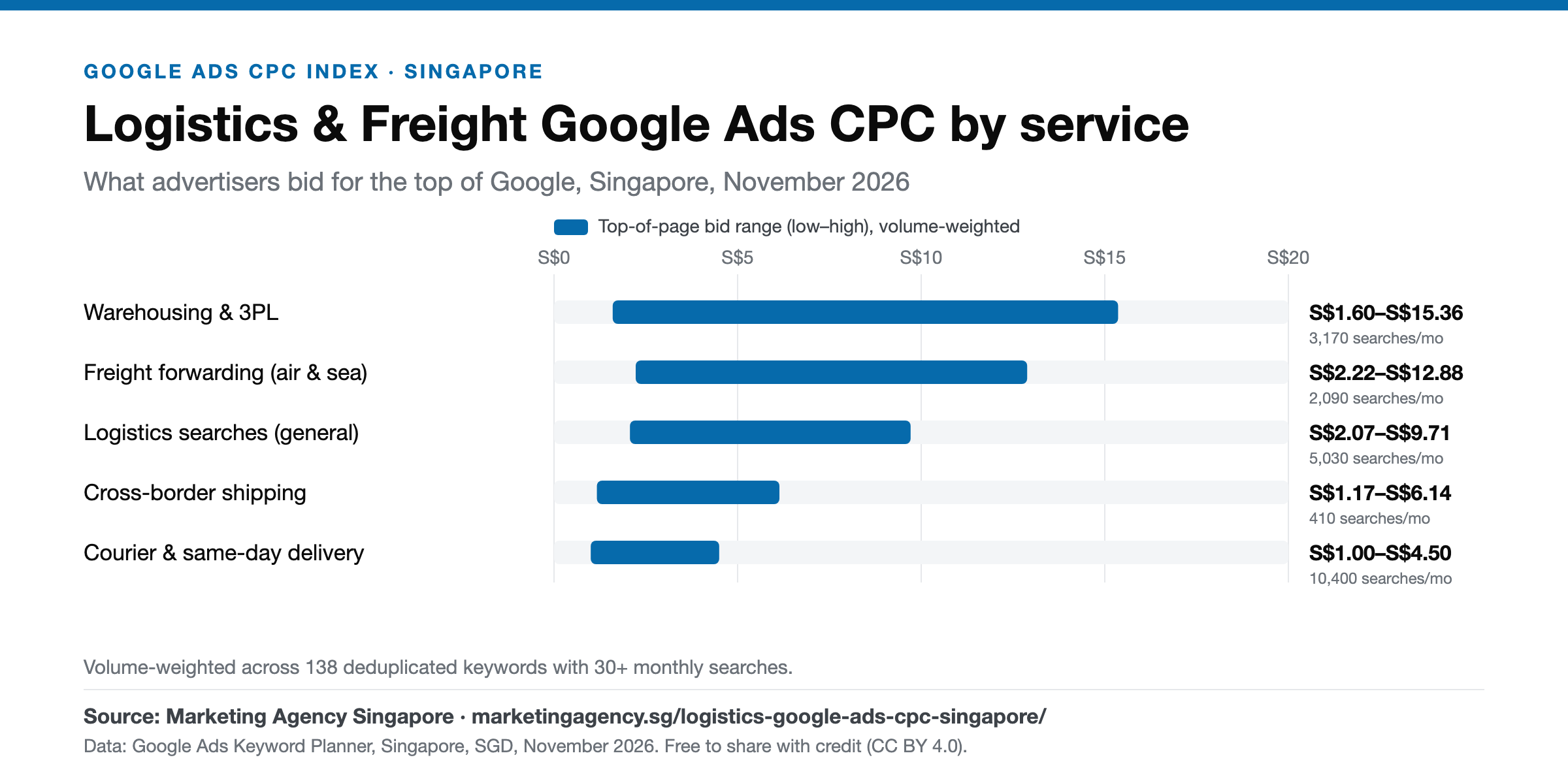
Source: Marketing Agency Singapore’s Singapore Google Ads CPC Index, built from Google Ads API data and updated monthly. Full breakdown, history and forecast →
Digital Marketing for Logistics in Singapore
Digital marketing for logistics companies is a B2B procurement game — long buying cycles, multi-stakeholder decisions, and reputational weight that gets built over years of trade press visibility and word-of-mouth. Whether you’re a 3PL, a freight forwarder, a cross-border specialist or a last-mile fulfilment operator, we help you show up credibly where shipping, supply chain and procurement leaders actually look.
Why Logistics Companies Need a B2B-Native Partner
Procurement Buyers, Not Browsers
Shipping, supply chain and fulfilment buyers run RFPs, shortlists and tender processes — not impulse purchases. We build content, SEO and LinkedIn programmes around the specific procurement journey, not generic lead-gen tactics copied from B2C.
ASEAN & Cross-Border Focus
Singapore’s logistics industry runs on ASEAN cross-border flows — Malaysia, Indonesia, Vietnam, Thailand. We build campaigns that speak to regional shippers and multinational procurement leads sitting in Singapore HQs, with content pitched at regional trade realities rather than Singapore-only scenarios.
Trade Press & LTA Credibility
LTA licensing, proper regulatory standing, and visibility in trade press like The Loadstar, Lloyd’s List and Logistics SG build trust faster than any ad. We weave PR, contributed thought leadership and credibility signals into digital campaigns so buyers arrive on your site already half-convinced.
Our Process for Logistics Digital Marketing
Service & Buyer Audit
We map your service lines — ocean, air, road, 3PL warehousing, fulfilment, last-mile — against target buyer segments, typical deal sizes and sales cycle length. The goal: priority routes to market rather than trying to rank for every logistics term.
Account-Aware Strategy
We build SEO, content and LinkedIn programmes that target named accounts and verticals — e-commerce brands needing 3PL, manufacturers needing freight, importers needing customs support — rather than undifferentiated traffic.
Credibility-Led Execution
We publish long-form content, client-case stories, route-specific guides and LinkedIn thought leadership for your leaders — plus targeted ads and retargeting that reach procurement buyers during active RFP windows.
Pipeline & Deal-Size Reporting
We report qualified enquiries, pipeline value, sales-accepted opportunities and closed-won revenue — tied back to channel. Logistics buying cycles can run 3-9 months, so we report both leading indicators and actual deals.
Further Reading
- Government Grants Logistics Supply Chain Businesses Singapore
- E-commerce Fulfilment in Singapore: Shipping, Warehousing and Last-Mile Delivery
- Logistics Market Entry Singapore
- Marketing For Courier Services
- Seo For Logistics
- Seo For Shipping
Frequently Asked Questions
Because the buyer is a procurement, supply chain or operations lead running a formal selection process, not a consumer. Our B2B marketing team builds programmes aligned to RFPs, vendor shortlisting and multi-stakeholder buying — which means long-form content, LinkedIn and credibility signals outperform generic paid social.
SEO for service-line and route-specific queries, LinkedIn for procurement and supply chain buyers, contributed trade press, targeted ABM programmes and email for mid-funnel nurture. Broad Meta and TikTok campaigns rarely reach the real decision-makers in this industry.
We build localised content for priority lanes — Singapore-Malaysia, Singapore-Indonesia, intra-ASEAN air freight — and target multinational procurement buyers based in Singapore whose decisions affect regional spend. We don’t pretend one campaign fits every ASEAN market.
A central one. Route guides, customs and HS-code explainers, peak-season readiness pieces, and leadership perspectives on supply chain shifts all earn trust from procurement buyers long before they’re ready to talk. Our content marketing programmes make that credibility compound.
It affects credibility claims. Any service that requires LTA licensing should reference proper licence status accurately — not embellished or implied. We write licensing language conservatively to match your actual regulatory standing, which is a trust asset rather than a throwaway footer line.
Typical RFP-driven logistics cycles run 3-9 months, sometimes longer for strategic 3PL contracts. We structure content, retargeting and email nurture for that horizon, and track leading indicators (engaged accounts, RFPs invited) alongside closed revenue so the programme’s value is visible throughout the cycle.
Smaller forwarders and fulfilment operators usually start from S$3,000-S$6,000 a month. Mid-size 3PLs and regional freight players tend to invest S$8,000-S$25,000 depending on the number of service lines and geographies. Trade press contributions and specialised content sit alongside as campaign-based investments.
We track engaged target accounts, RFP invitations received, sales-qualified opportunities, pipeline value and closed-won revenue — not just form fills. Leading indicators are reported monthly, revenue impact quarterly. The outcome we aim for is a bigger, better-qualified pipeline into your sales team.
Case studies with measurable results, service and sector pages with specific capabilities, guides on customs or regulatory changes, and practical content for procurement teams, such as how to compare 3PL quotes. These build credibility and capture searches made early in the buying process.
LinkedIn is often effective because you can target by job function, industry and company size, reaching supply-chain and procurement decision-makers directly. It works best supporting account-based campaigns and thought-leadership content rather than as a direct lead-generation channel on its own.
Google Ads can work for logistics firms when campaigns target specific service and route searches rather than broad terms. In November 2026, logistics and freight keywords in Singapore averaged S$1.47 to S$8.25 per click, with warehousing and 3PL terms around S$15.36 and freight forwarding around S$12.88. Because sales cycles run 3 to 9 months, success should be judged on qualified enquiries and pipeline, not clicks alone.
A shipping and logistics communications agency helps freight forwarders, 3PLs, couriers and shipping firms build credibility with procurement and supply chain buyers. Typical work includes trade press relations, contributed thought leadership, LinkedIn programmes for leaders, case studies, website and SEO content for each service line, and campaigns timed around RFP windows. In Singapore, a strong agency also understands ASEAN cross-border lanes and writes licensing claims accurately.
SEO for a logistics company in Singapore usually shows early ranking movement within three to six months, with meaningful enquiry growth often taking six to twelve months for competitive terms such as freight forwarding or warehousing. Niche route, sector and capability pages tend to rank faster than broad head terms. Results depend on site authority, the number of service pages and the quality of trade press links.
Yes, the EDGE Grant can support eligible logistics firms with the kinds of activities that PSG, EDG and MRA used to cover, which are now part of the EDGE Grant. These include branding and marketing strategy projects, digital solutions and overseas promotion for ASEAN expansion. Support is up to 50% for SMEs, or 70% for internationalisation, within a S$100,000 annual cap. Approval must be secured before work starts.