
Digital Marketing for Fitness & Gyms in Singapore
Digital marketing for gyms in Singapore is fundamentally a proximity game. Most members join the best-reviewed gym within a 10-15 minute commute — which means the Google Map-pack, local SEO and community-led content do more for your intake than any billboard ever will. We help boutique studios, functional gyms, yoga and pilates spaces, and full-service fitness chains fill classes, lift member retention and grow LTV.
Updated November 2026 Fitness & Gyms CPC in Singapore: November 2026 data
Fitness & Gyms keywords average S$0.91–S$5.26 per click at the top of Google (#17 of 22 industries). If you bid to win every auction, Google forecasts S$14.16 average CPC for December 2026, above the typical range because it assumes you outbid competitors for the top spot.
Priciest services: Boxing & martial arts S$10.53, Personal training S$7.64, Classes (spin, HIIT, CrossFit) S$5.38.
- “personal trainer singapore”: S$2.13–S$7.50 (9,900 searches/mo)
- “pilates singapore”: S$1.05–S$3.06 (4,400 searches/mo)
- “gym singapore”: S$1.25–S$5.62 (3,600 searches/mo)
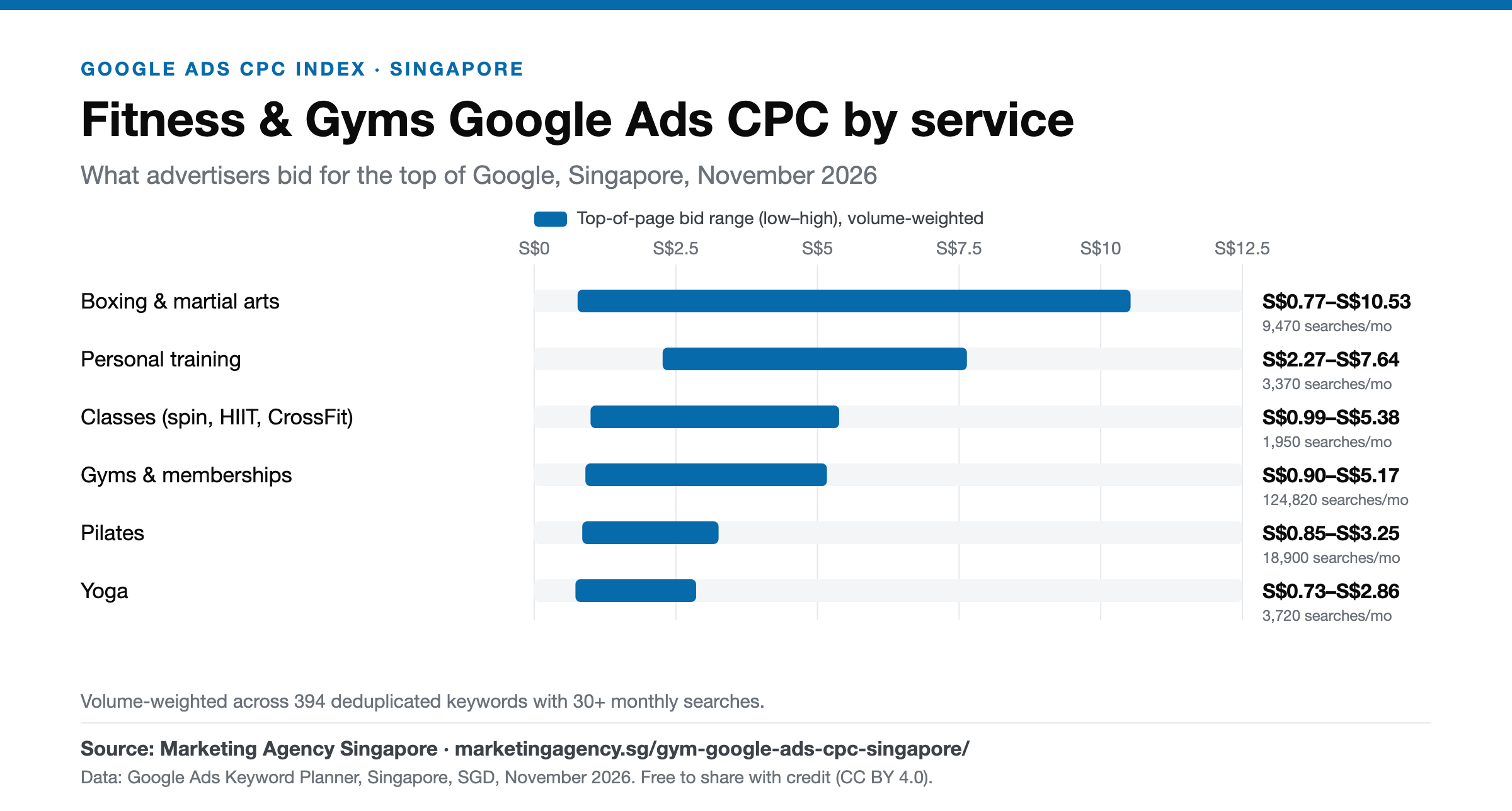
Source: Marketing Agency Singapore’s Singapore Google Ads CPC Index, built from Google Ads API data and updated monthly. Full breakdown, history and forecast →
Why Digital Marketing for Gyms Is a Specialist Category
Map-Pack & Proximity SEO
“Gyms near me” and suburb-level searches dominate fitness intent in Singapore. Ranking in the Google Map-pack for Tanjong Pagar, Novena, Paya Lebar or Jurong East is often worth more than any national campaign. Our local SEO work targets exactly those proximity clusters.
Retention, Not Just Acquisition
Most gyms can sign members; fewer keep them past month three. We design content, email and community programmes that reduce churn — goal-setting sequences, class milestones, challenge campaigns — so member LTV, not just sign-ups, actually grows.
Booking Tech & Aggregator Dynamics
ClassPass, Mindbody, Glofox and Singapore-specific aggregators shape how members discover and book classes. We optimise your presence across these platforms, manage paid aggregator visibility where it makes sense, and defend direct-member share so platform commissions don’t erode your margin.
Our Process for Fitness & Gym Marketing
Local & Member Audit
We benchmark your Google Business Profile, reviews, local rankings, booking tech setup and member retention curve against comparable studios in your catchment — identifying the fastest wins for lead volume and retention.
Intake & Retention Strategy
We plan campaigns around New Year, post-Lunar New Year, pre-summer and Q4 reset cycles — plus “always-on” community content that keeps existing members engaged between intakes.
Multi-Channel Execution
We run local SEO, Google Ads for “gyms near” queries, geo-targeted Meta and TikTok creative featuring real coaches and members, and email nurture sequences for free-trial and first-class sign-ups.
Members & LTV Reporting
We report cost per trial, trial-to-member conversion, cost per paying member, 90-day retention, and monthly member LTV trajectory — so growth decisions are made on business health, not top-of-funnel leads alone.
Further Reading
- Gym Fitness Marketing Singapore
- Marketing to Fitness Enthusiasts in Singapore: Gym, Run and Wellness Audiences
- Fitness Wellness Marketing Calendar Singapore
- Google Ads For Fitness
- Google Ads For Gyms
- Marketing For Pilates Studios
Frequently Asked Questions
Because fitness is a proximity purchase — most members choose within a 10-15 minute travel radius. Our local SEO programme targets map-pack rankings, Google Business Profile optimisation, and reviews — which consistently deliver a better cost per member than broad national campaigns.
Both — with a defined split. Aggregators help fill off-peak classes and introduce new members; direct sign-ups preserve margin and the member relationship. We typically recommend a target share for direct members and manage aggregator visibility around class capacity.
Through onboarding sequences that set early goals, milestone celebration campaigns, in-app or email challenge series, and community content that features real members. Retention marketing is often the single highest-ROI spend for an established gym, yet it’s the most under-invested.
Coach-led short-form video, real-member stories, class snippets, mobility and recovery tips, and behind-the-scenes culture content. We run our social media marketing around a weekly shoot cadence so the feed stays fresh without draining your coaches.
At least 4-6 weeks ahead of the intake window. New Year, post-Lunar New Year, back-to-school (August/September) and pre-summer resolutions all deserve distinct campaigns rather than a single generic launch. Our dedicated fitness marketing team plans the full calendar.
Single-studio independents usually start from S$1,500-S$3,500 a month across local SEO, paid social and email. Multi-outlet chains typically invest S$6,000-S$20,000 depending on pipeline goals. Ads, creative production and retention tooling are costed separately so you can see where each dollar goes.
Paid social and Google Ads can start delivering trial bookings within the first two weeks. Local SEO typically shows meaningful movement in 2-3 months. Retention gains compound over 4-6 months. We map a realistic trajectory upfront so nobody over-promises the first-month numbers.
We report cost per trial, trial-to-paying conversion, cost per paying member, 90-day retention, and monthly member LTV trend. Class utilisation and member-generated content reach sit alongside those as secondary indicators. Growth decisions always come back to healthy member economics.
Both can work. Free trials attract more sign-ups but more no-shows, while a small paid trial tends to attract more committed prospects. Many studios test both and keep whichever produces more paying members per dollar of ad spend.
Very. Prospective members compare nearby gyms on Google Maps, and rating, review count and recent responses strongly influence which ones they visit. Asking satisfied members for reviews at natural milestones, such as completing a programme, builds this steadily.
Most Singapore gyms combine a booking and membership system such as Mindbody or Glofox with a CRM or email tool for nurture sequences, plus WhatsApp for trial follow-ups. GA4 tracks key events such as trial bookings, while Google Business Profile handles reviews and map visibility. Larger operators may automate reminders through the WhatsApp Business Platform, which is billed per message. What matters most is connecting bookings, leads and ad data so cost per paying member can be measured.
A good fitness marketing agency reports on cost per paying member and retention, not just leads or likes. Ask for gym or studio case studies, how it approaches local SEO for map-pack rankings, and whether it produces coach-led video content. Confirm that ad accounts, pixels and member data stay in the gym’s name. For paid ads, management fees in Singapore are typically about 20% of ad spend or a fixed fee from S$600 a month.
Fitness and gym keywords in Singapore averaged about S$0.91 to S$5.26 per click at the top of Google in November 2026, with boxing and martial arts around S$10.53 and personal training around S$7.64. Total spend depends on the size of the catchment and how many classes need filling. Agency management is usually about 20% of ad spend or a fixed fee from S$600 a month, on top of the media budget.
Yes, but marketing messages to Singapore numbers must follow the PDPA’s Do Not Call rules. Unless a lead has given clear, recorded consent, the number must first be checked against the DNC Registry, and check results are valid for 21 days. Trial sign-up forms should include an opt-in for marketing messages. Breaches can lead to fines of up to S$1 million, or 10% of Singapore turnover for organisations with turnover above S$10 million.