
Digital Marketing for Travel and Tourism in Singapore
Travel buying is back to being research-heavy, booking-decisive and seasonality-driven. Effective marketing for travel and tourism in Singapore means being visible early in the inspiration phase, converting during narrow booking windows around school holidays and MICE calendars, and staying within STB accreditation requirements and NATAS (National Association of Travel Agents Singapore) guidelines where you are a member. Agencies and operators that treat digital as a year-round pipeline — not a set of one-off campaigns — see materially steadier bookings.
Plan Your Travel Marketing Calendar
Updated November 2026 Travel Agencies CPC in Singapore: November 2026 data
Travel Agencies keywords average S$0.46–S$3.15 per click at the top of Google (#18 of 22 industries). If you bid to win every auction, Google forecasts S$7.28 average CPC for December 2026, above the typical range because it assumes you outbid competitors for the top spot.
Priciest services: Cruises S$3.31, Japan & Korea S$2.91, Travel agency searches S$2.89.
- “cruise singapore”: S$0.51–S$4.37 (14,800 searches/mo)
- “travel agency singapore”: S$0.49–S$3.35 (4,400 searches/mo)
- “tour package singapore”: S$0.44–S$2.73 (880 searches/mo)
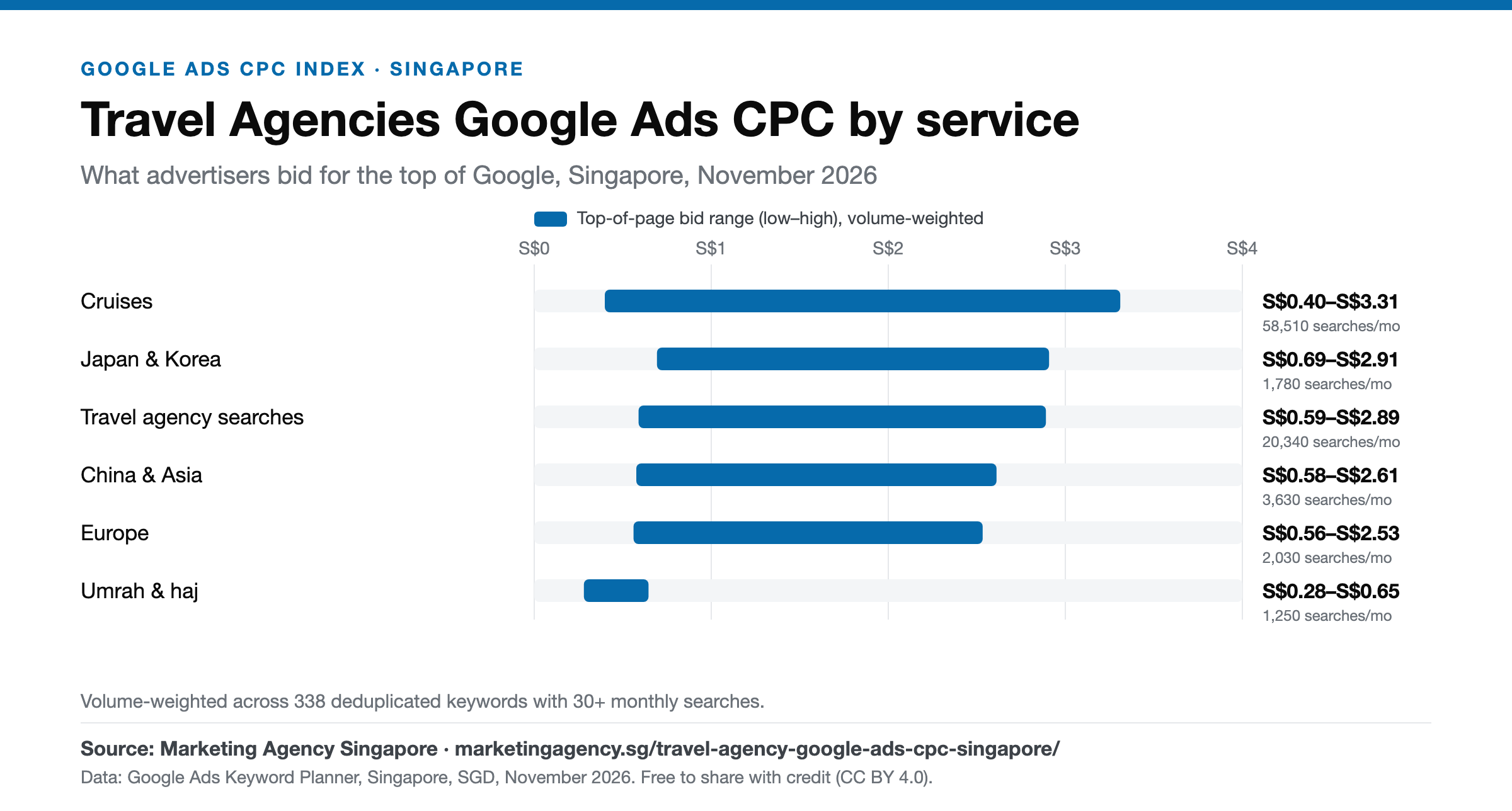
Source: Marketing Agency Singapore’s Singapore Google Ads CPC Index, built from Google Ads API data and updated monthly. Full breakdown, history and forecast →
Why Marketing for Travel and Tourism Needs a Specialist
STB and NATAS Standards Apply
Singapore travel agencies and tourism operators must hold the required STB licensing and, where applicable, align with NATAS guidelines. Ads, websites and booking flows must reflect genuine licensing status, accurate itineraries and fair pricing, not exaggerated offers or phantom availability.
Seasonality and MICE Windows Matter
Family travel peaks around school holidays and long weekends, outbound leisure concentrates around June and December, and MICE demand clusters with the Singapore events calendar. Marketing calendars and media plans must be built around these rhythms rather than run flat through the year.
Trust and Content Lead the Sale
Travellers comparing Singapore agencies, tour operators and hotels rely on itinerary depth, guide-style content, reviews and visible credentials. Video destination content, comparison guides and clear licensing cues do the heavy lifting well before the first enquiry lands.
How We Build Marketing for Travel and Tourism Brands
Market & Compliance Audit
We review your website, booking flows, paid accounts and content against STB licensing requirements and NATAS guidelines, then map the source markets, destinations and traveller profiles where you have the strongest unit economics.
Seasonal Strategy & Funnel Design
We build an always-on SEO and content layer under seasonal peaks, with Google Ads, Meta and retargeting tuned for the specific booking windows that matter for leisure, family and MICE segments.
Content, Video & Campaign Execution
We produce destination guides, itinerary pages, video and social content, and run booking-focused campaigns that send qualified travellers to properly structured booking pages or enquiry forms.
Bookings & Lifetime Value Tracking
We track enquiries, confirmed bookings, revenue by destination and repeat traveller behaviour, then reallocate spend each cycle toward the destinations, seasons and segments that deliver the strongest margin over time.
Further Reading
- Government Grants Tourism Hospitality Singapore
- Google Ads For Travel
- Holiday Ad Copy
- Holiday Landing Pages Singapore
- Hospitality Marketing Singapore
- Seo For Travel
Frequently Asked Questions
A mature programme covers SEO and content for destinations and itineraries, Google Ads and Meta for booking windows, email and remarketing for past travellers, video content for inspiration, a conversion-focused website and a plan that reflects STB licensing, NATAS guidelines and partner relationships with hotels, airlines and DMCs.
Travel agencies in Singapore generally require a valid STB-issued travel agent licence, and marketing materials should reflect accurate licensing and scope. Operating and advertising outside your licence scope is both a regulatory risk and a credibility issue with travellers, so we align campaigns with your licence from the start.
Travel demand in Singapore concentrates around school holidays, long weekends, the June and December windows and, for inbound and MICE, the events calendar. We plan budget shapes by quarter, front-load content so it ranks before peaks, and pull paid spend back in weeks where demand has thinned.
Google Search captures active bookers, Meta drives inspiration and remarketing, YouTube and short-form video support destination discovery, and email is typically the highest-margin channel for repeat bookings. The right mix depends on whether you focus on outbound leisure, inbound, MICE or special interest travel.
Destination guides, itinerary explainers, travel-prep articles and comparison content capture travellers months before they book. They also reduce paid media dependence over time, because well-ranked content continues to produce enquiries season after season with minimal incremental cost.
Independent agencies commonly invest S$3,000 to S$8,000 per month across SEO, content and paid media, with budget uplifts around peak seasons. Larger outbound, inbound and MICE operators typically spend S$10,000 to S$30,000 per month or more when video, partnerships and events are included.
Yes. MICE buyers behave more like B2B decision-makers, so we use a blend of LinkedIn, targeted search, authored content and sales-led nurture to reach meeting planners, associations and corporate event owners, in addition to traditional destination marketing channels.
Enquiries, quotes issued, confirmed bookings, revenue by destination, cost per booking and repeat-traveller rate are the primary metrics. Brand and content metrics are tracked as leading indicators, but every review returns to whether the programme is producing profitable, repeatable bookings for your business.
Very important. Travellers rely heavily on reviews from Google, TripAdvisor and booking platforms. Ask satisfied customers to leave honest reviews, respond professionally to criticism, and use recurring feedback to improve your products.
Yes. Short-form video lets potential travellers see the experience before they book, and it performs well on TikTok, Instagram and YouTube. Real footage from trips usually builds more trust than polished stock imagery.
A travel agency website in Singapore should include detailed itinerary pages with inclusions, dates and prices, a mobile-friendly enquiry or booking flow, WhatsApp contact, reviews and clearly displayed STB travel agent licence details. Destination guides and fast-loading pages help the site rank for package searches, while secure payment and clear cancellation terms reduce drop-off at the booking stage.
Look for a tourism marketing agency with proven travel or hospitality clients, experience planning around school holidays and MICE calendars, and reporting tied to confirmed bookings and revenue rather than clicks. Ask how it handles seasonal budget shifts, OTA competition and licensing accuracy in ads. Google Ads management in Singapore commonly costs around 20% of ad spend or a fixed fee from about S$600 a month.
Yes. Support previously offered under PSG, EDG and MRA is now part of the EDGE Grant, which covers digital solutions, branding and marketing strategy, and overseas promotion. Eligible travel and tourism SMEs can receive up to 50% support, or up to 70% for internationalisation projects, under an S$100,000 yearly cap. The Singapore Tourism Board also runs its own industry support schemes for tourism businesses.