Part of our Marketing Costs & Pricing guide →
Table of Contents
- Key Factors That Determine Video Production Costs
- Budget Tiers: What You Get at Each Price Point
- Detailed Cost Breakdown by Production Element
- Freelancer vs Production House vs In-House
- Hidden Costs and How to Avoid Budget Overruns
- How to Maximise Your Video Production Budget
- Understanding Cost From an ROI Perspective
- Frequently Asked Questions
Key Factors That Determine Video Production Costs
Understanding video production cost singapore requires breaking down the variables that drive pricing. Unlike commoditised services with fixed rates, video production costs vary dramatically based on scope, quality expectations, production complexity and distribution requirements.
Video length is the most obvious cost driver, but it is often misunderstood. A 60-second corporate video can cost more than a 10-minute interview because complexity, not length, determines production effort. A scripted video with multiple locations, actors, props and graphic overlays requires far more resources than a single-camera interview regardless of duration.
Production quality expectations set the baseline. Smartphone-quality content for social media costs a fraction of broadcast-quality corporate films. Both can be effective depending on the platform and purpose. A TikTok video shot on a phone may generate more engagement than a SGD 20,000 production because the audience expects authenticity on that platform.
Pre-production complexity includes scripting, storyboarding, location scouting, talent casting and logistics planning. Some videos require minimal pre-production while others need weeks of planning. A testimonial interview might need only a brief and location booking. A product launch film might require a full creative development process.
Post-production is where costs can escalate quickly. Basic editing with cuts and captions is straightforward. Motion graphics, 3D animation, colour grading, sound design and multi-language versions each add significant cost. Revision rounds also impact the final bill; most production companies include two to three rounds in their quotes, with additional revisions charged separately.
Location and logistics matter significantly in Singapore. Studio rentals range from SGD 100 to SGD 500 per hour depending on the facility. Outdoor filming may require permits from relevant authorities. On-location shoots at client premises eliminate location costs but may introduce logistical challenges.
Budget Tiers: What You Get at Each Price Point
Singapore’s video production market spans an enormous price range. Here is what to realistically expect at each tier.
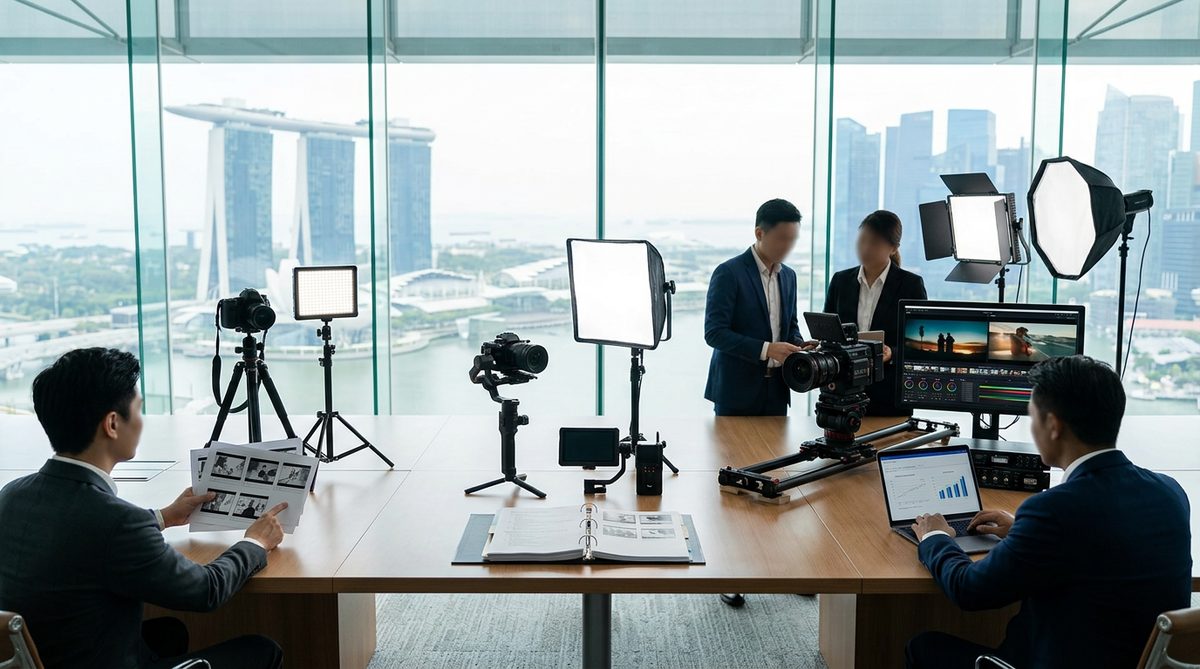
SGD 500 to SGD 1,500 covers basic content creation. At this level, expect a single videographer with their own equipment, half-day filming, basic editing with cuts and text overlays and delivery in one format. This suits social media content, simple product showcases and informal talking-head videos. Quality varies significantly by individual freelancer, so review portfolios carefully.
SGD 1,500 to SGD 5,000 covers professional single-camera production. This tier includes a videographer and basic lighting setup, full-day filming, scripted content with proper planning, professional editing with music licensing and delivery in multiple formats. Suitable for testimonial videos, team profiles, event coverage and mid-level social media content. Most small businesses in Singapore operate effectively in this range.
SGD 5,000 to SGD 15,000 covers multi-camera professional production. Expect a small crew of two to four people, professional lighting and audio, scripted content with storyboarding, advanced editing with motion graphics, licensed music and sound design. This tier suits corporate brand videos, product marketing videos, explainer videos with animation and recruitment films. Quality at this level is broadcast-ready.
SGD 15,000 to SGD 30,000 covers premium production. Full production crew including director, DP, sound engineer, lighting technician and production assistant. Multiple filming locations, professional talent, advanced post-production with colour grading and comprehensive sound design. This suits brand films, high-stakes product launches, annual report videos and content destined for paid media distribution.
SGD 30,000 to SGD 50,000 and above covers cinema-quality production. Large crews, premium equipment, multiple shooting days, professional actors, set design, complex visual effects and cinematic editing. Reserved for flagship brand campaigns, television commercials and content where production value directly impacts brand perception at the highest level.
Detailed Cost Breakdown by Production Element
Understanding individual cost components empowers you to negotiate intelligently and allocate budget where it matters most for your specific project.
Pre-production costs include concept development at SGD 500 to SGD 3,000, scriptwriting at SGD 300 to SGD 2,000, storyboarding at SGD 500 to SGD 1,500, location scouting at SGD 200 to SGD 500 and casting and talent coordination at SGD 300 to SGD 1,000. For simpler projects, pre-production may be included in the overall package. For complex productions, it represents 15 to 25 percent of the total budget.
Production day rates form the bulk of most budgets. A freelance videographer charges SGD 500 to SGD 1,500 per day. A two-person crew with professional equipment costs SGD 1,500 to SGD 3,500 per day. A full production crew of five to eight people runs SGD 5,000 to SGD 15,000 per day depending on equipment and expertise level.
Equipment rental is sometimes included in crew rates and sometimes charged separately. Camera packages range from SGD 200 to SGD 1,000 per day. Lighting kits cost SGD 150 to SGD 500 per day. Audio equipment adds SGD 100 to SGD 300 per day. Specialty equipment like drones, jibs, sliders and gimbals each add SGD 200 to SGD 500 per day.
Talent costs vary widely. Voiceover artists charge SGD 200 to SGD 1,000 per project depending on experience and usage rights. On-camera talent ranges from SGD 300 to SGD 3,000 per day. Using your own team eliminates talent costs but may require more filming time for non-professional presenters.
Post-production rates in Singapore typically range from SGD 80 to SGD 200 per hour for editing, SGD 100 to SGD 250 per hour for motion graphics and SGD 150 to SGD 300 per hour for animation. A typical corporate video requires 15 to 30 hours of post-production. Complex projects with extensive graphics or animation can require 50 to 100 hours.
Music licensing costs SGD 30 to SGD 300 for stock music libraries and SGD 1,000 to SGD 5,000 for custom compositions. Stock music from platforms like Artlist or Epidemic Sound provides unlimited licensing for annual subscription fees of SGD 200 to SGD 500, which is cost-effective for businesses producing regular video content.
Freelancer vs Production House vs In-House
Choosing between a freelancer, production house and in-house team depends on your volume, quality requirements and budget. Each option has distinct advantages.
Freelance videographers offer the best value for small businesses and straightforward projects. They have lower overhead costs, can mobilise quickly and often provide end-to-end service from filming to editing. The trade-off is limited capacity for complex shoots and variable availability. Build relationships with two to three reliable freelancers to ensure coverage. Singapore has a strong freelance videography community accessible through platforms and referrals.
Production houses deliver consistency, scalability and access to specialised equipment and talent. They manage complex projects with multiple stakeholders, locations and deliverables. Rates are higher because you are paying for project management, creative direction and quality assurance in addition to production. Choose a production house for projects where the video directly impacts brand perception or significant business outcomes.
In-house production suits businesses that need regular, high-volume content. Hiring a full-time videographer or content creator eliminates per-project costs and provides on-demand production capability. The investment includes salary of SGD 3,500 to SGD 6,000 monthly, equipment of SGD 5,000 to SGD 15,000 upfront and software subscriptions of SGD 100 to SGD 300 monthly. This model pays off when you produce 10 or more videos monthly.
A hybrid approach works for many Singapore businesses. Handle routine social media content in-house or with a freelancer, and engage a production house for flagship projects. This balances cost efficiency with quality for high-stakes content. Align this decision with your overall digital marketing strategy and content volume requirements.
Hidden Costs and How to Avoid Budget Overruns
Video production budgets frequently overrun due to costs that are not anticipated during the planning phase. Awareness of these hidden costs prevents unpleasant surprises.

Revision rounds are the most common source of budget overruns. Most quotes include two to three revision rounds. Additional rounds are charged at SGD 100 to SGD 300 per hour. Minimise revisions by providing clear, detailed briefs; involving all decision-makers in the scripting phase; and consolidating feedback into single revision requests rather than drip-feeding changes.
Scope creep occurs when additional requests are made during production. Adding another interview subject, an extra filming location or additional graphics after the project has started incurs additional costs. Define the scope in writing before production begins. If changes are necessary, discuss cost implications before proceeding.
Format adaptation costs arise when you need videos in multiple formats for different platforms. A single video may need to be reformatted for landscape YouTube, vertical TikTok, square Instagram feed and 16:9 LinkedIn. Each reformatting requires additional editing time. Request multi-format delivery in your initial brief and include it in the budget.
Licensing and usage rights can carry hidden costs. Some music, footage and talent agreements limit usage to specific platforms, durations or territories. Ensure your agreement covers all intended uses. A video produced for your website might need separate licensing to run as a paid advertisement. Discuss usage scope upfront to avoid renegotiation fees later.
Location-related costs include venue rental, parking, permits for public spaces and meals for the crew during full-day shoots. In Singapore, filming in public spaces may require permits from the relevant town council or government agency. Private venues may charge filming fees separate from regular rental rates. Factor these logistics into your budget.
How to Maximise Your Video Production Budget
Smart planning can stretch your video production budget significantly without compromising quality. These strategies are proven by Singapore businesses and production professionals.
Batch filming is the single most effective cost-saving strategy. Film multiple videos in a single production day. Setup time, equipment rental and crew mobilisation are fixed costs regardless of whether you film one video or five. A well-planned batch shoot can produce four to eight videos in a day, reducing per-video cost by 50 to 70 percent.
Repurpose every piece of content. A single long-form video can yield three to five short clips for social media, a podcast episode from the audio track, blog post content from the transcript and quote graphics from key moments. This multiplier effect means each production dollar generates content across multiple channels. Apply this thinking to your content marketing strategy.
Use a templated approach for recurring content. If you produce monthly client testimonials, weekly tips or regular product showcases, create a production template with standardised intro and outro, consistent graphics and a proven structure. Templates reduce pre-production and editing time, lowering costs for each subsequent video.
Invest in pre-production to save on production and post-production. A detailed script, shot list and storyboard ensure the filming day runs efficiently. Every hour saved on set and in the edit suite directly reduces cost. Conversely, arriving at a shoot without preparation guarantees wasted time and overspending.
Negotiate package deals for ongoing production. If you plan to produce videos monthly, negotiate a retainer or package rate with your freelancer or production house. Consistent work is valuable to production professionals, and they will often discount rates by 15 to 25 percent for guaranteed ongoing projects.
Use stock footage strategically to supplement original filming. B-roll footage of Singapore cityscapes, office environments, technology use and lifestyle scenes is available from stock libraries at SGD 10 to SGD 50 per clip. Mixing stock footage with original content maintains visual interest while reducing filming requirements.
Understanding Cost From an ROI Perspective
Video production cost should be evaluated as an investment, not an expense. The relevant question is not “how much does this video cost” but “what return will this video generate?”
Calculate the break-even point for each video project. If a testimonial video costs SGD 3,000 to produce and your average client value is SGD 10,000, the video only needs to influence one new client acquisition to deliver a 233 percent return. When that video sits on your website for two years and influences multiple purchase decisions, the ROI compounds dramatically.
Compare video cost per lead against your other marketing channels. Many Singapore businesses find that video content delivers a lower cost per lead than Google Ads, trade shows or print advertising once the initial production investment is amortised over the content’s lifespan. A Google Ads campaign costs money every day it runs. A video costs money once and generates returns indefinitely.
Consider the opportunity cost of not investing in video. Competitors who produce video content capture attention, build trust and convert customers that you are missing. In sectors where video is becoming standard, the cost of inaction, measured in lost market share, may exceed any production budget.
Track attribution rigorously. Use UTM parameters, dedicated landing pages and CRM tracking to connect video views to business outcomes. This data transforms video production from a cost centre into a measurable growth investment. Share ROI data with stakeholders to secure ongoing budget for video production.
Start small and reinvest. Begin with lower-budget content to test topics, formats and distribution channels. Identify what generates the best business results, then reinvest profits into higher-quality production of your proven content types. This approach minimises risk while building a data-driven video marketing programme as part of your video marketing strategy.
How AI Video Tools Are Shifting Singapore Production Costs (2026)
The biggest change in Singapore video production pricing between 2024 and 2026 is not crew rates or equipment — it’s which parts of a shoot you no longer need to physically film. AI video generation is now good enough to replace specific elements of a traditional corporate video budget, but only specific elements. Here is an honest breakdown of where it saves money and where it still does not work.

- Stock-style B-roll and cutaways (replaceable). Runway Gen-3, Veo 3, Sora, and Kling now produce competent 5-10 second cutaways for generic corporate scenes — office interiors, city skylines, abstract tech visuals. A project that previously licensed S$1,500-3,000 of stock footage or scheduled a half-day B-roll shoot at S$2,500-5,000 can often cover the same needs with S$50-200/mo of generation credits.
- Avatar talking-head explainers (replaceable for internal and training content). HeyGen and Synthesia produce corporate avatar videos at S$50-200/mo unlimited. Fully replaces live-action talking-head production for internal training, compliance videos, and multilingual explainer content. Still obvious-looking on close-shot external brand content.
- Multilingual voiceover (replaceable). ElevenLabs and Play.ht clone a voice once, then generate Mandarin, Malay, Tamil, Bahasa, Thai, and Vietnamese voiceovers from the same English script at S$50-300/mo. Traditional per-language voiceover talent runs S$300-800 per language per session. For Singapore brands that produce content in multiple languages, this alone can cut S$2,000-5,000 off a typical campaign video.
- Hero shots, brand narrative, testimonials (NOT replaceable in 2026). Customer-facing hero visuals, founder stories, real customer testimonials, and any high-stakes brand moment still needs live capture. AI-generated humans still fall into uncanny valley on close-up and any Singaporean audience member watching on a large screen spots the tell. This is where your money should still go.
- The hybrid model (dominant emerging pattern). Live-action hero sequences with AI-generated supporting cuts, stock-replacement B-roll, and AI voiceover for additional languages. A 2026 Singapore corporate video that cost S$15,000 fully live-captured in 2023 now typically lands at S$7,500-11,000 in a hybrid build — same output quality, meaningful budget saving reinvested into distribution or higher production values on the hero shots.
Caveat for Singapore-facing brand content: local audiences still read AI-generated humans as non-local even when the avatar is nominally Asian. Keep live actors for anything where the face sells the brand; use AI where the content is illustrative, educational, or where no identifiable person is needed. The brands making the most of AI video in 2026 are the ones who understand it is a budget lever for support content, not a replacement for brand storytelling.
Frequently Asked Questions
What is the minimum budget for a professional video in Singapore?
A professional-quality video can be produced for SGD 1,500 to SGD 3,000 using a skilled freelance videographer. This covers half to full-day filming, professional editing, music licensing and delivery in multiple formats. For simpler content like talking-head videos or product showcases, budgets as low as SGD 500 to SGD 1,000 can yield good results.
How much does a 1-minute corporate video cost in Singapore?
A 1-minute corporate video in Singapore ranges from SGD 3,000 to SGD 15,000 depending on production complexity. A simple interview-style video costs SGD 3,000 to SGD 5,000. A scripted video with multiple locations and graphics costs SGD 5,000 to SGD 10,000. A premium production with professional talent and cinematic quality costs SGD 10,000 to SGD 15,000 or more.
Is it cheaper to build an in-house video team or hire a production company?
In-house is cheaper at high volume. If you produce 10 or more videos monthly, a full-time videographer at SGD 4,000 to SGD 6,000 monthly plus equipment costs less per video than outsourcing. Below that volume, outsourcing to freelancers or production houses is more cost-effective because you avoid fixed salary and equipment costs during quiet periods.
How can we reduce video production costs without sacrificing quality?
Batch filming multiple videos per session, repurposing content across platforms, using production templates for recurring content, investing in detailed pre-production planning and negotiating package rates for ongoing work. These strategies can reduce per-video costs by 40 to 60 percent while maintaining consistent quality.
What should be included in a video production quote?
A comprehensive quote should itemise pre-production costs like scripting and planning, production day rates including crew and equipment, post-production including editing hours and revision rounds, music licensing, format delivery specifications, usage rights and a clear payment schedule. Beware of quotes that lack this detail, as they often lead to unexpected additional charges.
How long does it take to produce a video in Singapore?
A simple social media video can be produced in one to two days. A standard corporate video takes two to four weeks from brief to final delivery. A complex production with scripting, casting, multi-location shoots and advanced post-production takes four to eight weeks. Rush timelines are possible but typically incur a 25 to 50 percent premium.
Should we spend more on production or distribution?
Allocate 60 percent of your total video budget to production and 40 percent to distribution as a starting point. A beautifully produced video that nobody sees wastes the entire investment. Even modest paid promotion through social media ads ensures your content reaches its target audience. Adjust the ratio based on results; if organic distribution performs well, shift more budget to production.
Are there government grants for video production in Singapore?
Singapore businesses can access grants through Enterprise Singapore programmes that support digital marketing and branding activities, which can include video production. The Productivity Solutions Grant and Enterprise Development Grant historically covered digital marketing expenses including video content; since September 2026 they are combined in the EDGE Grant, which covers the same kinds of projects under one S$100,000 annual cap. Check the activity page for the current support level.
Should I use AI video generation instead of hiring a Singapore crew in 2026?
Use AI for support content, not brand content. AI video generation (Runway, Veo 3, Sora, Kling) works well for stock-style B-roll, abstract visuals, and generic office or city scenes — anything that would have been licensed stock or a half-day B-roll shoot. AI avatar tools (HeyGen, Synthesia) work for internal training and multilingual compliance videos. AI voice cloning (ElevenLabs) works for multilingual voiceover. Hire a real Singapore crew for hero shots, founder stories, customer testimonials, and anything where the face or voice genuinely represents your brand — AI-generated humans still read as off-brand on close-up to local audiences.
How much can AI video tools actually save on Singapore corporate video costs?
A typical corporate explainer that cost S$10,000-15,000 fully live-captured in 2023 now lands at S$6,000-11,000 when you replace B-roll with AI-generated cutaways, use ElevenLabs for additional language voiceovers, and keep live-action only for the hero sequences. That’s a 30-45% reduction on support-content spend, not on the whole production. The hero shots still cost what they always cost because they are still the half-day to full-day shoot they always were. For pure internal or training content (no external hero shots needed), avatar-based production can be 80% cheaper than live-action equivalents, which is why L&D and compliance video has moved almost entirely to AI avatars in 2026.
What video production work is still better done by humans in 2026?
Five categories where live production remains the right call: (1) founder and leadership storytelling videos where authenticity is the point; (2) real customer testimonials — AI-replicated customer faces are a credibility risk if ever spotted; (3) brand hero films and launch campaigns where the production value itself signals the brand; (4) event coverage, behind-the-scenes, and documentary-style content where the reality is the content; (5) any content featuring identifiable Singapore locations, people, or cultural moments where a local audience would recognise the difference. AI is a powerful budget lever on everything else — adopt it on the 60-70% of a video’s runtime that is context and support, protect the 30-40% that is brand and human.