
Digital Marketing for Insurance in Singapore
Marketing for insurance in Singapore is a high-trust, high-regulation category. Every ad, landing page and social post sits within the Financial Advisers Act framework and MAS advertising guidance — and consumers are rightly sceptical of anything that sounds like a sales pitch. We help insurers, financial advisory firms and MAS-licensed representatives build digital programmes that generate qualified enquiries without overpromising, inducing or misrepresenting cover.
Updated November 2026 Insurance CPC in Singapore: November 2026 data
Insurance keywords average S$3.19–S$10.47 per click at the top of Google (#13 of 22 industries). If you bid to win every auction, Google forecasts S$20.28 average CPC for December 2026, above the typical range because it assumes you outbid competitors for the top spot.
Priciest services: Critical illness S$88.49, Life & term life S$15.35, Car & motorcycle S$12.38.
- “travel insurance singapore”: S$3.25–S$8.53 (27,100 searches/mo)
- “car insurance singapore”: S$5.84–S$14.01 (5,400 searches/mo)
- “insurance singapore”: S$3.69–S$11.12 (1,900 searches/mo)
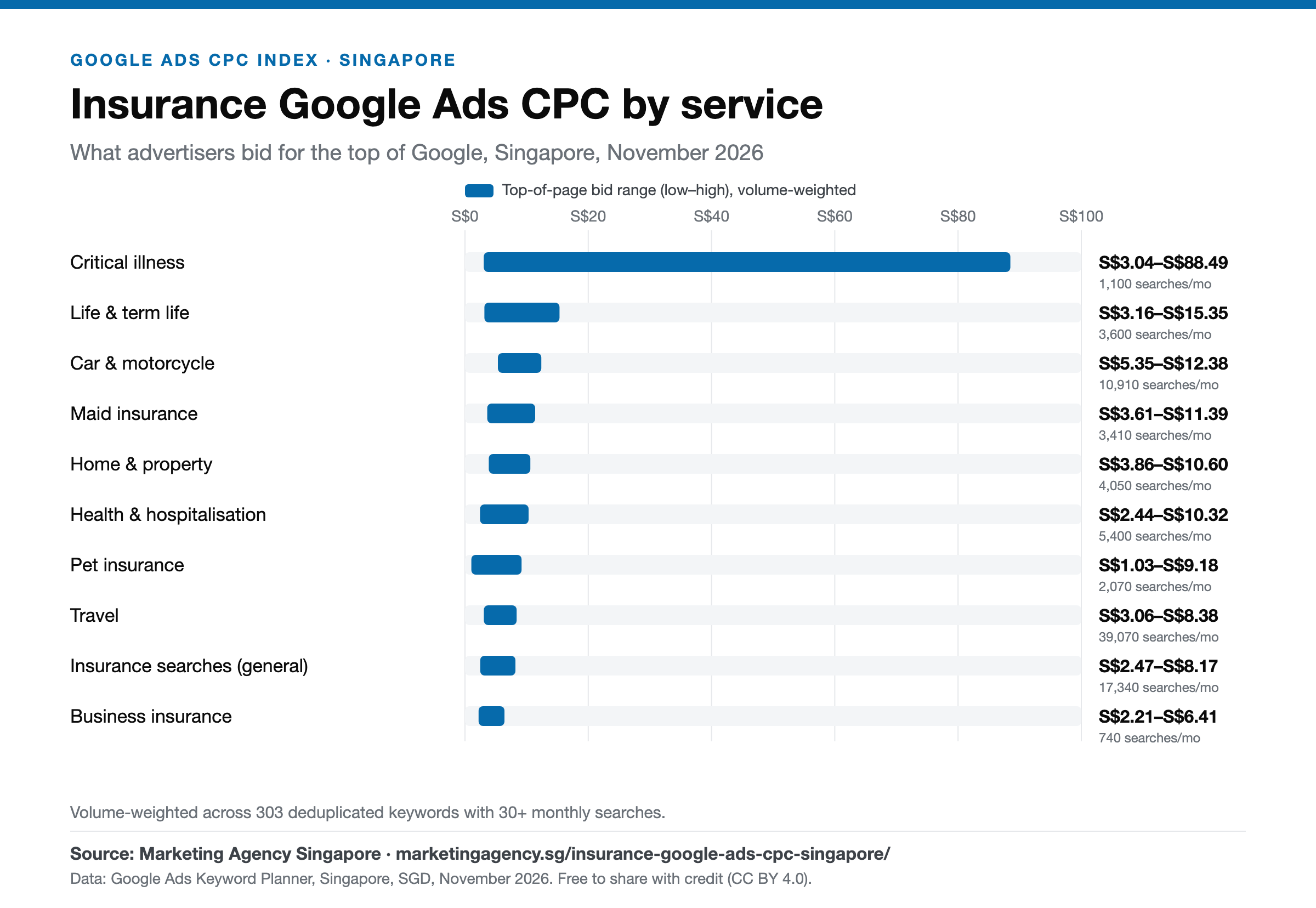
Source: Marketing Agency Singapore’s Singapore Google Ads CPC Index, built from Google Ads API data and updated monthly. Full breakdown, history and forecast →
Why Marketing for Insurance Needs a Specialist Approach
MAS & FAA Notice-Aware Copy
The Financial Advisers Regulations and MAS guidance set expectations for advertisements by Financial Advisers in Singapore. We draft ad copy, landing pages and social content with prominent disclosure, no misleading coverage claims, no inducement-led messaging, and clear “full terms and conditions apply” framing throughout.
Trust-Led, Not Yield-Led
We deliberately avoid return-chasing or savings-promise hooks for insurance-linked products. Instead, campaigns lead with education, scenario planning, and adviser credibility — which aligns with FAA advertising limits and, in our experience, produces better-quality enquiries anyway.
Consumer Journey Realism
Most Singapore buyers research cover across several sessions and compare two or three advisers before responding. We build content, remarketing and email programmes for that considered journey — not shortcut funnels that force a decision before the buyer is ready.
Our Process for Insurance Digital Marketing
Regulatory & Brand Audit
We review your current website, ads and social content against MAS advertising requirements for financial advisers, IAIS conduct expectations, and your in-house compliance guidelines — flagging claim language that needs tightening before we scale spend.
Compliant Strategy Design
We map priority products — life, health, GE, Integrated Shield Plans, endowment — to distinct content pillars and channels, keeping CPF-linked and investment-linked communications separate and conservatively worded.
Execution With Compliance Review
Every campaign asset routes through your compliance or legal reviewer before launch. We build creative in versions so minor wording edits don’t delay launch and we maintain a proper audit trail for approved copy.
Enquiry Quality Reporting
We report qualified enquiries, consultations booked, and policies issued where privacy permits — not raw lead counts. The goal is a sustainable pipeline of suitable prospects, not volume at any cost.
Further Reading
- Insurance Agent Marketing Singapore
- Marketing For Insurance Agents
- Google Ads For Insurance
- Seo For Insurance
Frequently Asked Questions
Yes, within the Financial Advisers Act framework. The Financial Advisers Regulations and related MAS guidance set the rules for advertisements by Financial Advisers. Core expectations include no misleading claims, prominent disclosure, and no inducement-led language. Our content marketing programmes are built around these requirements.
No — and we strongly advise against it. Return-led or guaranteed-outcome messaging on investment-linked or CPF-linked products sits squarely where FAA advertising limits apply. We focus on education, adviser credibility and scenario planning instead, which is both compliant and more credible to informed Singapore buyers.
Every asset — ad copy, landing page, email, social post — goes through your in-house compliance or legal reviewer before it goes live. We maintain a version-controlled archive of approved creative so future audits are straightforward and repeat campaigns don’t start from scratch.
These require particular care. Messaging must avoid implying guaranteed CPFB-linked outcomes, must be accurate about coverage limits, and should encourage consultation rather than self-selection. We treat this as educational content that leads to a qualified conversation, not a direct-response checkout.
Search — through SEO and Google Ads — captures informed buyers. Educational content on YouTube and LinkedIn builds adviser credibility. Meta works for specific life-stage audiences. Cold prospecting on open social tends to underperform and attract more compliance risk than it is worth.
Conservatively. We avoid claim outcomes that imply guaranteed payouts, do not publish case references that could be misinterpreted as inducement, and keep testimonials focused on adviser service quality rather than product performance. Every testimonial is client-approved before publication.
Independent advisers typically start from S$3,000-S$6,000 a month. Mid-size financial advisory firms usually invest S$8,000-S$20,000. Insurer brand-level campaigns can run higher. We right-size against adviser capacity — there is no point generating more enquiries than your compliant adviser team can actually serve.
We report qualified enquiries, consultations booked, show-up rates and — where the client shares it — policies issued. Ranges rather than single-point claims. The headline is sustainable, high-quality pipeline into advisers, not vanity lead volumes that crumble under compliance scrutiny.
Representatives can usually market themselves digitally, but content generally needs to follow their firm’s compliance procedures and approval process. We work with both the firm’s compliance team and individual advisers so personal branding stays within the firm’s rules.
Plain-language explainers, life-stage guides (such as starting a family or buying a home), calculators and answers to common claims questions tend to perform well, because they help people understand their options rather than pushing a specific policy.
An insurance PR agency in Singapore secures media coverage for insurers and advisory firms through product launches, expert commentary, research releases and spokesperson interviews, and manages reputation issues such as claims disputes. Every release and quote should pass the firm’s compliance review, avoid implying guaranteed outcomes and stay within MAS expectations. Insurance PR works best paired with educational content that builds trust before an enquiry.
Insurtech marketing in Singapore leans more on digital acquisition, such as search, app installs, comparison content and fast online quotes, while traditional insurance marketing relies more on advisers and relationship selling. Insurtechs still face the same MAS conduct expectations, so claims must be clear and not misleading. Product simplicity, transparent pricing and smooth mobile journeys are usually their main marketing advantages.
Yes. Insurance lead generation in Singapore must follow the PDPA, so enquiry forms need clear consent and purpose statements, and leads cannot be reused or bought without valid consent. Calls, SMS and WhatsApp marketing messages to Singapore numbers must be checked against the Do Not Call Registry unless the person has given clear consent. Breaches can attract significant financial penalties.
Insurance firms in Singapore can work with influencers, but MAS expects financial institutions to remain responsible for content that third parties publish for them, under its guidelines on digital advertising conduct. Influencer posts should be reviewed by compliance, clearly disclosed as sponsored and free of misleading or guaranteed-return claims. Many firms limit influencers to general education and route product questions to licensed representatives.