
Video Production Guide: Process, Costs, and Choosing a Company in Singapore
Video production in Singapore is a well-established industry serving businesses of every size — from startups needing a 60-second explainer to multinationals producing regional brand campaigns. The city-state offers a concentrated pool of production talent, world-class filming infrastructure, and a diverse range of locations, all within a compact geography that keeps logistics manageable.
But commissioning video production can feel opaque if you have not done it before. How does the process actually work? What should you expect to pay? How do you evaluate production companies? What decisions do you need to make, and when?
This guide answers those questions with practical detail. We walk through the entire production process from initial brief to final delivery, break down realistic costs for the Singapore market, and provide a framework for choosing the right production partner. Whether you are producing your first corporate video or your fiftieth, this guide gives you the information to make better decisions.
Pre-Production: Planning and Preparation
Pre-production is everything that happens before the camera starts rolling. It is arguably the most important phase of the entire production process because decisions made here determine the quality, efficiency, and cost of everything that follows. Rushing through pre-production is the single most common reason video projects go over budget or fail to meet expectations.
Creative brief. The process begins with a creative brief — a document that outlines the video’s purpose, target audience, key messages, desired tone, distribution channels, and success metrics. A strong brief aligns everyone involved before any creative work begins. Be specific about what you want the viewer to do after watching the video. Vague objectives like “raise brand awareness” lead to vague videos that achieve nothing measurable.
Concept development. Based on the brief, the production team develops creative concepts. These might include narrative approaches, visual styles, presenter formats, animation techniques, or documentary-style treatments. Expect to review two or three concept options and provide feedback. The concept defines the overall direction and must align with your brand identity and campaign objectives.
Scriptwriting. Once the concept is approved, the production team writes the script. For a typical corporate video, the script covers voiceover narration, on-screen text, dialogue (if any), and scene descriptions. Review the script carefully — changes after filming are expensive. A one-minute video typically requires a script of 130 to 160 words. A common mistake is trying to cram too much information into a short video. Edit ruthlessly for clarity and focus.
Storyboarding. A storyboard is a visual representation of the script, showing what each shot will look like. Storyboards range from rough sketches to detailed illustrations depending on the complexity of the production. For straightforward talking-head videos, storyboards may be minimal. For complex narrative or animated videos, detailed storyboards are essential.
Production planning. This covers logistics — location scouting, permits, talent casting, crew booking, equipment rental, wardrobe, props, and scheduling. In Singapore, filming in public spaces often requires permits from the Infocomm Media Development Authority (IMDA) or relevant building management. Indoor locations may require facility fees and insurance.
Professional video production services handle the entire pre-production process, but your involvement in brief development and script review is essential for a successful outcome.
Production: The Shoot Day
The production phase — commonly called “the shoot” — is when footage is captured. A well-planned shoot day is efficient and productive. A poorly planned one burns budget and morale in equal measure.
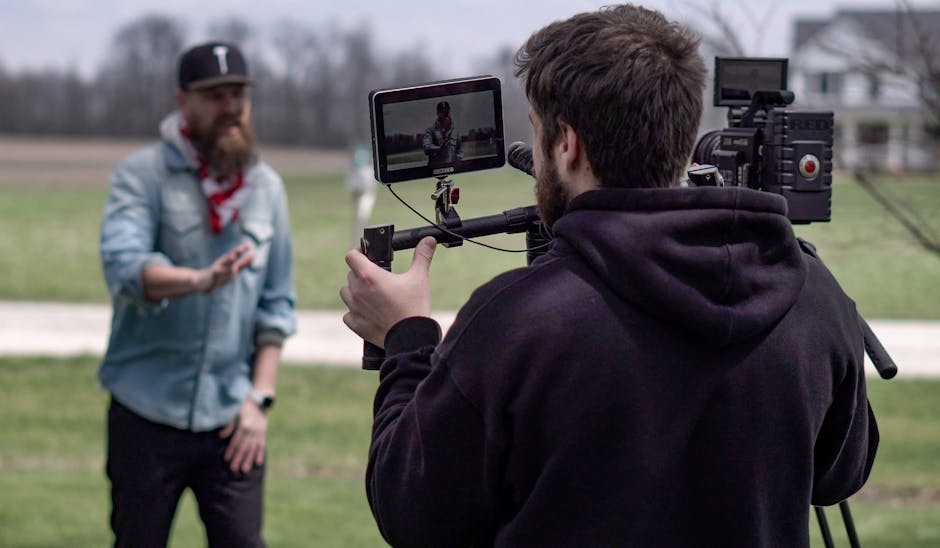
Crew composition. A typical corporate video shoot in Singapore involves a director, director of photography (DP or cinematographer), camera operator, sound recordist, gaffer (lighting technician), and a production assistant. Larger productions may add a producer, art director, hair and makeup artist, teleprompter operator, and additional camera operators. Smaller budget productions may combine roles — a DP who also operates the camera, for example.
Equipment. Standard corporate video production in Singapore uses cinema cameras (such as the Sony FX6, RED Komodo, or Blackmagic Pocket Cinema Camera), professional lighting kits, wireless lavalier and shotgun microphones, tripods, sliders, and gimbals. More ambitious productions may incorporate drones, jibs, dollies, or specialised rigs. The equipment selection depends on the creative concept and budget.
Location considerations in Singapore. Singapore’s compact geography is an advantage — you can move between locations quickly. However, the tropical climate presents challenges. Outdoor shoots must account for intense midday sun, sudden rain showers, and high humidity that fogs lenses. Many productions schedule outdoor footage for the golden hours (early morning and late afternoon) and reserve midday for indoor scenes. Popular filming locations include Marina Bay, the CBD, Sentosa, Haji Lane, Chinatown, and various co-working spaces and studios.
Talent direction. If your video features employees, executives, or hired talent on camera, expect the director to guide them through the performance. Non-professional presenters often need multiple takes and patience. A teleprompter can help with scripted content, but rehearsal time is still important. For interview-style videos, a skilled director puts subjects at ease and draws out natural, authentic responses.
Your role during the shoot. As the client, your primary role on shoot day is to be available for approvals and decisions. Review shots on the monitor, confirm that messaging is accurate, and flag any brand compliance issues in real time. Making changes during the shoot is far cheaper than fixing problems in post-production.
For specialised filming requirements, dedicated videography services provide expertise in specific formats and techniques.
Post-Production: Editing and Delivery
Post-production transforms raw footage into a finished video. This phase typically takes longer than the shoot itself and includes several distinct stages.
Rough cut. The editor assembles the footage according to the script and storyboard, selecting the best takes and arranging them in sequence. The rough cut focuses on structure, pacing, and narrative flow. It typically uses placeholder music and minimal colour correction. Review the rough cut for overall structure and content accuracy — this is the stage where major changes (reordering scenes, removing sections, adding new content) are easiest to implement.
Fine cut. After incorporating feedback from the rough cut review, the editor refines the edit — tightening pacing, polishing transitions, and fine-tuning audio levels. The fine cut is closer to the final product but still allows for adjustments. Review this cut for detail and nuance — timing of cuts, appropriateness of selected takes, and flow of the narrative.
Colour grading. Colour grading adjusts the visual look of the footage to create a consistent, polished aesthetic. Grading can transform the mood of a video — cool tones for corporate professionalism, warm tones for lifestyle content, high contrast for dramatic impact. A skilled colourist ensures visual consistency across shots filmed at different times, locations, and lighting conditions.
Sound design and mixing. This includes background music selection or composition, sound effects, voiceover recording and integration, and final audio mixing. Audio quality has an outsized impact on perceived production value. Poor audio — unbalanced levels, background noise, tinny voiceover — undermines even the most beautifully shot footage. Professional sound mixing ensures clarity, balance, and emotional impact.
Motion graphics and animation. Many corporate videos incorporate animated elements — lower thirds (name and title overlays), data visualisations, logo animations, and transition effects. These elements are created in post-production using software like Adobe After Effects or Cinema 4D. For fully animated videos, the entire post-production process revolves around animation rather than footage editing. Specialist video animation services handle complex animated content.
Delivery formats. The final video is exported in formats optimised for its distribution channels. A video destined for YouTube, Instagram, LinkedIn, and your website may need four or more different versions with varying aspect ratios, durations, and file specifications. Discuss delivery formats with your production company before the edit begins so the editor can plan accordingly.
Types of Video Content for Businesses
Different business objectives call for different types of video content. Understanding the options helps you commission the right format for your goals.
Corporate profile videos. These present your company’s story, mission, capabilities, and culture. Typical duration is 2 to 4 minutes. They are used on your website, at events, and in sales presentations. A strong corporate video communicates credibility and differentiates your brand from competitors.
Product and service videos. These demonstrate what you sell and how it works. They range from simple product showcases to detailed demonstrations with narration. Product videos are most effective on e-commerce listings, landing pages, and social media.
Testimonial and case study videos. Real customers sharing their experience with your product or service. These are among the most persuasive video formats because they leverage social proof. A well-produced testimonial video features genuine, articulate customers in professional but authentic settings.
Explainer videos. Short animated or live-action videos that explain a concept, process, or product in simple terms. Typically 60 to 120 seconds. Explainer videos are particularly effective for technology companies, financial services, and any business with complex offerings. Our explainer video guide covers this format in detail.
Social media content. Short-form videos optimised for Instagram Reels, TikTok, YouTube Shorts, and LinkedIn. These are typically 15 to 60 seconds, vertical format, and designed for immediate engagement. Production values vary — some social content benefits from polished production, while other formats work better with a raw, authentic aesthetic.
Event coverage. Documentation of corporate events, conferences, product launches, and exhibitions. Event videos serve as both marketing content and internal communication tools. They typically combine highlight reels with extended coverage of key moments.
Aerial and drone footage. Drone videography provides dramatic perspectives for property, construction, tourism, and large-scale event content. In Singapore, drone operation requires a permit from the Civil Aviation Authority of Singapore (CAAS), and there are significant restrictions on where drones can fly. Professional drone videography services handle permitting and compliance.
Video Production Costs in Singapore
Video production costs in Singapore vary widely based on complexity, duration, crew size, equipment, talent, and post-production requirements. Here is a realistic breakdown for common video types.
Budget tier (SGD 3,000 to SGD 8,000). This covers a simple video with one camera, basic lighting, one location, minimal crew (2 to 3 people), basic editing, and stock music. Suitable for simple talking-head videos, basic product showcases, and social media content. Production value is functional but not premium.
Mid-range tier (SGD 8,000 to SGD 25,000). This covers a professionally produced video with multiple camera angles, professional lighting, two to three locations, a full crew (5 to 8 people), professional editing with motion graphics, licensed music, and colour grading. Suitable for corporate profile videos, product launch videos, and testimonial series. This is where most Singapore businesses find the right balance of quality and budget.
Premium tier (SGD 25,000 to SGD 80,000+). This covers high-end production with cinema-grade equipment, large crews, professional talent (actors, voiceover artists), multiple shoot days, complex post-production including animation and visual effects, original music composition, and multiple delivery formats. Suitable for brand campaigns, television commercials, and content intended for regional distribution.
Animated videos. Fully animated explainer videos typically cost SGD 5,000 to SGD 20,000 for a 60 to 90-second video, depending on animation style (2D, 3D, motion graphics) and complexity. Custom character animation and 3D animation sit at the higher end of this range.
Cost factors that increase budgets:
- Multiple shoot days or locations
- Professional actors or voiceover talent
- Complex animation or visual effects
- Drone or specialised equipment
- Rush turnaround timelines
- Multiple language versions
- Extensive revision rounds beyond the standard two to three rounds
Understanding the broader video marketing landscape in Singapore helps you plan budgets that align with your marketing strategy and expected returns.
Choosing the Right Production Company
Selecting a video production company is a consequential decision. The company you choose determines not just the quality of your final video but also the efficiency of the production process and the stress level of your experience.
Portfolio relevance. Review the company’s portfolio for work similar to what you need. A company that produces stunning cinematic brand films may not be the best choice for a simple product demo, and vice versa. Look for examples that match your industry, style, tone, and budget level. Ask to see work at various budget points, not just their showreel highlights.
Process clarity. A professional production company should be able to explain their process clearly — timelines, milestones, deliverables, revision rounds, and payment schedules. Vague or unstructured processes lead to budget overruns and missed deadlines. Ask about their typical project timeline and what they need from you at each stage.
Client references. Ask for references from recent clients, particularly those who commissioned similar types of video. Speak to those references about the company’s communication, responsiveness, ability to meet deadlines, and willingness to accommodate feedback.
Creative capability vs. technical execution. Some production companies excel at creative storytelling but are less rigorous on technical execution. Others produce technically flawless footage but lack creative imagination. The best companies deliver both. Evaluate creative capability through their concepts and storytelling, and technical execution through the quality of their cinematography, lighting, sound, and editing.
Post-production capabilities. Ensure the company has in-house post-production capabilities, including editing, colour grading, sound mixing, and motion graphics. Companies that outsource post-production often have less control over quality and timelines. Ask specifically about their post-production workflow and who will handle each element.
Budget transparency. Request detailed, itemised quotes rather than lump-sum pricing. A detailed quote shows exactly what you are paying for — crew, equipment, locations, editing hours, music licensing, revision rounds — and makes it easier to compare quotes from different companies. Be wary of quotes that are significantly lower than competitors; the savings usually come from reduced crew, cheaper equipment, or fewer editing hours, all of which affect quality.
Maximising Value from Your Investment
Video production represents a significant marketing investment. Here is how to extract maximum value from every dollar spent.
Plan for multiple outputs from a single shoot. A single shoot day can produce content for multiple platforms and purposes. Film extended interviews that can be edited into a main video, social media clips, quote cards, and audio snippets for podcasts. Capture behind-the-scenes footage for social content. Plan B-roll footage that can be reused across multiple future projects.
Invest in quality over quantity. One excellent video generates more impact than five mediocre ones. A well-produced video earns shares, builds credibility, and has a longer shelf life. A cheap video can actually damage your brand perception. If budget is tight, produce fewer videos at a higher quality standard rather than spreading your budget thin.
Brief thoroughly and decide quickly. The biggest source of cost overruns is scope creep and delayed feedback. Invest time in writing a thorough brief at the outset. Provide feedback promptly at each review stage. Make decisions and stick with them. Every change of direction costs time and money.
Negotiate usage rights carefully. Understand what you are paying for in terms of content ownership and usage rights. Most production companies transfer full ownership of the final deliverables to the client. However, some retain ownership and license usage rights instead. Clarify this before signing any contract. Ensure you have the rights to use the video across all intended channels and for the duration you need.
Plan distribution before production. Know where and how your video will be distributed before you start production. This affects aspect ratio, duration, captioning requirements, and file specifications. A video produced for cinema-style YouTube viewing requires different specifications than a video designed for Instagram Stories.
Frequently Asked Questions
How long does video production take from start to finish?
A typical corporate video in Singapore takes 4 to 8 weeks from brief to final delivery. Pre-production accounts for 1 to 3 weeks (briefing, concept, script, planning), production takes 1 to 2 days of filming, and post-production requires 2 to 4 weeks (editing, revisions, colour grading, sound mixing, delivery). Complex productions with animation, multiple shoot days, or extensive post-production can take 8 to 12 weeks or longer. Rush timelines are possible but typically incur premium charges of 20 to 50 per cent.
Do I need to provide a script or will the production company write it?
Most production companies offer scriptwriting as part of their service. You provide the brief — objectives, key messages, target audience, and tone — and the production team develops the script. Some companies include scriptwriting in their production fee, while others charge it separately (typically SGD 500 to SGD 2,000 depending on complexity). You should always review and approve the script before filming begins. If you have an in-house copywriter who understands your brand voice, providing a draft script can speed up the process and reduce costs.
What permits are needed for filming in Singapore?
Filming in public spaces in Singapore generally requires a filming permit from the Infocomm Media Development Authority (IMDA) if you are using professional equipment (tripods, lighting, large cameras). Filming in parks and nature reserves requires a permit from the National Parks Board (NParks). Shopping malls, office buildings, and private properties require permission from the building management. Drone filming requires a permit from the Civil Aviation Authority of Singapore (CAAS) and is restricted in many areas, including near airports and military installations. Your production company should handle all permit applications as part of their service.
How many revision rounds should I expect?
Most production companies include two to three rounds of revisions in their standard pricing. A typical revision process involves feedback on the rough cut, feedback on the fine cut, and final approval after minor adjustments. Additional revision rounds beyond the included number are usually charged at an hourly rate (SGD 100 to SGD 200 per hour for editing). To minimise the need for extra revisions, consolidate all stakeholder feedback into a single, clear revision list at each stage rather than providing piecemeal feedback.
Should I use a freelancer or a production company?
Freelance videographers are suitable for simple, single-camera projects with straightforward editing — event coverage, basic talking-head videos, and social media content. They typically charge SGD 800 to SGD 3,000 per shoot day. Production companies are better suited for projects that require creative concept development, multi-person crews, complex lighting, multiple locations, and professional post-production. The premium you pay for a production company covers project management, creative direction, specialised equipment, and accountability. For business-critical content — brand campaigns, investor presentations, product launches — a production company is usually the better investment.


 English
  Chinese
  Malay
Malay  Korean