Overview
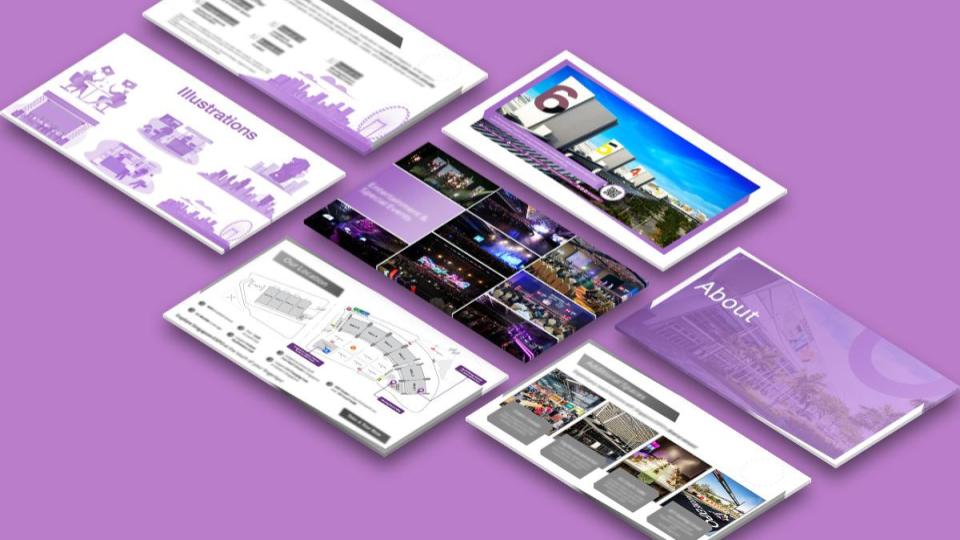
Singapore Expo is one of the region’s largest exhibition and convention venues. Their challenge wasn’t visibility — it was presentation consistency: sales and marketing teams across multiple divisions each working from their own assembled slides, producing inconsistent brand tone, off-spec visuals and copy quality that depended on who built the deck. We were engaged to write the master B2B slide deck any team could use as the source of truth, with Conquest Creatives handling design in parallel.
Project Snapshot
- Sector: Events & venues — MICE, Singapore
- Engagement: Master B2B slide deck: structure and copy
- Timeline: Discovery through delivery with design partner
- A master B2B deck now serving as the presentation source of truth across Singapore Expo’s sales and marketing divisions
- Modular template slides for the common use cases — proposal text, venue showcases, capacity and floor-plan data — editable by non-designers without brand drift
The Challenge
The unified-deck problem looks trivial and fails predictably: too rigid and teams work around it; too loose and the inconsistency returns; beautiful but hard to edit and it’s abandoned within a quarter; no copy-and-tone framework and the drift continues under a consistent visual layer. The deck had to serve internal teams adapting it per client — not all of them designers — and external audiences (organisers, planners, sponsors, partners) who needed brand-consistent credibility regardless of which division was presenting.
Our Approach
- Discovery by division — mapped presentation use cases, the messaging variations to preserve versus standardise, and the brand tone constraints governing the copy.
- Structural design — slide hierarchy from cover to call-to-action: brand introduction, venue capabilities, divisional breakdowns, case-study sections, modular content blocks, and clean closing slides — each slide type defined by purpose and copy framework.
- Master copy with customisation rules — premium-but-approachable voice, with explicit guidance on what to adapt per audience and what stays verbatim; placeholder copy that signals how to edit without breaking consistency.
- Self-contained governance — brand guidelines (logo, palette, typography, imagery) embedded inside the deck itself, plus a curated on-brand asset library, so teams never need to source independently.
The Results
- A master B2B deck now serving as the presentation source of truth across Singapore Expo’s sales and marketing divisions
- Modular template slides for the common use cases — proposal text, venue showcases, capacity and floor-plan data — editable by non-designers without brand drift
- A clean three-party collaboration: our copy, Conquest Creatives’ design, the client’s institutional knowledge — each discipline staying in its lane
Why This Worked
The unified-deck problem looks trivial — “just make a template” — and fails in four predictable ways: too rigid and teams work around it; too loose and inconsistency returns; beautiful-but-uneditable and it’s abandoned in a quarter; and without a copy framework, presentational drift continues under a consistent visual skin. This engagement worked because it treated all four failure modes as design constraints from day one.
Discovery mapped how each division actually presents — which messaging variations were load-bearing and had to be preserved, versus which were accidents of history to standardise. The structural design then defined every slide type by purpose and copy framework: what a capability slide says, what adapts per audience, what stays verbatim. Placeholder copy was written to signal how to edit without breaking brand register — the difference between a template that guides and a template that merely decorates.
Embedding the brand guidelines inside the deck itself — logo usage, palette, typography, imagery direction — meant the governance travelled with the file rather than living in a PDF nobody opens. And the clean division of labour with Conquest Creatives (their design, our copy, jointly-developed structure) kept both disciplines at full strength instead of compromising each other.
Key Takeaways
- Template projects fail on governance, not aesthetics — the copy framework is the deliverable that prevents drift.
- Map real divisional use cases before standardising; some variation is load-bearing.
- Placeholder copy should teach editing behaviour, not just hold space.
- Put brand guidelines inside the working file — governance that travels gets followed.
- Copy and design collaborations work best with clean lanes and a jointly-owned structure.
Frequently Asked Questions
Who was the deck built to serve?
Two audiences at once: internal sales and marketing teams who adapt it per client — not all of them designers — and the external organisers, planners, sponsors and partners who need every division’s presentation to feel like one credible brand.
What kinds of modular slides did the master deck include?
Text-weighted slides for proposal sections, image-led slides for venue capability showcases, and data-representation layouts for capacity and floor-plan information — the recurring jobs a venue’s sales conversations actually involve, each with copy guidance attached.
How is tone kept consistent when many people edit a deck?
Through explicit rules rather than hope: documented voice (“premium but approachable, authoritative without being corporate”), customisation guidance on what may change per audience, and verbatim-protected sections for the brand-critical claims.
Does a master deck really change sales outcomes?
It changes the floor: the worst presentation any division can now give is brand-consistent and professionally credible. For an institution presenting hundreds of times a year across teams, raising the floor is worth more than raising the ceiling.
Why do master decks usually fail within a quarter?
Four failure modes: too rigid (teams work around them), too loose (inconsistency returns), beautiful but uneditable (abandoned), or missing a copy framework (drift continues under consistent visuals). The deck was designed against all four.
What audiences did the deck serve?
Internal sales and marketing teams adapting it per client — not all designers — and external organisers, planners, sponsors and partners who needed brand-consistent credibility from every division’s presentation.
How did the copy and design collaboration work?
Clean lanes: structure developed jointly so briefs aligned, our copy and Conquest Creatives’ design each executed independently, with light copy adjustments where layout required tightening — no discipline compromising the other.
How is the deck kept alive rather than drifting?
Through the governance built into the file: embedded brand guidelines, verbatim-protected sections and per-audience customisation rules mean each division adapts within guardrails. Periodic reviews fold the best divisional adaptations back into the master — so the deck improves through use instead of degrading.