Overview
D&G Flooring (dgfloors.com) is a North American flooring specialist covering hardwood, vinyl plank, laminate and tile across the US and Canadian markets — a lead-generation business whose site exists to capture buyers mid-research and convert them into quote requests. We ran the launch SEO engagement from an effectively zero organic baseline: technical foundations, a keyword-mapped content library, and measurement wired in before the first visitor.
Project Snapshot
- Sector: Home improvement — flooring, North America
- Engagement: Launch SEO: technical, content library, measurement
- Timeline: First 30 days from a zero baseline
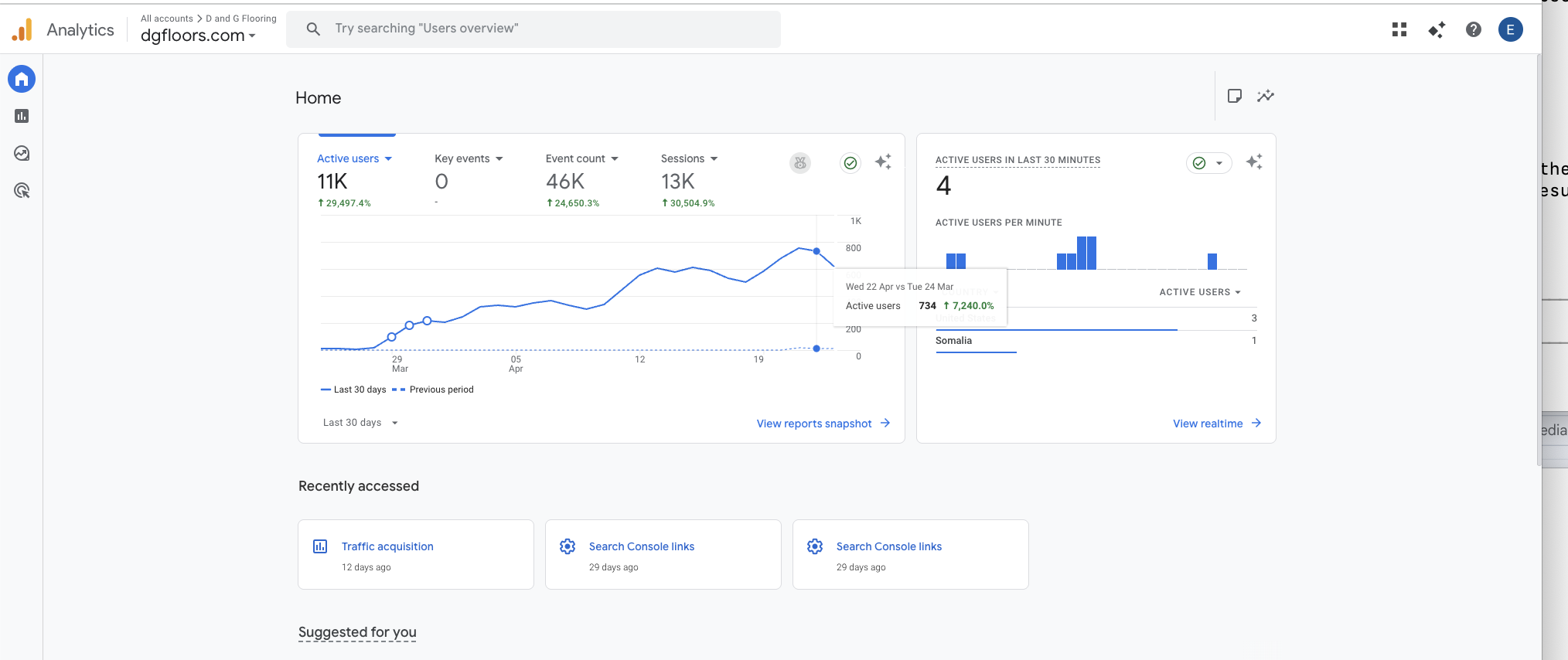
- 11,000+ active users and 12,000+ sessions, ramping from ~0 to over 800 daily active users
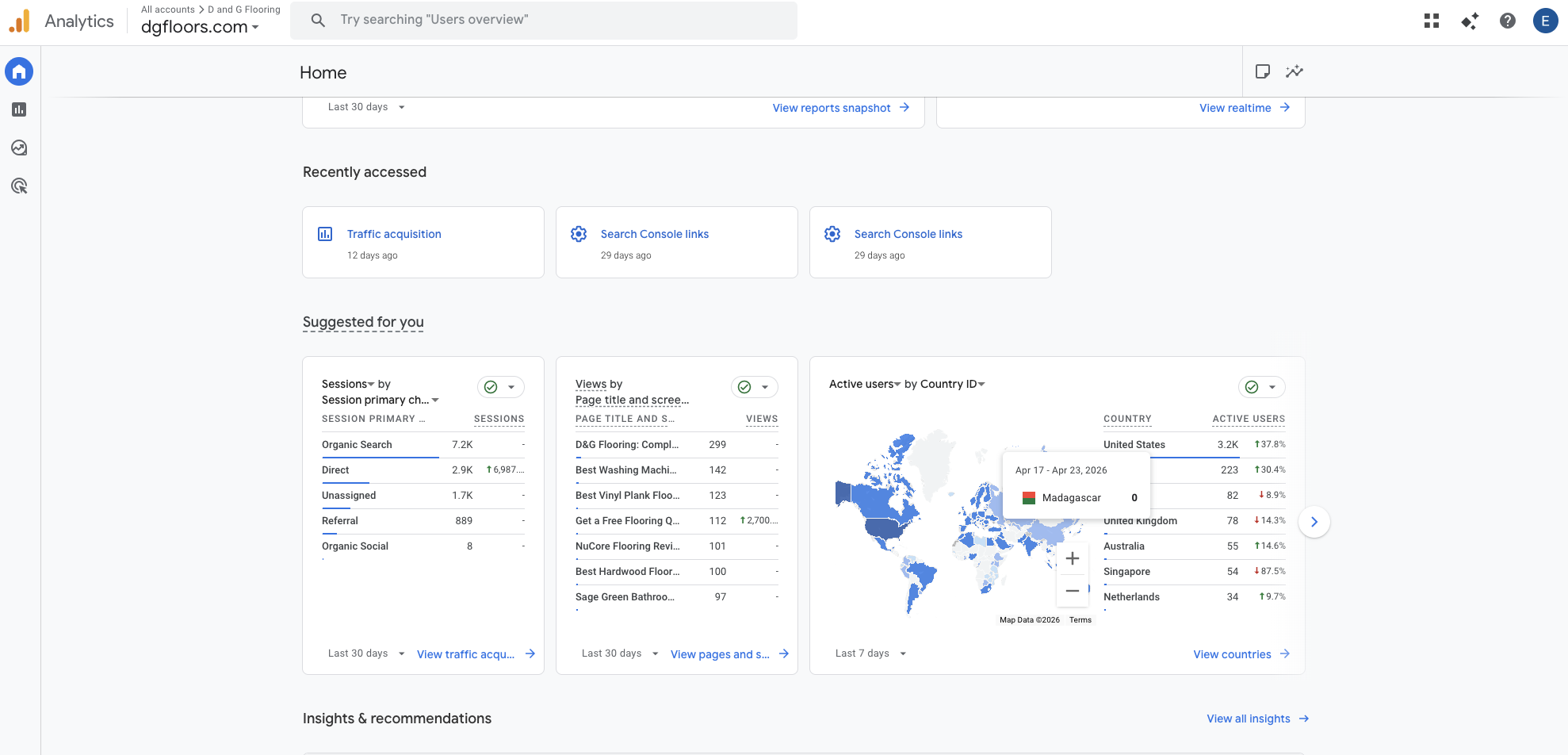
- 6,900 organic search sessions — 57% of the traffic mix — confirming organic, not ad spend or existing audience, was doing the acquisition work
The Challenge
The previous 30-day period showed almost no search traffic. Flooring is a mobile-heavy, trust-heavy, high-consideration category — buyers research on their phones in showrooms and spend thousands on something that stays in their home for fifteen years — and the site had neither the technical foundation nor the content to participate in any stage of that journey.
Our Approach
- Technical SEO first — indexability, site architecture, Core Web Vitals and mobile rendering fixed before any content investment; internal linking built to carry signal from content through to lead-capture pages.
- Full-funnel content library — research (“hardwood vs laminate”), evaluation (“best brands”, “durable flooring for kitchens”) and commercial intent (“flooring installation cost”), interlinked to move the same visitor from research entry points to the quote page.
- Conversion assets — “Get a Free Flooring Quote” built as the primary capture page, integrated into the content funnel rather than bolted on.
- GA4 from day one — measurement configured before the launch content went live, so source, landing-page and event data were clean from the first session.
The Results
Across the first 30 days of the engagement:
- 11,000+ active users and 12,000+ sessions, ramping from ~0 to over 800 daily active users
- 6,900 organic search sessions — 57% of the traffic mix — confirming organic, not ad spend or existing audience, was doing the acquisition work
- Geographic mix followed the commercial footprint: US 3,100 active users (+44% period on period), Canada 211 (+27%)
- 43,000 tracked events giving the client decision-grade data from week one
Why This Worked
Launch SEO lives or dies on sequencing, and this engagement got the order right: technical foundations before content, measurement before traffic, commercial pages woven into the content library rather than bolted on after. By the time the launch content wave went live, the site could be crawled cleanly, rendered fast on mobile — the device where flooring research actually happens, in showrooms and on job sites — and every session was already being measured in GA4.
The content library was mapped to the full buyer journey rather than a keyword dump: research queries (“hardwood vs laminate”), evaluation queries (“best vinyl plank flooring”, “durable flooring for kitchens”) and commercial queries (“flooring installation cost”) each got their layer, with internal links deliberately moving the same visitor from research entry points toward the quote page. That structure is why 57% of first-month traffic arrived from organic search rather than ad spend — the library was being found, page by page, for the questions buyers actually type.
The trust layer mattered too. Flooring is a five-figure, fifteen-year purchase; EEAT signals on the converting pages and authority-building in the home-improvement vertical gave both Google and buyers reasons to take a new domain seriously.
Key Takeaways
- Sequence beats speed at launch: technical → measurement → content → conversion, in that order.
- Organic share of traffic mix is the launch metric that matters — it proves discovery rather than spend.
- Mobile performance is the whole game in research-heavy home-improvement categories.
- Analytics configured before launch is cheap; reconstructing attribution six weeks later is impossible.
AI Search Visibility: Cited Across the Answer Engines
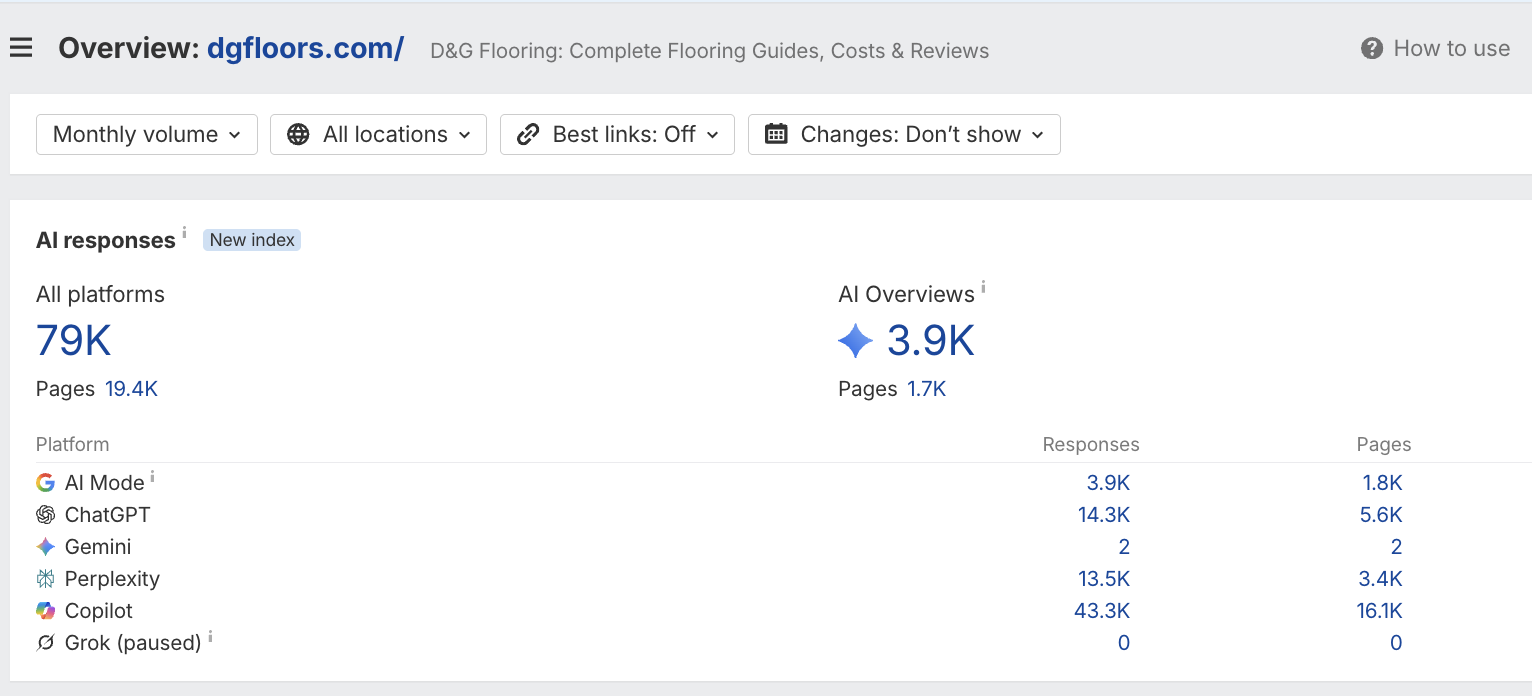
Beyond classic organic traffic, D&G Flooring’s content is now a cited source across the AI answer engines — the clearest evidence that Answer Engine Optimisation (AEO) and Generative Engine Optimisation (GEO) are working. Ahrefs’ AI-response index shows the site referenced in:
- 79,000+ AI responses across all platforms, spanning 19,400 pages
- Microsoft Copilot: 43,300 responses · ChatGPT: 14,300 · Perplexity: 13,500
- Google AI Overviews / AI Mode: 3,900 responses
Frequently Asked Questions
Is 11,000 users in 30 days realistic for a new site?
In high-search-volume categories with a properly built content library, yes — flooring queries carry enormous aggregate demand across North America. The same playbook in a niche B2B category would produce smaller absolute numbers with the same structural pattern: organic leading the mix early.
What were the most important technical fixes before launch?
Indexability and architecture first — making sure every content page could be crawled and understood — then Core Web Vitals on the key templates (LCP, CLS and INP), then internal linking that carries ranking signal from guides to quote pages. None are glamorous; all are prerequisites.
How does content connect to actual flooring leads?
Every research and evaluation piece links contextually toward the quote page, so the reader comparing hardwood brands is one click from requesting a quote at the moment their research matures. Content without that routing generates traffic; content with it generates pipeline.
What happens after the first 30 days?
The compounding phase: expanding the library into remaining category queries, deepening authority in the vertical, and optimising the pages that GA4 shows are converting — the launch window proves the engine; the following quarters scale it.
What did the keyword-mapped content library cover?
The full buyer journey across product categories: research comparisons like hardwood vs laminate, evaluation queries like best vinyl plank flooring and durable flooring for kitchens, and commercial-intent terms like flooring installation cost — each cluster internally linked toward the quote page.
Why measure active users rather than just sessions?
Active users approximate real people; sessions inflate with repeat visits. Reporting both — 11,000+ users, 12,000+ sessions — alongside the 57% organic share gives an honest picture of acquisition rather than a flattering one.
What made the US and Canada split meaningful?
It matched the business’s commercial footprint: 3,100 US active users growing 44% period on period and Canada growing 27% confirmed the content was reaching the markets D&G actually serves, not accumulating vanity traffic elsewhere.
What distinguishes launch SEO from ongoing SEO?
Sequencing density: launch compresses the technical, content, measurement and conversion foundations into the opening weeks so the compounding starts immediately, whereas ongoing SEO optimises an existing system. Done in the wrong order — content before technical, traffic before tracking — launches spend their first quarter accumulating problems instead of momentum.