Annual marketing planning is too important to happen in isolation. The best marketing strategies emerge not from a single strategist working in a silo, but from structured collaboration that brings together diverse perspectives, challenges assumptions, and builds shared ownership of the plan. A well-facilitated marketing planning workshop achieves all of this in a concentrated timeframe.
In Singapore’s fast-moving business environment, where market conditions shift rapidly and digital channels evolve constantly, the annual planning workshop serves as a critical alignment moment. It is the point where leadership’s business objectives translate into concrete marketing actions, where lessons from the past year inform future strategy, and where team members commit to shared goals with a clear understanding of their individual roles.
This guide provides everything you need to plan and facilitate an effective marketing planning workshop for the new year, including a complete agenda, practical exercises covering SWOT analysis, goal setting, and channel planning, facilitation tips, pre-work requirements, and expected outputs and deliverables.
Pre-Work: Setting the Workshop Up for Success
A marketing planning workshop is only as productive as its preparation. Distributing pre-work ensures participants arrive informed, aligned on baseline data, and ready to contribute meaningfully from the first minute.
Distribute the annual performance review: Share your end-of-year marketing review at least one week before the workshop. This ensures everyone has reviewed the data, digested the findings, and formed initial perspectives. Expecting participants to absorb a full year of performance data during the workshop itself wastes valuable collaborative time.
Circulate a pre-workshop questionnaire: Ask each participant to answer three to five questions before the session: What was our biggest marketing win this year? What is our biggest untapped opportunity? What should we stop doing? What external trend will most impact our marketing next year? What is the one thing you would change about our marketing operations? Compile and anonymise responses to identify common themes.
Gather competitive intelligence: Prepare a brief competitive landscape summary covering key competitor activities, new market entrants, and notable campaigns from the past year. In Singapore’s compact market, competitive movements are highly visible and directly relevant to planning.
Confirm business objectives: Before the workshop, align with leadership on the company’s business objectives for the new year. Revenue targets, market expansion plans, new product launches, and strategic priorities all shape the marketing plan. Without this input, the workshop risks producing a marketing plan disconnected from business reality.
Logistics matter: Book an off-site venue if budget allows — removing the team from their daily environment reduces distractions and signals that this is a priority event. Ensure the room has adequate whiteboard space, sticky notes, markers, and reliable Wi-Fi. For Singapore teams, consider venues in business hotels or co-working spaces that offer dedicated workshop rooms.
The Complete Workshop Agenda
A full-day marketing planning workshop works best for most teams. Here is a tested agenda that balances strategic thinking with practical planning.
09:00–09:30 — Welcome and context setting: The workshop facilitator (typically the marketing director or an external facilitator) sets expectations, reviews the agenda, and presents the company’s business objectives for the new year. This grounds all subsequent discussion in business reality.
09:30–10:30 — Year in review: A facilitated discussion of the annual performance review, focusing not on rehashing the data but on extracting insights. What surprised us? Where did we over- or under-invest? What assumptions proved wrong? Use the pre-workshop questionnaire responses to prompt discussion.
10:30–10:45 — Break
10:45–12:00 — SWOT analysis exercise: A structured SWOT analysis focusing specifically on marketing capabilities, market position, and digital presence. This is the first major collaborative exercise and sets the strategic context for goal setting.
12:00–13:00 — Lunch
13:00–14:30 — Goal setting with OKRs: Translate business objectives into marketing objectives and key results. This is the most critical session of the day as it defines what success looks like for the marketing team in the new year.
14:30–14:45 — Break
14:45–16:15 — Channel planning and prioritisation: Map marketing objectives to specific channels, allocate relative priorities, and identify the key initiatives for each channel. This session produces the operational backbone of the annual marketing plan.
16:15–17:00 — Action items, owners, and next steps: Summarise decisions, assign owners for each deliverable, set deadlines for the detailed marketing plan, and agree on follow-up cadence. Close with a round-table check-in on team energy and commitment.
Exercise 1: SWOT Analysis for Marketing
A SWOT analysis remains one of the most effective strategic planning tools when applied with discipline. The key is specificity — generic observations like “strong brand” or “competitive market” add little value. Push participants towards concrete, actionable insights.
Strengths: Identify specific marketing assets and capabilities that give you an advantage. Strong email list with high engagement rates, established thought leadership in a niche, proprietary customer data, an experienced content team, or a high-performing website with strong SEO foundations. Quantify strengths wherever possible — “email list of 15,000 with 28% open rate” is more useful than “good email list.”
Weaknesses: Be honest about gaps and limitations. Limited video production capability, low social media engagement, poor marketing-sales alignment, insufficient budget for paid media, or outdated website technology. Weaknesses are only useful if they lead to remediation plans.
Opportunities: Look outward at market trends, platform changes, and unserved audience segments. In Singapore’s context, consider opportunities such as growing TikTok adoption among older demographics, increasing demand for sustainability-focused content, the expansion of conversational commerce through WhatsApp and Telegram, or untapped audience segments in specific estate clusters.
Threats: Assess external risks including rising ad costs, platform algorithm changes, new competitor entries, regulatory changes (such as Singapore’s evolving data protection landscape), economic headwinds, and shifts in consumer behaviour. For each threat, brainstorm potential mitigation strategies.
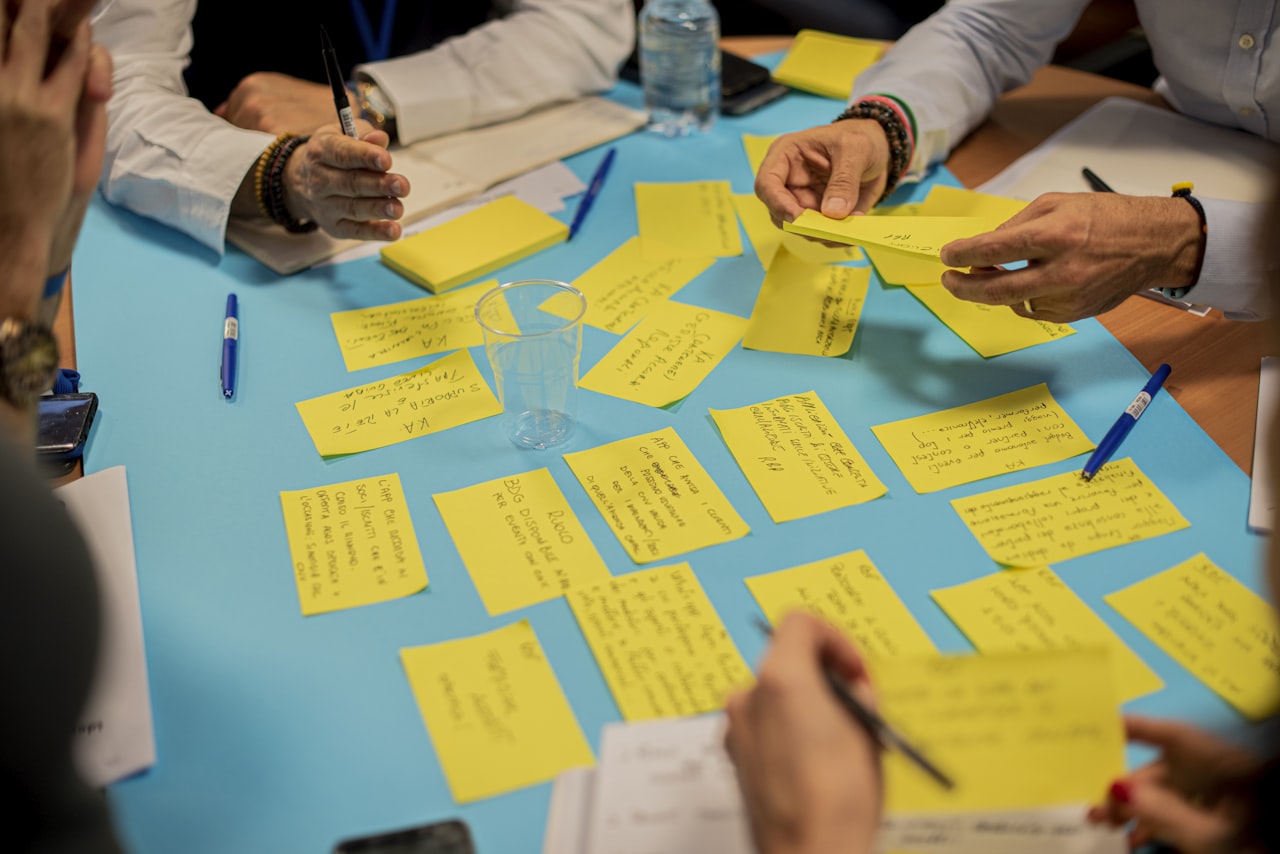
Facilitation tip: Run the SWOT as a silent brainstorming exercise first. Give participants five minutes to write individual observations on sticky notes (one per note), then have everyone post their notes simultaneously. Group similar observations and discuss themes. This approach prevents groupthink and ensures quieter team members contribute equally.
Exercise 2: Goal Setting with the OKR Framework
Objectives and Key Results (OKRs) translate business ambitions into measurable marketing targets. This framework works particularly well in workshop settings because it forces clarity on both the “what” (objectives) and the “how we will measure it” (key results).
Setting marketing objectives: Derive three to five marketing objectives directly from the company’s business goals. If the business goal is “grow revenue by 25%,” a marketing objective might be “increase marketing-qualified leads by 35% to support the sales pipeline.” Objectives should be ambitious but achievable, qualitative, and time-bound to the year.
Defining key results: Each objective should have two to four key results — specific, measurable outcomes that indicate progress. For the lead generation objective, key results might include: “Increase organic traffic by 40% from 50,000 to 70,000 monthly sessions,” “Achieve a 3.5% website conversion rate (up from 2.8%),” and “Generate 200 marketing-qualified leads per month by Q3.”
Workshop exercise structure: Divide participants into small groups of three to four. Assign each group one to two business objectives to translate into marketing OKRs. Give groups 20 minutes to draft their OKRs, then reconvene for group presentations and collective refinement. This parallel working approach covers more ground than whole-group brainstorming.
Common pitfalls: Avoid setting too many objectives (five is the maximum), confusing key results with tasks (a key result is an outcome, not an activity), and setting key results without baseline data. If you do not know your current conversion rate, you cannot meaningfully set a target. Where baselines are missing, make establishing the baseline a Q1 priority.
Align your marketing OKRs with your overall digital marketing strategy to ensure coherence across all channels and initiatives.
Exercise 3: Channel Planning and Prioritisation
With objectives defined, the next step is mapping those objectives to specific marketing channels and initiatives. This exercise transforms strategic goals into an operational plan.

Channel assessment matrix: Create a matrix listing all potential marketing channels on one axis and your objectives on the other. For each intersection, assess the channel’s likely contribution to the objective on a scale of one to five. This quickly reveals which channels serve multiple objectives (high priority) and which serve few (candidates for deprioritisation).
Resource and capability check: For each high-priority channel, assess your current capability and resource level. Do you have the skills in-house to execute? Do you need agency support? What tools or technology are required? This reality check prevents the common mistake of planning ambitious initiatives without the resources to deliver them.
The 70-20-10 allocation: A proven planning framework allocates 70% of resources to proven, reliable channels that delivered results last year, 20% to emerging opportunities that showed promise, and 10% to experimental initiatives. In Singapore’s digital landscape, your 70% might cover Google Ads and SEO, your 20% might include TikTok advertising, and your 10% might explore AI-generated content or new platforms.
Initiative prioritisation: Within each channel, list specific initiatives and prioritise them using an impact-effort matrix. High-impact, low-effort initiatives go first. High-impact, high-effort initiatives need careful planning. Low-impact initiatives — regardless of effort — should be deprioritised or eliminated. Be ruthless about saying no to low-priority activities.
Calendar mapping: Plot your prioritised initiatives across a 12-month calendar, accounting for seasonal peaks, Singapore’s festive calendar, product launch dates, and resource availability. Identify potential bottlenecks where multiple major initiatives overlap and adjust timing accordingly.
Facilitation Tips for Productive Sessions
The facilitator’s skill determines whether the workshop produces genuine strategic clarity or devolves into unfocused discussion. These tips help ensure productive outcomes.
Manage dominant voices: In every team, some individuals naturally dominate discussions while others hold back. Use structured exercises (silent brainstorming, round-robin sharing, small group work) to ensure balanced participation. Actively invite quieter participants to share their perspectives — they often have the most insightful observations.
Keep discussions strategic: Workshops frequently drift into tactical execution details. When someone starts discussing specific ad copy or email subject lines, gently redirect: “That is an important execution detail — let us capture it in the action items and stay at the strategic level for now.” Save tactical planning for follow-up sessions.
Use time boxing ruthlessly: Assign specific time limits to each discussion and exercise. When time is up, move on — even if the conversation feels unfinished. Unresolved items go on a “parking lot” list for follow-up. Without time boxing, the first session invariably consumes the entire day.
Document in real time: Assign a dedicated note-taker who captures decisions, action items, and key discussion points as they happen. At the end of each session, read back the key decisions to confirm alignment. Waiting until after the workshop to document outcomes risks losing important nuances.
Manage energy levels: Schedule the most creative and strategic exercises for the morning when energy is highest. Use the post-lunch slot for structured, framework-driven exercises that provide clear direction. Build in breaks and consider energiser activities if the group’s attention flags. For Singapore teams, a good catered lunch makes a meaningful difference to afternoon productivity.
Workshop Outputs and Deliverables
A successful marketing planning workshop should produce tangible outputs that drive action in the weeks following the session. Without clear deliverables, even the best discussions fade into forgotten intentions.
Marketing SWOT summary: A one-page document capturing the prioritised strengths, weaknesses, opportunities, and threats identified during the workshop. This serves as a strategic reference point throughout the year.
Marketing OKRs for the year: Three to five objectives with two to four key results each, agreed upon by the full team. These become the scorecard against which all marketing activity is measured. Review progress against OKRs monthly or quarterly.
Channel prioritisation matrix: A clear ranking of marketing channels by priority, with allocated resource levels and key initiatives for each. This prevents scope creep and provides a decision framework when new opportunities or requests arise — if it does not serve a prioritised channel or objective, it should not consume resources.
12-month marketing calendar: A high-level calendar showing major campaigns, content themes, seasonal initiatives, and milestone dates across the year. This becomes the operational backbone of marketing execution. Integrate it with your content marketing editorial calendar and paid media planning schedule.
Action items and owners: A detailed list of every action item agreed during the workshop, each with a named owner and a deadline. Typically, the major follow-up action is the completion of a detailed marketing plan document within two to three weeks, incorporating all workshop outputs.
Post-Workshop Follow-Up
The workshop itself is only the beginning. What happens in the weeks afterwards determines whether the planning effort translates into action.

Distribute the workshop summary within 48 hours: Send a comprehensive summary document to all participants within two days. Include the SWOT summary, agreed OKRs, channel priorities, calendar, and action items. Ask participants to review and flag any misunderstandings or disagreements within one week.
Complete the detailed marketing plan: Assign one to two people to translate workshop outputs into a formal marketing plan document. This should include channel strategies, budget allocations, campaign briefs, KPI targets, and a detailed execution timeline. Set a deadline of two to three weeks post-workshop.
Present to leadership: Schedule a presentation of the marketing plan to senior leadership within four weeks of the workshop. Frame the plan in terms of business impact — expected revenue contribution, lead generation targets, and market share objectives. Secure budget approval and executive buy-in before beginning execution.
Set up a review cadence: Establish monthly or quarterly OKR review meetings to track progress against the goals set during the workshop. These check-ins create accountability and provide opportunities to adjust the plan in response to changing market conditions or performance data.
Solicit participant feedback: After the workshop, gather feedback from participants on the format, facilitation, and outcomes. Use this input to improve next year’s planning workshop. Continuous improvement in the planning process itself leads to better plans over time.
Frequently Asked Questions
How long should a marketing planning workshop be?
A full-day session (approximately seven to eight hours including breaks) works best for most teams. This provides sufficient time for the year-in-review discussion, SWOT analysis, goal setting, and channel planning without feeling rushed. For larger teams or more complex businesses, consider a one-and-a-half or two-day format. Half-day workshops are possible but typically sacrifice depth for speed.
Who should attend the marketing planning workshop?
Include the full marketing team, a representative from sales, and ideally a senior leader who can speak to business objectives. For smaller Singapore businesses where marketing might be a team of two or three, consider including the business owner, a customer-facing team member, and any key agency partners. The workshop benefits from diverse perspectives but becomes unwieldy with more than 12 participants.
Should I use an external facilitator?
An external facilitator adds value when the marketing leader wants to participate fully in the discussion rather than managing the process, when there are team dynamics or political tensions that benefit from neutral management, or when the team has never conducted a formal planning workshop before. For experienced teams with strong internal facilitators, managing the workshop in-house is perfectly effective.
What if we cannot agree on priorities during the workshop?
Disagreement is healthy and expected. Use structured decision-making techniques such as dot voting (each participant gets a set number of votes to allocate across options), impact-effort matrices, or forced ranking exercises. If genuine impasses remain, escalate to the business leader for a tiebreaking decision. Do not leave the workshop with unresolved priority conflicts — they will paralyse execution.
How do I connect the workshop outputs to budget planning?
The channel prioritisation and initiative planning from the workshop should directly inform your budget requests. For each prioritised initiative, estimate the required budget across media spend, content production, tools, and personnel. Use the previous year’s cost data and performance metrics to build realistic projections. Present the budget as a direct extension of the strategic plan rather than a separate exercise.