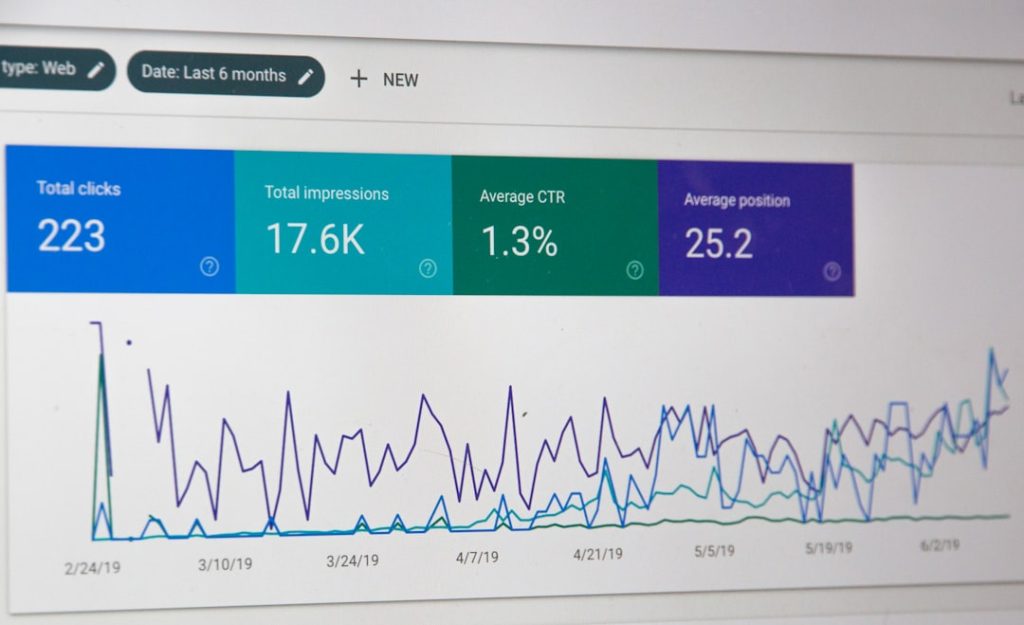
SEO for Manufacturing Companies in Singapore: Technical B2B Search Strategy
Table of Contents
Why SEO Matters for Singapore Manufacturers
A disciplined manufacturing SEO Singapore programme is one of the few marketing investments that compounds rather than decays. Paid media stops generating leads the day you pause spend. Search rankings, once earned on well-structured capability pages and cornerstone technical content, continue delivering qualified inbound for years. For manufacturers with 90-180 day buying cycles and deal values in the hundreds of thousands or millions of SGD, that compounding is the difference between a marketing programme that funds itself and one that the CFO questions every budget cycle.
Manufacturing SEO is structurally different from consumer or even generic B2B SEO. The queries are lower in volume but higher in intent. A search like “ISO 13485 injection moulding contract manufacturer Singapore” may see only 30-60 searches per month — but every one of those searches is a procurement or engineering professional actively shortlisting. Ranking in positions one to three for 40-80 such queries produces more pipeline than ranking for any single high-volume consumer term ever could.
Manufacturing SEO sits alongside your broader digital marketing for manufacturing programme as the durable, long-cycle pipeline layer. Paid search, LinkedIn and email handle the 0-12 month window; SEO builds the 12-60 month baseline that makes those other channels cheaper and more effective by creating earned authority search engines trust.
Capability-Led Keyword Strategy
The biggest keyword research mistake Singapore manufacturers make is treating their website like a brochure (“About”, “Products”, “Contact”) rather than a search graph mapped to buyer intent. A capability-led keyword strategy inverts that.

Build your keyword universe along four dimensions. First, capability: precision CNC machining, 5-axis milling, Swiss turning, EDM, surface grinding, injection moulding, PCB assembly, cable harness assembly, sheet metal fabrication, laser cutting, additive manufacturing. Second, material and process specificity: titanium machining, medical-grade silicone moulding, aluminium anodising, IPC-A-610 Class 3 PCB assembly. Third, certification and compliance: ISO 13485 contract manufacturer, AS9100D machining, IATF 16949 supplier, RBA-compliant electronics assembly. Fourth, geography and market: Singapore, ASEAN, Southeast Asia, and sometimes specific export corridors (Thailand, Vietnam, Malaysia).
Cross these four dimensions to generate your target query set. “5-axis CNC machining Singapore”, “AS9100D precision machining ASEAN”, “medical device injection moulding Singapore”, “IPC-A-610 Class 3 PCB assembly Southeast Asia”. A mid-size contract manufacturer should map 80-200 target queries; specialists 40-80. Validate search volume in Ahrefs, SEMrush or Google Keyword Planner, but do not discard low-volume terms — in manufacturing, a query with 10 monthly searches can be worth more than one with 1,000.
Layer in informational and top-of-funnel queries that warm buyers earlier in the cycle: “how to choose a precision machining supplier in Asia”, “China+1 contract manufacturing options”, “what is SIRI Band 2 manufacturing”. These feed your content marketing calendar and build topical authority that lifts your commercial pages.
Site Architecture for Manufacturing Sites
Architecture matters more in manufacturing SEO than in almost any other vertical because of the combinatorial complexity of capabilities, materials, industries and certifications. A well-architected manufacturing site looks like a hub-and-spoke graph, not a linear brochure.
The homepage establishes the top-level proposition and certifications. Immediately beneath, three hub types branch out. Capability hubs (“Precision Machining”, “PCB Assembly”, “Injection Moulding”) each deep-link into specific sub-capability pages (5-axis, Swiss turning, EDM under machining). Industry hubs (“Medical Device Manufacturing”, “Aerospace Manufacturing”, “Automotive”, “Semiconductor Back-End”) present your offering filtered through the buyer’s lens. Certification and compliance pages (ISO 13485, AS9100D, IATF 16949) act as qualification magnets pulling in specific procurement searches.
Every capability page should cross-link to the industries it serves and the certifications that apply, and vice versa. This creates the internal linking density search engines reward with ranking authority. Case studies become the connective tissue — a case study on titanium aerospace brackets links upward to “5-axis machining”, “Aerospace Manufacturing” and “AS9100D”, embedding commercial proof throughout the graph.
Build out blog and resource content as the topical authority layer beneath the hubs. Technical deep-dives, buyer guides, process explainers and industry commentary. A well-designed web design and development engagement is the right time to rebuild this architecture; patching it onto a legacy site rarely produces the same results as rebuilding the information architecture from scratch.
Technical SEO for Industrial Sites
Technical SEO for manufacturing sites focuses on four areas more than on a generic B2B site.

Schema markup: Organisation, LocalBusiness, Product (for catalogue SKUs where applicable), Service (for capabilities), FAQPage on every page with a FAQ section, and BreadcrumbList throughout the hub-and-spoke structure. Manufacturers often have defensible entries in Knowledge Graph that remain un-claimed — fixing this alone can lift branded CTR noticeably.
Core Web Vitals and performance: manufacturing sites historically load slowly because of heavy image galleries showing machinery, cleanrooms and products. Compress aggressively (WebP, lazy loading, responsive srcset), defer non-critical JavaScript, and ensure LCP under 2.5 seconds on mobile. Buyers research on desktop but frequently first click through on mobile; slow mobile pages destroy rankings.
Crawlability and indexation: large manufacturing catalogues can generate crawl budget problems if faceted navigation creates thousands of parameter URLs. Use robots.txt and canonical tags to consolidate authority on canonical capability pages. Submit XML sitemaps segmented by content type (capabilities, industries, case studies, blog) to Search Console for clean indexation signal.
International and hreflang: manufacturers exporting across ASEAN and globally benefit from hreflang implementation if they maintain country-specific pages. For single-site architectures, geographic keyword coverage on capability pages is typically sufficient. Do not implement hreflang half-heartedly — broken hreflang is worse than no hreflang.
Technical SEO overlaps heavily with general SEO services, but the manufacturing context amplifies the cost of getting it wrong. One misconfigured canonical tag on a capability hub can cost you 60-80% of rankings overnight.
Content Depth and E-E-A-T for Manufacturing Buyers
Google’s Experience, Expertise, Authoritativeness and Trustworthiness (E-E-A-T) framework is not a ranking factor by itself, but it powerfully influences how Google’s systems evaluate manufacturing content. Manufacturing buyers, and the algorithms trained on their engagement signals, reward depth and specificity.
Every capability page should run 1,200-2,500 words with the substance to justify that length. Process description, equipment list with makes and models where commercially sensible, tolerance ranges, typical materials, secondary operations offered, inspection methodology, typical lead times, minimum and maximum order quantities, and example applications. Generic “we offer precision CNC machining” pages rank for nothing and convert nobody.
Named authorship strengthens E-E-A-T materially. Engineering managers and technical directors named as authors on technical content, with LinkedIn-linked author bios, give Google and buyers the expertise signal they need. Include process photography, video snippets from the shopfloor, and measurement data. Every customer-approved case study adds trust that no amount of copywriting can replicate.
Structured data supports E-E-A-T signals: Author schema on blog posts, reviewedBy and review schema where applicable, and links to ISO certification bodies’ verification pages where possible. A good content marketing operating model pairs marketing writers with subject-matter experts to produce content that ranks because it is genuinely authoritative, not because it is search-optimised in isolation.
Link Building for Industrial B2B
Link building for manufacturing SEO is narrower and harder than for consumer sectors, which is also why the links are more valuable. A single dofollow link from EDB, Enterprise Singapore, SMF, A*STAR, an aerospace OEM customer press release or an industry publication outweighs dozens of low-quality links.
Build links along five pathways. First, industry associations and governmental bodies: SMF directory, Singapore Precision Engineering and Technology Association, ASMI, EDB supplier pages and Enterprise Singapore showcases. Membership already paid for; claim the directory listings.
Second, customer-driven links: press releases on new customer partnerships, co-marketing case studies, quotes in customer PR announcements. Global OEMs often link back to selected suppliers in sustainability reports and supplier showcase pages — actively pursue these.
Third, earned media: trade publications such as The Business Times, Manufacturing Today Asia, EMSNow, Aviation Week, Medical Design & Outsourcing. A well-run PR programme generates links alongside coverage. Guest expert commentary on industry trends, grant programmes and supply chain topics is often easier to place than feature coverage.
Fourth, academic and research partnerships: A*STAR SIMTech and ARTC collaborations, NUS and NTU engineering partnerships, polytechnic student project sponsorships. These domains carry high topical authority weight and are disproportionately valuable for manufacturing sites.
Fifth, digital PR on proprietary data: original research on Singapore manufacturing wage trends, energy costs, SIRI adoption rates, ASEAN export flows. Even modest data studies can earn links from multiple industry outlets. Avoid paid link schemes, PBNs and low-quality guest posts — Google’s manufacturing-adjacent spam detection has improved significantly and these tactics now materially hurt more often than they help.
Budgets, Timelines and Measurement
Realistic SEO budgeting for Singapore manufacturers in 2026: S$3,500-6,500 per month for single-site programmes focused on domestic and primary ASEAN keywords, S$7,500-15,000 per month for larger manufacturers pursuing multi-market, multi-capability visibility. These bands cover technical SEO, content production (4-10 pieces per month), link outreach and reporting.
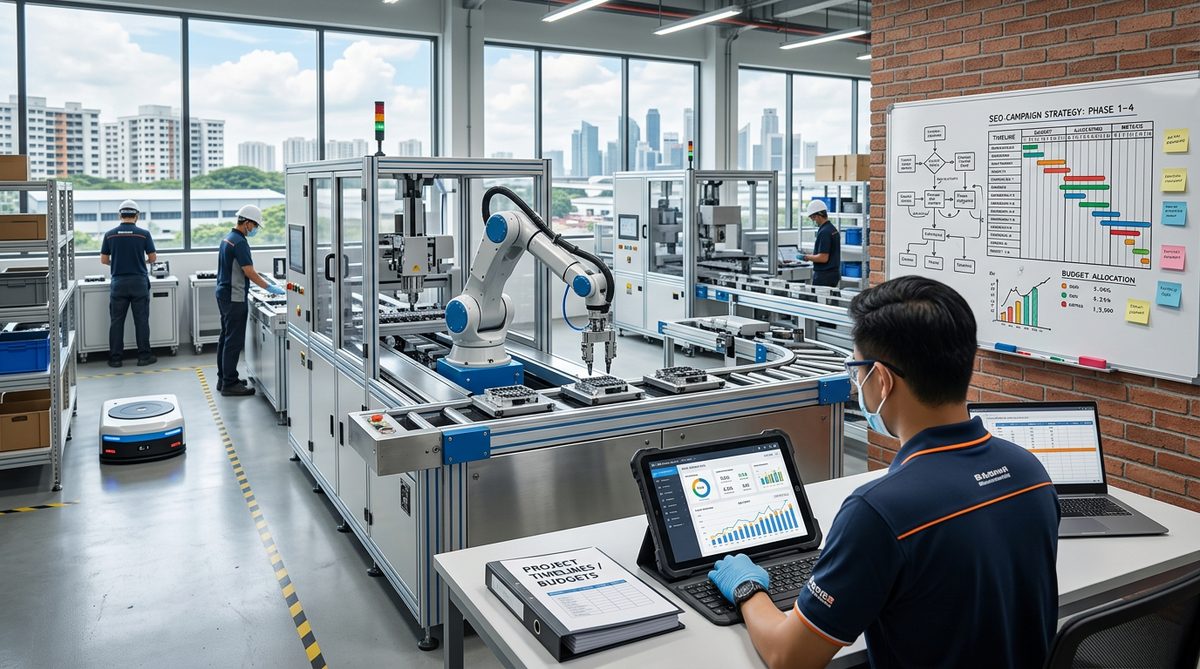
Factor in PSG Pre-Approved marketing vendors, which can subsidise up to 50% of qualifying adoption costs within caps, and EDG co-funding of up to 50% of qualifying project costs for SMEs on capability development projects that include SEO as part of a broader transformation. Your finance team should always evaluate SEO spend net of grants.
Timelines: expect 4-6 months to measurable organic traffic lift, 9-12 months to ranking in top three for your priority capability queries, and 18-24 months to full programme maturity where organic contributes 30-50% of qualified inbound pipeline. Manufacturers chasing 90-day SEO results are either buying from charlatans or misreading the fundamentals of how search works.
Measure pipeline, not traffic. Configure GA4 conversion events for quote requests, capability page downloads, technical consultation bookings and contact form submissions. Integrate with CRM so organic-sourced MQLs flow through to closed-won revenue. Report quarterly on organic-attributed pipeline and revenue, not monthly on keyword rankings. For a broader organic-channel context, see our B2B SEO strategy guide which complements this manufacturing-specific playbook.
Frequently Asked Questions
How much does manufacturing SEO cost in Singapore?
Entry programmes run S$3,500-6,500 per month for focused single-capability SEO. Mid-tier manufacturers with multiple capabilities and ASEAN export focus typically invest S$7,500-15,000 per month. PSG and EDG grants can offset up to 50% of qualifying spend within prevailing caps. Underfunded SEO below S$3,000 monthly rarely produces meaningful ranking movement for competitive manufacturing queries.
How long before SEO generates leads for a Singapore manufacturer?
Expect 4-6 months to measurable organic traffic growth, 9-12 months to ranking in top three positions for priority capability queries, and 18-24 months to SEO contributing 30-50% of qualified inbound pipeline. Manufacturing buying cycles of 90-180 days add another 3-6 months from first organic visit to closed revenue.
What keywords should a Singapore contract manufacturer target?
Capability-plus-geography combinations (5-axis CNC machining Singapore, ISO 13485 injection moulding Asia), certification-led queries (AS9100D aerospace supplier, IATF 16949 contract manufacturer), and industry-specific variants (medical device contract manufacturing Singapore). A typical mid-size manufacturer targets 80-200 prioritised queries across four to seven capability clusters.
Does schema markup actually help manufacturing SEO?
Yes. Organisation, Service, Product, FAQPage and BreadcrumbList schema collectively improve rich result eligibility, enhance branded SERP appearance and support Google’s entity understanding of your site. Proper schema implementation typically lifts branded CTR by 10-25% and helps capability pages qualify for additional SERP features.
Can a small manufacturer realistically compete on SEO against larger firms?
Yes, because manufacturing keywords are narrow enough that topical depth beats brand size. A focused 30-person precision machining specialist with 60 deeply optimised capability pages and credible technical authorship frequently outranks much larger diversified manufacturers whose SEO is shallow across many verticals. Specificity is the specialist’s structural advantage.
Should manufacturing SEO focus on English only, or include Chinese or Bahasa?
For most Singapore manufacturers, English-first is correct. Decision-level procurement and engineering audiences across ASEAN and globally operate in English. Dedicated Chinese SEO makes sense only if you have material China market exposure and the content infrastructure to support it; otherwise it dilutes domain authority across fewer English pages.
What is the single biggest SEO mistake manufacturers make?
Treating the website as a static brochure rather than a living capability graph. Shallow “About / Services / Contact” architectures with no depth on individual capabilities, materials, certifications or industries cannot rank for the queries that generate procurement pipeline. Rebuilding the information architecture is often more valuable than any amount of on-page optimisation on the wrong structure.
How does manufacturing SEO differ from general B2B SEO?
Manufacturing SEO emphasises capability-and-certification-led architecture, deeper technical content with named engineering authorship, industrial schema markup, and link-building through industry associations, customer PR and academic partnerships rather than generic guest posting. Search volumes per query are lower, but intent and deal values are dramatically higher, which changes the economics of what content is worth producing.