Overview
Skyscanner is a global travel search engine with deep organic visibility across most major markets. The brief to us was specific: re-optimise meta titles, meta descriptions and H1s on two of their highest-intent template page types — Flights to {city/airport} and Routes — across ten markets needing sharper localisation: Israel, Singapore, Belgium, Greece, Saudi Arabia, New Zealand, Switzerland, Taiwan, Mexico and Turkey.
Project Snapshot
- Sector: Global travel search
- Engagement: Template-scale international on-page SEO
- Timeline: Ten markets; measured over the following 12 months
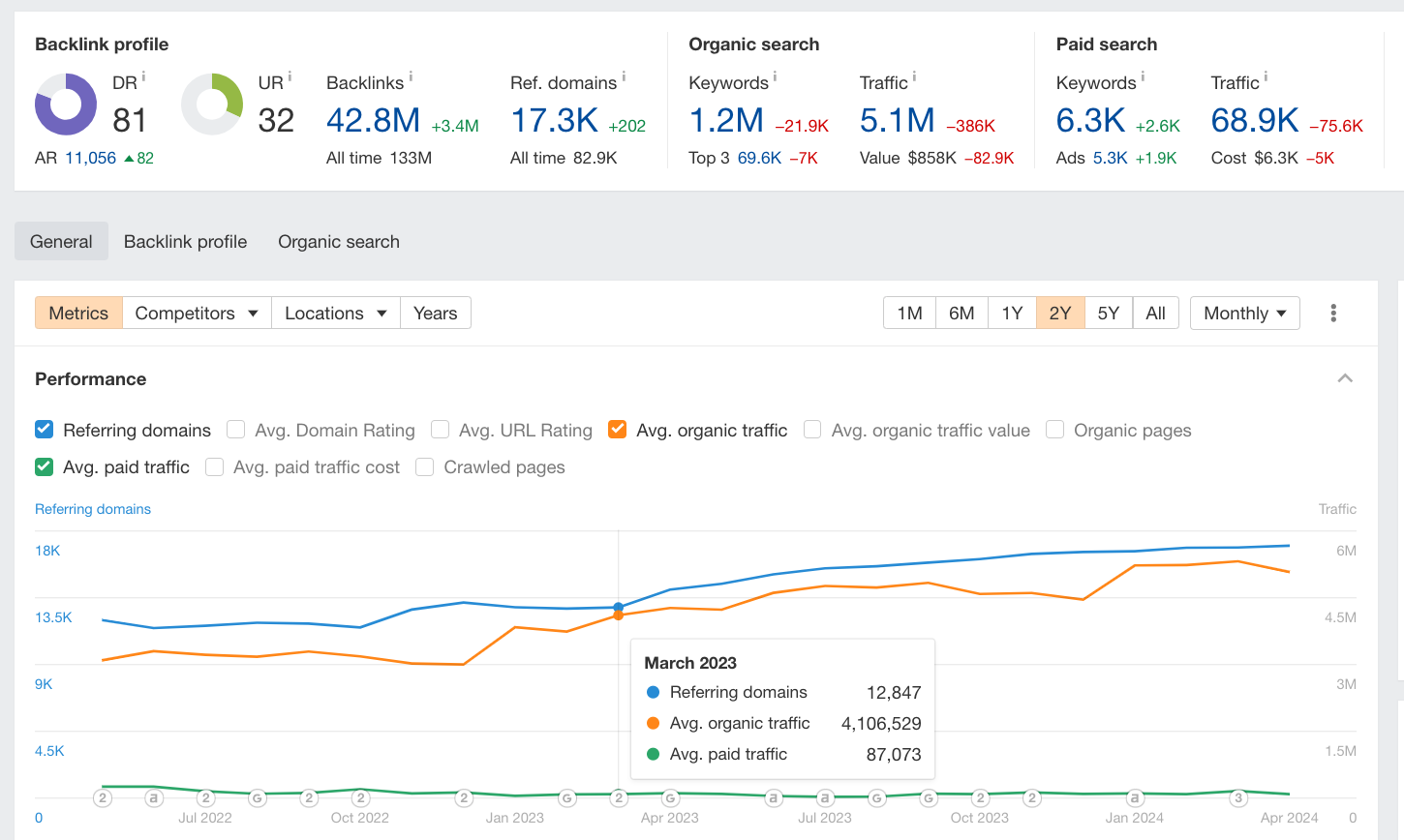
- Twelve months after the optimisations went live, Skyscanner’s overall organic traffic had grown approximately 25% year on year — from around 4 million to over 5 million monthly organic visitors (Ahrefs).
- To be clear about attribution: a lift of that size on that base reflects many parallel initiatives, and this work was one input among several. The optimised templates were performing in line with the test hypotheses at handover, and the per-market patterns were folded into the central template playbook.
The Challenge
This was on-page SEO at template scale. A single template change at Skyscanner’s size propagates to thousands of URLs simultaneously — the right pattern compounds across the index; the wrong pattern damages thousands of pages at once. The existing templates in the ten markets were either literally translated or under-optimised for local search behaviour, and every recommendation had to survive a controlled experimentation pipeline before touching production.
Our Approach
- Per-market keyword research — local-language and Romanised destination variants, airline brand modifiers, and intent qualifiers (cheap, direct, return), cross-checked against click-through patterns to filter out high-volume but low-intent queries.
- Competitor SERP analysis per market — the top organic competitors’ title patterns, description hooks and H1 framings. The patterns differed sharply: some SERPs rewarded price-led descriptions, others trust signals or carrier modifiers; Israel and Saudi Arabia looked nothing like the Western European baseline.
- Template copy as testable hypotheses — meta and H1 variants combining Skyscanner’s brand voice with local query patterns, delivered into their experimentation framework for staged rollout with CTR and position baselines per variant.
The Results
- Twelve months after the optimisations went live, Skyscanner’s overall organic traffic had grown approximately 25% year on year — from around 4 million to over 5 million monthly organic visitors (Ahrefs).
- To be clear about attribution: a lift of that size on that base reflects many parallel initiatives, and this work was one input among several. The optimised templates were performing in line with the test hypotheses at handover, and the per-market patterns were folded into the central template playbook.
- For context, sustained high-single-digit year-on-year organic growth is healthy for a mature travel platform at this scale — a 25% blended lift is well above that benchmark.
- Specific keyword sets and experiment results remain under NDA until 2027.
Why This Worked
Template-scale SEO succeeds or fails on pattern quality. At most companies, a meta-title tweak is a page-level decision; at Skyscanner’s scale, a single template pattern propagates across thousands of live URLs in each market. That concentration of leverage is exactly why the engagement was structured around hypotheses rather than opinions — every proposed pattern had to carry a testable prediction about click-through and position movement before it went anywhere near production.
The second success factor was refusing to treat “international” as “translated”. The SERPs in Tel Aviv, Riyadh and Taipei reward genuinely different things — price-led hooks in some markets, carrier-brand modifiers in others, trust signals in a third — and those differences only surface when you analyse each market’s competitive set natively rather than porting a Western European baseline. The ten markets in scope each got their own keyword research, their own competitor teardown, and their own copy patterns, unified only by brand voice.
Finally, working inside Skyscanner’s experimentation framework — rather than around it — meant every change that survived did so on evidence. That is slower than pushing copy straight to production, and considerably more durable.
Key Takeaways
- At template scale, one pattern decision outweighs a hundred page-level optimisations — invest the analysis where the leverage is.
- Localisation is competitive analysis, not translation: each market’s SERP rewards different title and description patterns.
- High-intent transactional templates (destination and route pages) are where travel SEO revenue concentrates — optimise those before anything editorial.
- Experimentation pipelines are an asset, not an obstacle: hypotheses that survive controlled rollout keep compounding after handover.
Frequently Asked Questions
What is template-level SEO?
Optimising the patterns that generate metadata and headings across an entire page type — so one change improves thousands of URLs simultaneously. It’s the highest-leverage on-page work available to platforms and marketplaces with programmatic pages, and the highest-stakes, since a bad pattern damages the same thousands of pages at once.
Why can’t the 25% traffic growth be fully attributed to this work?
Because platforms like Skyscanner run many SEO and product initiatives in parallel, and honest attribution acknowledges that. What can be said: the optimised templates performed in line with their test hypotheses, and the blended result — 25% year-on-year growth on a four-million-visitor base — sits far above the mature-platform benchmark of high single digits.
Does this kind of work apply to businesses smaller than Skyscanner?
Yes — any site with programmatic or repeating page types benefits: e-commerce category and product templates, directory listings, location pages. The method scales down cleanly; the leverage stays proportionally identical.
How long does market-localised template optimisation take?
For a multi-market scope like this one, research through delivery typically runs two to three months, with results measured over the following quarters as rollouts complete and rankings mature.
Which markets were in scope?
Israel, Singapore, Belgium, Greece, Saudi Arabia, New Zealand, Switzerland, Taiwan, Mexico and Turkey — ten markets whose templates were either literally translated or under-optimised for local search behaviour, each analysed natively rather than from a Western European baseline.
What page types were optimised?
Two of Skyscanner’s highest-intent programmatic templates: the Flights to {city/airport} pages targeting destination demand, and the Routes pages capturing origin-destination comparison and planning queries — the surfaces where travel search revenue concentrates.
Why are the exact keyword results under NDA?
Platform-scale experimentation data is competitively sensitive — the specific keyword sets, before/after rankings and test results remain confidential under the engagement’s terms until 2027, which is also why this case study reports the blended public traffic figures with attribution caveats instead.