B2B Lead Generation for Singapore Manufacturers: Channels, Tools and Tactics
Table of Contents
- Why Manufacturing Lead Generation Differs
- Defining the Ideal Customer Profile
- Inbound Channels: SEO, Content and Referral
- Outbound and Account-Based Marketing
- Paid Channels: LinkedIn, Search and Industry Directories
- Tools and Tech Stack for the SME Manufacturer
- Lead Scoring, Nurture and Sales Handoff
- Benchmarks, Budgets and ROI Expectations
- Frequently Asked Questions
Why Manufacturing Lead Generation Differs
Effective B2B lead generation manufacturing Singapore is structurally different from services lead gen or consumer demand generation. Sales cycles run 6 to 18 months. Buying committees include 6 to 12 stakeholders. Average contract values run from S$80,000 for small parts contracts to S$25 million for capital equipment or multi-year supply agreements. The lead generation programme has to match that reality.
Volume metrics mislead in this environment. A manufacturing marketing team that generates 500 leads per month but only 6 qualified opportunities is failing, while a team that generates 40 leads per month with 18 qualified opportunities is winning. The right metric is pipeline value and sales-accepted lead rate, not raw lead count.
The second structural difference is the gap between enquiry and revenue. A Shopify brand sees revenue within days; a precision engineering shop in Tuas may see revenue 14 months after the first marketing touch. Your leadership team, your cash-flow model and your marketing budget have to accommodate that gap. For the strategic context this tactical guide sits inside, start with our digital marketing for manufacturing Singapore service page.
Defining the Ideal Customer Profile
A sharp ICP is the single highest-leverage input to a manufacturing lead generation programme. Vague ICPs (“medium-sized companies that need contract manufacturing in Asia”) produce vague targeting, vague messaging and vague pipeline. Sharp ICPs concentrate every subsequent decision.

A good ICP specifies industry and sub-vertical, company size band (employees, revenue, or plant count), geography, technical requirements (certifications needed, tolerance bands, volume per year), and pain signal (what triggers them to look for a new supplier). For a Singapore precision engineering SME targeting medical device customers, a strong ICP reads: “ISO 13485 certified medical device OEMs and contract manufacturers with 200-2,000 employees, headquartered or with manufacturing presence in Singapore, Malaysia or Penang, requiring Class II or III metal components with tolerances tighter than ±0.01 mm, currently purchasing from vendors with a lead time longer than 6 weeks.”
Build a target account list of 150 to 400 named companies against that ICP. This list drives outbound targeting, LinkedIn ad audiences, trade show pre-meeting requests, and content topic selection. An ICP without a named account list is an exercise in theory, not a marketing input.
Inbound Channels: SEO, Content and Referral
Inbound is the foundation because it captures active demand at the moment buyers need you. For Singapore manufacturers, the inbound stack is led by search — specifically, long-tail technical and application-level queries that engineers and sourcing managers type into Google.
A well-built manufacturing SEO programme targets three query types: solution-aware (“PCB assembly IPC-610 Class 3 Singapore”), vendor-aware (“ISO 9001 AS9100D contract manufacturer Singapore”), and comparative (“CNC machining Singapore vs Malaysia cost”). Each type needs purpose-built landing pages with real technical content, not sales collateral. Expect 4 to 8 months to rank for competitive terms and another quarter before traffic converts to pipeline at scale. Pair this with a strong SEO services engagement or in-house capability.
Referral and partner channels are the second inbound source. System integrators, design houses, distributor partners and complementary manufacturers all generate qualified referrals when the relationship is structured. Build a formal referral programme with documented commission or reciprocal arrangements, and track referral sources in your CRM. Many Singapore manufacturers have strong informal referral flow that never gets measured — measuring it is usually the first step to growing it.
Outbound and Account-Based Marketing
Outbound lead generation works for Singapore manufacturers when it is targeted, researched and multi-touch. Mass cold outreach rarely produces sustainable results and damages brand perception. ABM — coordinated outbound against the named account list — is the right frame.
A typical ABM cadence against a 200-account target list runs over 8 to 12 weeks per wave. Week 1 to 2 is research and LinkedIn connection requests to the 3 to 5 relevant contacts per account. Week 3 to 4 layers in personalised emails referencing specific operational challenges. Week 5 to 6 adds a direct mail touchpoint (a physical sample, a printed technical brief, or an industry report) posted to the named stakeholder. Week 7 onwards escalates to phone outreach from a BDR or sales team member.
Personalisation at scale is the hard part. Use tools like Apollo, LeadIQ or Cognism to pull verified contact data for Singapore and ASEAN accounts, and use a structured brief template to personalise without rewriting every email from scratch. Budget S$8,000 to S$25,000 per quarter for a proper ABM wave once research, contact data, content and outreach labour are included. The payoff is that well-executed ABM typically delivers 5 to 15 qualified opportunities per wave in Singapore manufacturing.
Paid Channels: LinkedIn, Search and Industry Directories
LinkedIn is the dominant paid B2B channel for Singapore manufacturing because the targeting precision matches the narrow ICP. You can target by industry, company size, job function, seniority and specific job titles like “Director of Supply Chain” or “VP of Engineering.” Pair this with your named account list uploaded as a matched audience and you get highly concentrated delivery.
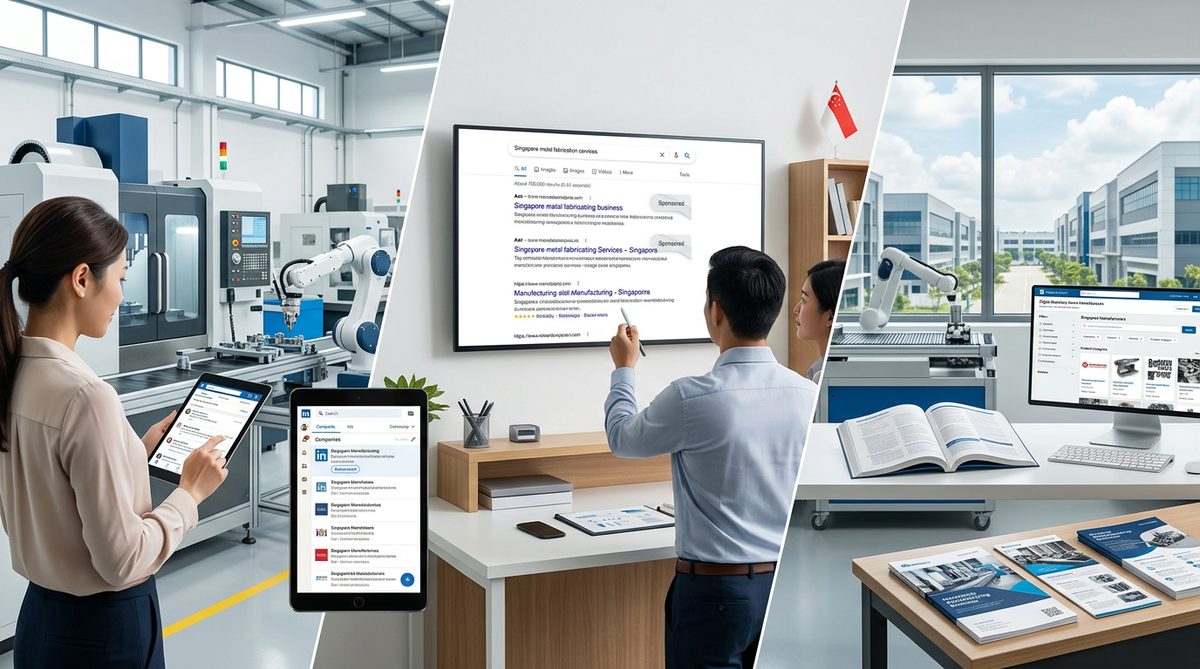
LinkedIn formats for manufacturing lead gen: Sponsored Content with technical whitepapers (cost per lead S$80 to S$180), Message Ads with event invitations (cost per meeting S$300 to S$700), and Conversation Ads with multi-step qualification flows (cost per MQL S$120 to S$300). Running a strong LinkedIn marketing programme alongside your inbound is where most SG manufacturers find their scale lever.
Google Ads plays a different role. Use it to capture high-intent commercial queries — “[product category] supplier Singapore,” “[capability] contract manufacturer Asia” — and drive them to dedicated landing pages with specific CTAs (request a quote, book a plant tour, download the capability deck). Expect cost per click in the S$4 to S$18 range and cost per MQL in the S$150 to S$450 range for well-optimised campaigns. A disciplined Google Ads programme complements SEO by filling the top-of-SERP real estate on buying-stage queries.
Tools and Tech Stack for the SME Manufacturer
A credible Singapore manufacturing lead gen stack in 2026 typically includes a CRM (HubSpot Professional at roughly S$1,200/month or Zoho at around S$300/month for SMEs), a marketing automation layer (often the same CRM), a contact data provider (Apollo or Cognism at S$150 to S$800/month), a LinkedIn Sales Navigator seat per BDR at around S$130/month, and a conversation intelligence tool like Gong or Chorus for larger teams.
The critical integration is your website to your CRM. Every form fill, chat interaction and downloaded asset should land against a contact and account record, with UTM source, campaign and content tagged automatically. Most Singapore manufacturers start with leaky attribution — leads dropping into an email inbox without proper tracking — and plug this gap within the first six months of serious lead generation work.
Add conversion-rate optimisation early. A 1.5 per cent visitor-to-lead rate and a 3 per cent visitor-to-lead rate produce very different pipeline outcomes on the same traffic. Tools like Hotjar or Microsoft Clarity for session recording, and a disciplined conversion rate optimisation programme, typically return 2 to 4 times their cost within a year.
Lead Scoring, Nurture and Sales Handoff
Not every lead deserves sales attention. A tiered scoring model — based on ICP fit (firmographic fit score) and engagement level (behavioural score) — lets your sales team spend time on the prospects likeliest to close. Typical thresholds: accounts in ICP + at least two high-intent actions (quote request, demo booking, pricing page visit) qualify for sales, while everything else goes into nurture.
Nurture sequences for manufacturing run long. A 12-month nurture track with monthly email touches — technical content, case studies, event invites, light sales outreach — converts 2 to 6 per cent of nurtured contacts into sales-accepted leads over the cycle. Brands that drop contacts after the first three emails lose compounding pipeline. Disciplined email marketing infrastructure is the engine here.
Sales handoff is where most manufacturing programmes leak. A qualified lead handed to sales should include: ICP fit rationale, engagement history, inferred intent signals, suggested talking points and an SLA for first outreach (target: under 4 business hours). Without this structure, BDRs and AEs either ignore leads or pitch them poorly, destroying the marketing investment. Read our companion article on manufacturing marketing in Singapore for the strategic frame that sits above this tactical layer.
Benchmarks, Budgets and ROI Expectations
Realistic benchmarks for Singapore manufacturing lead generation in 2026: cost per MQL of S$150 to S$450 blended across channels, MQL-to-SQL conversion of 25 to 40 per cent, SQL-to-opportunity conversion of 40 to 60 per cent, and opportunity-to-close of 20 to 35 per cent. If all four are within range, you have a healthy funnel — even if the absolute volume feels low compared to consumer brands.

Budget planning: a serious Singapore manufacturing lead gen programme targeting regional growth typically requires S$80,000 to S$250,000 per year in year one, rising to S$150,000 to S$500,000 by year three. That budget covers an agency or in-house marketing headcount, paid media, martech subscriptions, content production and event presence. Programmes below S$50,000 annual budget can generate leads but usually cannot sustain the content, tooling and campaign depth required for consistent pipeline.
ROI expectation: well-run B2B lead generation manufacturing Singapore programmes typically deliver 4 to 10 times pipeline multiple (pipeline value divided by marketing cost) and 2 to 5 times revenue multiple on closed-won business. The spread is wide because the gap between best-in-class and mediocre execution in this space is unusually large. The brands that invest in disciplined ICP work, content depth, and attribution tend to land in the top quartile.
Frequently Asked Questions
How many leads per month should a Singapore manufacturer expect?
For a mid-sized SME with a focused programme, expect 25 to 80 marketing-qualified leads per month after the first 9 months of activity. The right number depends on your deal size and close rate — a manufacturer with S$500,000 average deals needs far fewer leads than one with S$20,000 deals. Always calibrate targets against pipeline value, not lead count.
Is cold email still legal and effective in Singapore for B2B?
Yes, under the PDPA cold B2B email to professional business addresses is permitted when done with legitimate-interest framing and clear unsubscribe. Effectiveness depends on targeting and personalisation. Mass untargeted blasts are largely ignored; well-researched outreach to 50 named accounts per week with tailored value propositions still converts in this market.
Should I hire an in-house marketer or an agency?
Most sub-S$20 million revenue Singapore manufacturers are best served by a lean in-house marketing lead working with a specialist B2B agency for content, SEO and paid media delivery. Pure in-house tends to lack channel depth; pure agency tends to lack product and ICP depth. The hybrid typically gets both.
What CRM works best for a Singapore manufacturer?
HubSpot Professional offers the best marketing-to-sales integration for SMEs with 5 to 30 commercial users. Zoho CRM is strong on cost for smaller teams. Salesforce is often over-engineered for sub-S$30 million revenue manufacturers unless you already run other Salesforce products. Whichever you pick, integrate it properly with your website on day one.
How do I generate leads from ASEAN outside Singapore?
Combine a multi-country SEO approach with LinkedIn targeting by country and regional trade show presence (Manufacturing Indonesia, Metalex Thailand, METALTECH Malaysia). The Market Readiness Assistance grant covers up to S$100,000 per market for overseas business development, including digital marketing and trade missions, which materially offsets the cost of regional expansion.
What is a realistic conversion rate on a manufacturing website?
Benchmark visitor-to-lead conversion for a well-optimised Singapore manufacturing site is 1.5 to 3.5 per cent. Below 1 per cent usually signals weak positioning, unclear CTAs or poor mobile experience. Above 4 per cent is excellent and often indicates tight traffic quality from a focused SEO and paid mix rather than raw optimisation.
Do I need a lead magnet or gated content?
Gating works for a subset of content — high-value technical whitepapers, capability decks, pricing guides — where the information justifies the form fill. Over-gating damages SEO and frustrates engineers who want to evaluate suppliers quickly. A balanced approach keeps most educational content ungated and reserves gating for clear bottom-of-funnel assets.
How should I handle leads that go quiet after the first conversation?
Put them on a structured 12-month nurture track with monthly value-first touches: new case studies, industry benchmarks, regulatory updates, event invitations. Do not surrender them to the sales team as “dead.” Manufacturing buying cycles routinely restart 9 to 15 months after an initial enquiry once internal conditions change.
What marketing grants can fund lead generation for a Singapore manufacturer?
The Enterprise Development Grant (EDG) can co-fund strategic marketing capability build-outs. The Market Readiness Assistance grant funds overseas marketing and trade show activity. The Productivity Solutions Grant covers adoption of approved CRM and marketing automation tools. Combined, a Singapore SME manufacturer can typically secure S$30,000 to S$150,000 in grant support for a comprehensive lead gen build.