Product Photography Guide for Singapore Businesses
Your product photos do most of your selling. On an e-commerce listing, customers cannot touch, hold, or try your product. The image is everything. Poor photos create doubt. Strong photos build trust and drive purchases.
In Singapore’s competitive retail and e-commerce landscape, product photography is not optional — it is a baseline requirement. Whether you sell on Shopee, Lazada, your own Shopify store, or through social media, the quality of your product images directly affects conversion rates, return rates, and brand perception.
This guide covers what Singapore businesses need to know — from DIY setups to professional studio options, platform requirements, costs, and how to choose the right photographer.
Why Product Photography Matters
Product photography is not about making things look pretty. It is about communicating value, building confidence, and reducing friction in the buying process.
Conversion rates improve measurably. On marketplaces like Shopee and Lazada, listings with professional photos outperform those with amateur shots — often by significant margins. When customers compare similar products side by side, the one with better images wins.
Return rates decrease. When customers receive a product that looks exactly like the photos, they are less likely to return it. In Singapore, where return logistics eat into already-thin margins, reducing returns through accurate imagery is a genuine cost-saving measure.
Brand perception is shaped instantly. A customer’s first impression of your brand often comes from a product image. Blurry, poorly lit, or inconsistent photos signal a lack of professionalism. Consistent, high-quality images signal a business that cares about details.
For businesses serious about their online presence, investing in product photography in Singapore is one of the highest-return marketing decisions you can make. Learn more about our product photography services.
Types of Product Photography
Not all product photos serve the same purpose. Understanding the types helps you plan shoots effectively and allocate budget where it matters most.
White background (packshot) photography. The standard for e-commerce listings. The product is photographed against a clean white background with even lighting. Most marketplaces require or strongly prefer this style for main listing images.
Lifestyle photography. These images show the product in use or in a styled setting — a coffee mug on a desk, a dress worn by a model, a skincare product in a bathroom. Lifestyle images help customers imagine owning the product and work well for social media and advertising.
Detail and close-up shots. These highlight textures, finishes, labels, or specific features. For products where material quality matters — leather goods, jewellery, electronics — close-up shots answer questions customers would otherwise have to ask.
Scale and comparison shots. Showing a product next to a common object helps customers understand actual dimensions. This is especially important for products sold online where size is difficult to judge from photos alone.
Group and flat-lay photography. Arranging multiple products together shows breadth and encourages multi-item purchases. Flat-lay photography, shot from directly above, is particularly popular for social media content.
Food photography. A specialised category with its own techniques and styling requirements. Singapore’s food-centric culture means that food photography demands particular attention to making dishes look appetising and authentic.
Most businesses need a combination of these types. A typical e-commerce listing might include three to five white background shots, one or two lifestyle images, and a detail close-up.
DIY Product Photography Setup
Not every business needs a professional photographer for every product. If you are starting out or working with a limited budget, a DIY setup can produce acceptable results.
Essential equipment:
- Camera or smartphone. Modern smartphones (iPhone 14 and above, Samsung Galaxy S series) produce excellent product photos. An entry-level mirrorless camera with a kit lens is sufficient for most needs.
- Tripod. Camera shake ruins product photos. Smartphone tripods are affordable and widely available in Singapore.
- Lighting. Natural light from a large window works well for smaller products. For more control, invest in a pair of LED panel lights — basic sets start from around S$50 to S$100.
- Background. A large sheet of white paper curved from wall to table creates a seamless white background. For lifestyle shots, consider textured surfaces like wood or marble.
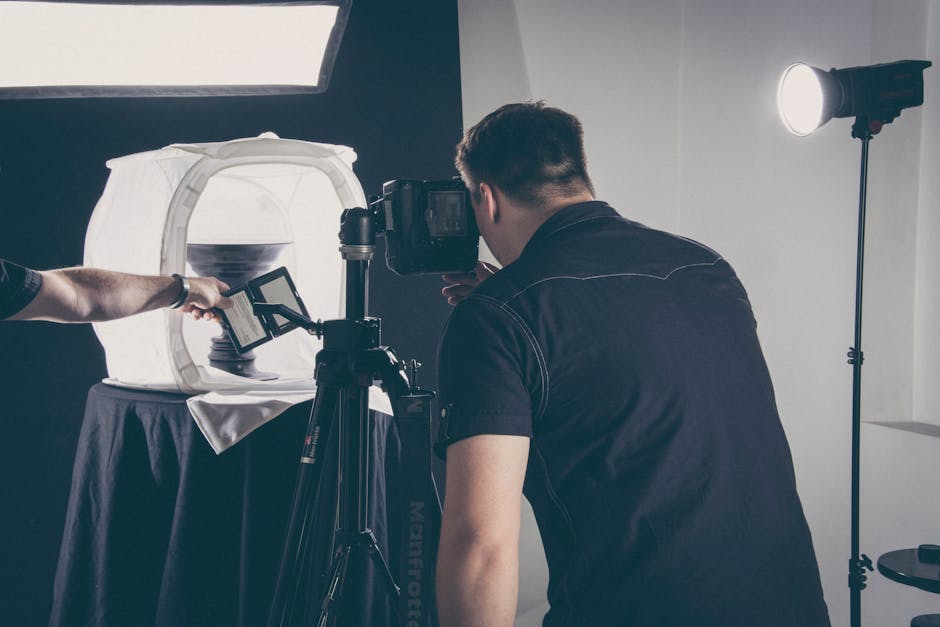
- Lightbox. For small products (jewellery, electronics, cosmetics), a collapsible lightbox provides even, diffused lighting. Available from S$30 to S$80 in Singapore.
Key tips:
- Shoot in manual mode or lock exposure settings for consistency across products.
- Use the lowest ISO setting to minimise image noise.
- Shoot more angles than you think you need — selecting is easier than reshooting.
- Maintain consistent styling, angles, and lighting across your entire product range.
DIY photography has limits. For hero images, advertising campaigns, or high-value product launches, professional photography delivers a noticeably better result.
Professional Studio Costs in Singapore
Understanding the cost structure of professional product photography in Singapore helps you budget effectively and evaluate quotes.
Per-image pricing. Rates typically range from S$15 to S$80 per image for standard white background photography, depending on the photographer’s experience, product complexity, and shoot volume. Specialist photographers may charge S$100 or more per image for complex items.
Half-day and full-day rates. Expect S$500 to S$2,000 for a half-day (four hours) and S$800 to S$3,500 for a full day (eight hours).
What affects pricing:
- Product complexity. Reflective products (glass, metal, jewellery) require sophisticated lighting and additional post-production.
- Styling requirements. Lifestyle shots with props and backgrounds cost more than simple packshots.
- Model involvement. Professional model rates in Singapore range from S$150 to S$500 or more per session.
- Post-production scope. Basic retouching is typically included. Extensive compositing or colour grading costs extra.
- Volume discounts. Most photographers offer better per-image rates for shoots of fifty or more products.
For businesses with ongoing needs, explore our e-commerce photography services for scalable solutions.
E-Commerce Platform Image Requirements
Each platform has specific image requirements. Failing to meet these can result in rejected listings or reduced visibility.
Shopee Singapore:
- Minimum: 500 x 500 pixels (recommended 1024 x 1024 or higher)
- Maximum file size: 2MB. Formats: JPG, PNG
- White or clean background preferred for main image. Up to nine images per listing
Lazada Singapore:
- Minimum: 330 x 330 pixels (recommended 800 x 800 or higher)
- White background required for main image. Product should fill 80% or more of the frame
- Up to eight images per listing
Amazon Singapore:
- Minimum: 1000 x 1000 pixels (recommended 2000 x 2000 for zoom)
- Pure white background (RGB 255, 255, 255) required. Product must fill at least 85% of frame
- No watermarks, logos, or text overlays on main image
Shopify and own website:
- Square images (1:1 ratio) most versatile. Recommended minimum: 2048 x 2048 pixels
- Consistent aspect ratios across all products. Optimise file sizes for fast loading
Brief your photographer on the specific platforms you sell through. Proper product photography supports your broader e-commerce marketing efforts significantly.
Choosing a Product Photographer
Selecting the right photographer is not just about finding someone with a good camera. Here is what to evaluate.
Portfolio relevance. Look at their previous work with products similar to yours. A photographer who excels at food may not be the best choice for jewellery. Ask to see examples in your product category.
Consistency across images. Review their portfolio for consistent lighting, colour accuracy, and styling. Inconsistency in their portfolio may carry through to your project.
E-commerce experience. Ask whether they have experience shooting for Shopee, Lazada, or Amazon and whether they deliver images optimised for these platforms.
Post-production capabilities. Do they handle background removal, colour correction, and retouching? Some photographers deliver raw files and expect you to handle the rest. Know what you are getting before you commit.
Turnaround time. For large shoots, professional turnaround in Singapore is usually five to ten working days. Ask upfront if you are on a tight schedule.
Pricing transparency. Request a detailed quote that breaks down shooting fees, editing fees, and any additional charges for styling, props, or model hire.
For a comprehensive overview of how product photography fits into your online selling strategy, read our e-commerce marketing guide.
Post-Production and Editing
The shoot is only half the work. Post-production transforms raw captures into polished, platform-ready images.
Background removal and replacement. Cleanly isolating the product and replacing the background with pure white requires careful attention to edges, shadows, and fine details like fabric textures or transparent elements.
Colour correction. Camera sensors and lighting can shift colours. Post-production ensures your product’s red looks like the actual red, not a slightly orange version. This is critical for fashion, cosmetics, and any product where colour accuracy drives purchases.
Shadow and reflection work. Adding natural-looking drop shadows gives products a grounded, three-dimensional appearance. Without shadows, products look like they are floating.
Retouching. Removing dust spots, scratches, and fingerprints that the camera reveals but the eye overlooks. For certain products, this includes smoothing surfaces or correcting minor manufacturing inconsistencies.
Batch consistency. Maintaining consistent brightness, contrast, colour temperature, and cropping across dozens or hundreds of products gives your catalogue a professional, cohesive appearance.
File preparation. Delivering images in the correct formats, resolutions, and file sizes for each platform — a high-resolution master, a web-optimised version, and a thumbnail with appropriate naming conventions.
Frequently Asked Questions
How much does product photography cost in Singapore?
For standard white background e-commerce photography, expect S$15 to S$80 per edited image. Half-day studio sessions typically range from S$500 to S$2,000. Lifestyle photography with styling and props tends to cost more. Volume shoots of fifty or more products usually qualify for discounted per-image rates. Always request a detailed breakdown so you understand exactly what is included.
Can I use my smartphone for product photography?
Yes, modern smartphones produce very good product photos, particularly for social media and marketplace listings. The key factors are lighting, stability (use a tripod), and a clean background — not the camera itself. For high-end brand imagery or products with reflective surfaces, a professional camera and photographer deliver noticeably better results. Many successful Singapore-based sellers started with smartphone photography before transitioning to professional services as their business grew.
How many product photos do I need per listing?
Aim for a minimum of four to six images per product: a main white background image, two to three additional angles, a close-up of key details, and ideally one lifestyle image. Platforms like Shopee allow up to nine images, and using all available slots generally improves conversion rates. More images mean fewer unanswered questions for the customer.
Should I photograph products myself or hire a professional?
It depends on your budget, volume, and quality requirements. DIY works well for small catalogues, social media content, and initial product testing. Professional photography is worth the investment for hero products, advertising campaigns, and brand launches. Many Singapore businesses use a hybrid approach — professional photography for their core product range, with DIY shots for new arrivals and social media updates.
What background colour works best for product photos?
White is the standard for e-commerce because most platforms require or prefer it, it creates a clean catalogue appearance, and it makes background removal straightforward. For lifestyle and social media content, coloured or textured backgrounds add character. If you sell across multiple channels, shoot on white first to meet platform requirements, then create lifestyle variations. Consistency across your catalogue matters more than any single background choice.